Char Dham Yatra

Char Dham Yatra

A Pilgrimage tale (Lucio Magi, October 2026)
Trail to Kedarnath

For several years I had been preparing for this journey, without knowing if or when I would ever have the chance to leave.
By then, my desire to explore the world had long been confined to its preliminary stages: studying, reading, researching and, above all, imagining. I had grown accustomed to travelling to distant countries only in my mind, occasionally watching other people’s adventures with a touch of envy. Their stories became a substitute for my own journeys, just as I learned to be content with the wonderful, if less remote, trips I shared with my family.
And yet, I never stopped planting seeds, sometimes deliberately and sometimes without even realising it. It came naturally. One of those seeds had been planted many years earlier, somewhere among the Himalayan mountains that had left such a deep impression on me. Even after I had almost resigned myself to the idea that I might never return, a part of me still believed that the journey was not truly over, and that sooner or later something would begin to move again.
My curiosity had drawn me towards Eastern philosophy and spirituality long before that. The connection deepened through several journeys across Asia and was nourished over the years by continuous reading and study, eventually growing into a strong desire to visit some of Hinduism’s most sacred places.
During a number of work trips to India, I began to realise that this dream might actually become possible. Even so, I never imagined that a promise exchanged with a friend, one of those promises people make without really expecting them to come true, would one day turn into reality. There never seemed to be a right moment. There were always too many pieces that needed to fall into place.
In truth, all it took was for a single strand in the web of connections that shapes our lives to be set in motion.
It took years, but eventually those seeds germinated and grew into an experience that may come only once in a lifetime.

One day in August, I received a phone call from Venky ─ Venkanagouda, a colleague and friend from Bangalore. My first thought was that something had gone wrong at work. Probably one of the usual headaches involving the network connection between our offices in India and Italy.
Instead, the voice on the other end of the line was bursting with excitement.
«No sir, no sir, we are planning Yatra!»
It took a few moments of back-and-forth before I understood what he was actually trying to tell me. Venky and another colleague, Raghavendra, whom I had never met in person, were organizing a Char Dham pilgrimage and wanted to know whether I would be interested in joining them. We had talked about the idea several times before. In fact, the original plan had been to undertake the pilgrimage together with another former colleague, who had eventually managed to complete it without us. So, the proposal did not come entirely out of nowhere. Even so, it caught me off guard. My immediate reaction was enthusiasm. Of course I wanted to go. I could already picture myself planning the journey for the following spring, before the arrival of the monsoon season. Then I realized they were talking about October. This October. Excitement instantly collided with a familiar fear: the fear of letting a rare opportunity slip away. In a matter of seconds, my mind filled with obstacles, responsibilities and unanswered questions. Work could probably be organized. My children would be already back to school, but they were old enough not to need me every moment. My mother’s health was no longer as worrying as it had been a year earlier. One by one, the objections began to fall apart. And as quickly as they had appeared, they left behind a simple realization: this was a once-in-a-lifetime opportunity. The kind that rarely comes twice. Before I had time to overthink it, I heard myself replying:

“I’m going with you. No doubt!”

The following weeks were strangely suspended between excitement and uncertainty. I still did not know the exact itinerary or even how we would be travelling. In truth, that part hardly mattered to me. Venky explained that a travel agency in Bangalore would take care of almost everything. Even so, I refused to let myself become too enthusiastic. I kept repeating that nothing was certain until I was actually on a plane heading for India. I told my family about my plans and received nothing but encouragement. Yet for the next two weeks I remained convinced that something would go wrong and that the trip would collapse before it even began. Then a message arrived on WhatsApp. Attached was a document from the agency. The itinerary had been finalized. Dates, costs and logistics were all there. For the first time, the journey felt real. The race began immediately. Flights had to be booked. A visa had to be obtained. Registration for the Yatra itself, mandatory for all pilgrims, had to be completed.
I dusted off old checklists that had not been used in years and started gathering what I would need for a journey that, however carefully organized, was unlikely to be comfortable.
I wondered whether I still had the appetite for it. Whether I was still capable of dealing with the inconveniences that used to be a normal part of travel. The exhaustion. The unpredictable schedules. The different food. The abrupt changes to habits that, over the years, had become reassuringly fixed. There would be overnight flights, endless hours in vehicles on rough mountain roads and a couple of demanding treks. The altitude would not be extreme, but it would still be high enough to command respect. None of it would be easy. And yet, if all the pieces were finally falling into place after so many years, perhaps there was a reason.

No more hesitation. No more excuses. This time, I was really going.

Before continuing with the journey itself, it may be worth explaining what the Char Dham Yatra actually is.
The name literally means “the pilgrimage of the four sacred abodes.” It refers to four major Hindu shrines located high in the Indian Himalayas, in the state of Uttarakhand: Yamunotri, Gangotri, Kedarnath and Badrinath. The pilgrimage follows the courses of four Himalayan rivers. Yamunotri is associated with the Yamuna, Gangotri with the Bhagirathi, Kedarnath with the Mandakini and Badrinath with the Alaknanda. Another fundamental element of the sacred journey is represented by the river confluences known as prayags. For many pilgrims, a special energy is believed to reside wherever the forces of different waters come together. The most important of these are Devprayag, where the Bhagirathi and the Alaknanda merge to form the Ganga ─ the Ganges ─ and Prayagraj, home to the Kumbh Mela, one of the largest religious gatherings in the world, where the Ganges meets the Yamuna and the mythical Saraswati.

For Hindus, the river is far more than water flowing from the mountains. The Ganges is believed to possess a profound purifying power, capable of washing away the burden of past actions and helping devotees move closer to moksha, liberation from the endless cycle of rebirth. Undertaking the Char Dham Yatra is therefore seen as both a physical and spiritual journey. For many pilgrims, it is quite literally the journey of a lifetime.
Traditionally, the pilgrimage progresses from west to east, beginning at Yamunotri before continuing to Gangotri, Kedarnath and finally Badrinath. Each sanctuary is dedicated to a particular deity and connected to specific myths, legends and manifestations drawn from the vast tapestry of Hindu tradition.
For me, reaching these places represented the fulfilment of a dream I had carried for years.
Experiencing them alongside two genuine pilgrims would make the journey something even more special.
Once the practical arrangements had been settled with surprisingly little drama, I turned my attention to equipment, clothing and, perhaps most importantly, my camera gear. I was ready. Late October seemed like the ideal time to go. Temperatures would certainly be colder but cold had never worried me much. If anything, it should have worried my companions more, both of whom came from the warm climate of southern India. The greater concern earlier in the season would have been the monsoon. Only a few weeks before our departure, severe floods had stranded more than fifteen hundred people on the route to Kedarnath. By travelling later in the year, we would hopefully avoid that risk. As usual, I packed light. One habit that years of travel had firmly taught me was to avoid checked luggage whenever possible. Fewer bags meant fewer opportunities for things to go wrong.

The plan itself was straightforward. I would fly to Bangalore, meet Venkanagouda and Raghavendra, and together we would catch a domestic flight to Dehradun, at the foot of the Himalayas. The internal flight had already been arranged by the agency. Simple enough. At least, that was the plan. The journey, however, had other ideas. My flight out of Bologna was delayed. Not by much, but enough to make me miss my connection in Munich by five minutes. I was mad they would not wait for me for five minutes. Instead of Bangalore, I found myself rerouted directly to Dehradun via Delhi. Not exactly the beginning I had imagined. On the other hand, it was oddly reassuring to discover that I could still navigate the kind of travel disruption that once seemed routine. There had been a time when missed connections, sudden changes and improvised solutions were simply part of the adventure. Apparently I had not completely lost the knack.

I arrived in Dehradun several hours before my friends. The airport was brand new, bright and surprisingly relaxed. The air felt warm and gentle. For the first time in days there was nothing to hurry for. I simply waited. Then, at last, Venky and Raghavendra appeared. Within minutes, the fatigue and frustrations of the journey faded into the background. Although I had not seen Venky for many months and had never met Raghavendra in person, we immediately felt like old friends who had travelled together countless times before. The final member of our small expedition soon joined us.
His name was Raman, and he would be our driver for the entire pilgrimage. Now, finally, we were complete. We left the airport and headed towards Haridwar, “the Gateway to the Gods,” our first stop and the place where we would spend the night.

Ganges at Haridwar

Haridwar is one of the holiest cities in Hinduism and the traditional starting point of the Char Dham pilgrimage. Even its two names, Hardwar and Haridwar, reflect the deities who would accompany us throughout the journey: Shiva, in his form as Hara, and Vishnu as Hari.
It is here that the Ganges emerges from the foothills of the Himalayas and begins its long passage across the vast plains of northern India. For countless pilgrims, the Yatra truly begins in Haridwar with a ritual immersion in the sacred river. Our own journey would begin the same way. We barely had time to leave our bags at the hotel before my companions announced that our first appointment awaited us: a purifying bath in the Ganges, followed by an evening blessing at sunset. Raman drove us to the river and dropped us near one of the great ghats, the broad stone stairways descending to the water’s edge. And just like that, I found myself immersed in India once again. For Venky and Raghavendra, this world was ordinary, familiar, simply home. For me, even after several previous visits, India remained what it had always been: an overwhelming assault on the senses.
The river seemed to permeate everything. Here the Ganges does not flow through a single channel. Instead, it divides into countless branches that separate and reunite across the landscape. Along many of them, ghats have been built so that pilgrims can descend to the water. The one we reached was large and crowded. The river broadened here, but the current remained surprisingly strong. At the base of the stone steps, heavy chains had been anchored into the riverbed, each ending in a large metal ring. Pilgrims held onto them while bathing to avoid being swept away by the current. We joined them. The water was cloudy but not particularly cold. Holding one of the rings with both hands, I searched the riverbed with my feet and found only the uneven remains of a submerged wall. Then a group of young men plunged into the river nearby. Unlike the pilgrims gripping the chains, they surrendered themselves completely to the current, laughing as they were carried downstream at astonishing speed. Within seconds they disappeared from sight.
After leaving the ghat, we headed toward one of the hills overlooking the city.
At its summit stood the Temple of Mansa Devi, the serpent goddess who, according to tradition, was born directly from the mind of Shiva. We reached it by cable car. Inside, the temple was crowded. I looked around and quickly realized that I was the only non-Indian there. This was not the first Hindu temple I had visited. In the past, however, I had always entered as a tourist, moving quickly through sacred spaces with the detached curiosity of an outsider. This time was different. Venky and Raghavendra encouraged me to participate.
And I did my best to follow their lead. After leaving our shoes at the entrance, we passed through a succession of shrines fragrant with incense and overflowing with flowers. Images of the goddess were housed in small chambers, while others stood upon altars circled continuously by pilgrims moving in a clockwise direction. When the time came for a blessing, we entrusted ourselves to one of the temple priests. He sprinkled us with water. Then, into the palm of my right hand, he placed a mixture of coloured powders, grains of rice, flower petals and coarse crystals of sugar. Next came the mark upon the forehead, a streak of red and yellow pigment. Finally, he lit a small flame and began reciting ritual verses while we returned a portion of the offering to the fire. I understood neither the words nor many of the gestures.

Yet for the first time, I did not feel like a spectator. What struck me most was the feeling of being welcomed. Throughout the journey I would often attract attention. People frequently asked to take photographs with me, curious about the foreigner travelling among them. Yet never once did I encounter suspicion. I was free to participate or simply watch from the side. Either choice was entirely acceptable. No one seemed concerned about what I believed. No one appeared interested in drawing boundaries around who belonged and who did not.
At one point, Raghavendra explained that, according to his understanding of Hinduism, there are very few absolute obligations. Everyone is free to follow their own path, provided they respect others and all forms of life.
«The first rule…» he told me, «…is not to cause harm. Everything else can be adjusted. »
It was one of those simple statements that linger in the mind long after the conversation ends.
Before long, both Venky and Raghavendra became invaluable guides in a world that, despite all my reading, I still only partially understood.
Raghavendra came from a Brahmin family and possessed an impressive knowledge of rituals, mythology and tradition. Venky, meanwhile, excelled at explaining how those traditions lived within everyday life. He had a gift for making complex customs feel practical and human.
But above all, I saw in them two close friends. Watching them together often made me think about the distance between inherited social structures and the relationships people actually build. I was hardly in a position to draw conclusions about India’s caste system. Still, their friendship quietly challenged some of the assumptions I had carried with me.

As sunset approached, we returned to the Ganges. This time we settled along a different branch of the river, looking for a priest willing to perform an evening blessing. It was the first of many such encounters. One thing immediately surprised me: the age of the priests. Many were remarkably young. My companions explained that priesthood is often passed down through families, requiring years of study beginning in childhood. In pilgrimage centres where thousands of devotees pass through every day, youth and stamina can be advantages.
We sat on broad steps facing the river. The banks on both sides were packed with people.
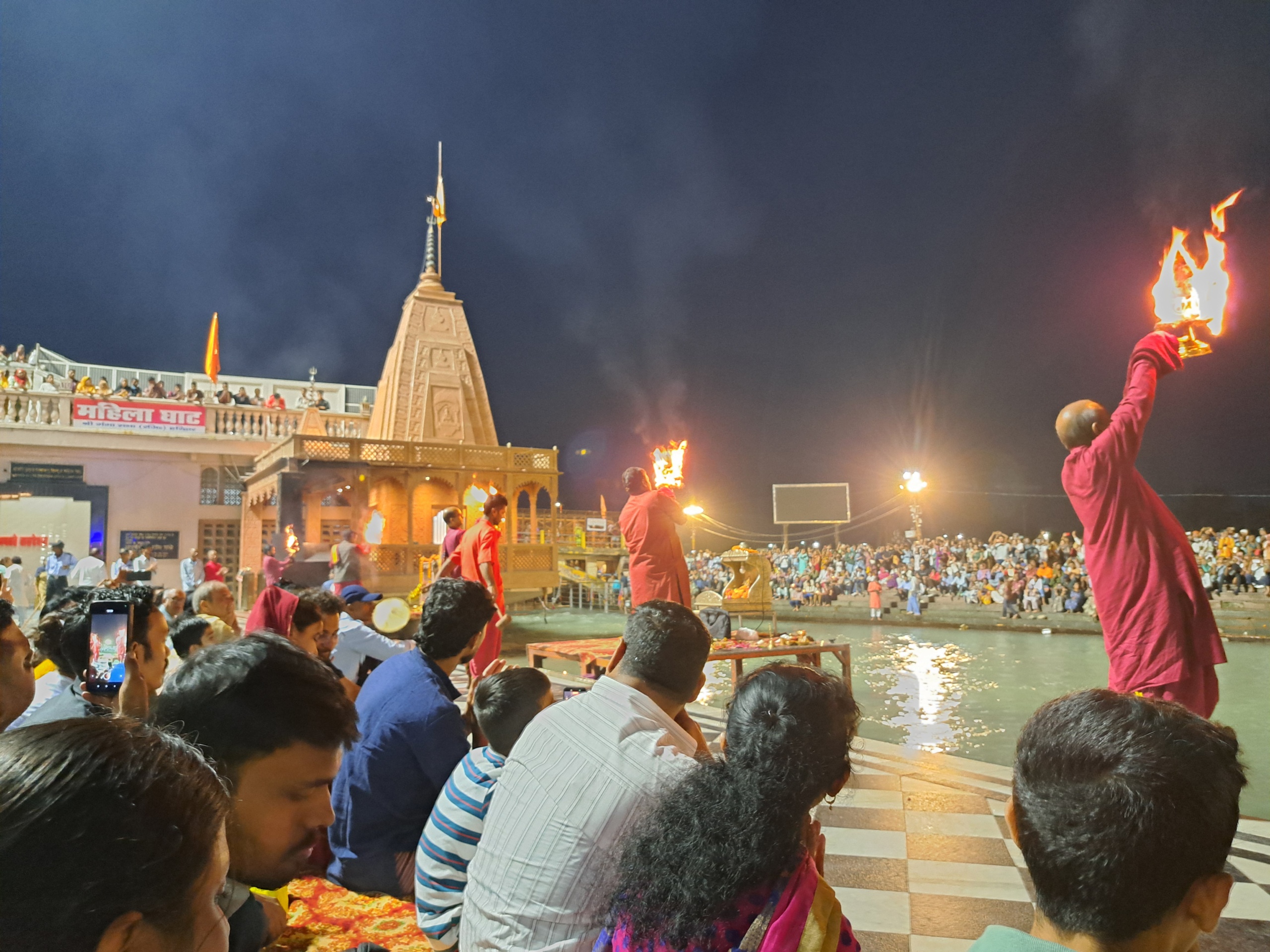
Soon the evening Ganga Aarti began. A line of priests dressed in red positioned themselves beside the water. As ritual chants echoed from loudspeakers and were taken up by the crowd, they lifted enormous oil lamps and began moving them in sweeping circles through the air.
The flames traced glowing arcs above the river. Their reflections shimmered across the darkening water. The effect was mesmerizing. When the ceremony ended, the lamps were lowered and the flames gradually disappeared.
Some devotees descended once more into the river, completing their purification in the fading light. Later I was told that this ritual takes place every evening throughout the year, here, in Varanasi and in Rishikesh, rarely interrupted even by the harshest weather.
It was only in that moment that I realized what kind of magnificent adventure I had gotten myself into.
Ganga Aarti

The real Yatra began the following morning.
Haridwar was already buzzing before sunrise. Families loaded luggage onto cars. Royal Enfield motorcycles, scooters, buses and Tata Travellers lined the streets, preparing for the long journey into the mountains. Many vehicles seemed impossibly overloaded, their roofs piled high with bags and supplies. We, however, were in no hurry. As I would soon discover, travelling with Venky and Raghavendra meant accepting a very different relationship with time. Morning prayers and ablutions came first. Only when everything had been completed properly could we set off. As long as we remained on the plains, progress was reasonably smooth. But the moment the road began to climb into the hills, everything changed.
Two-lane roads became a luxury. Patches of asphalt appeared and disappeared. Landslides became part of the scenery. Yet traffic somehow continued to move. Where debris blocked the road, bulldozers compressed it into a temporary surface. Where floods had eaten away entire sections of the roadbed, workers carved out new tracks along the cliffs.
Like the roads I had once seen in Ladakh, these routes existed thanks to the constant labour of the Border Roads Organisation. Everywhere we travelled, crews were clearing rockfalls, repairing retaining walls and rebuilding embankments under clouds of dust.
It felt like an endless battle against the mountains, one that would begin all over again after every winter.
To be fair, until Mussoorie, the road treated us kindly. Along the way, it had been a pleasure to reacquaint myself with all the scenes I remembered as being part of everyday life on Indian roads: people sitting on the roofs of vehicles, cows standing in the middle of the road, and brightly painted trucks bearing the words “blow horn” across the back.
I was equally entertained by the animated conversations in Hindi between my travelling companions and Raman. I understood none of it, except for those rare and mysterious moments when a small fragment of the discussion would suddenly be translated into English.
We stopped at a couple of attractive temples beside the highway and spent some time at Kempty Falls before continuing deeper into the hills. Then the ordeal began, and everything else became little more than a film unfolding beyond the window. The distance to Barkot was only two hundred kilometres. It took more than eight hours. I was still carrying some fatigue from the long journey from Italy, and my stomach was struggling to appreciate Raman’s driving style. He attacked the mountain roads with the enthusiasm of a rally driver and seemed permanently focused on the next bend. The road, meanwhile, showed no interest in forgiving mistakes. By the time we arrived, we were exhausted. As soon as the sun disappeared behind the mountains, the warmth of the plains vanished with it. Temperatures dropped quickly, despite the relatively modest altitude. Fortunately, we would be spending two consecutive nights in the same hotel. That simple fact felt like luxury.

The next morning we set off for our first destination of the pilgrimage: Yamunotri.
The roads remained challenging, but a good night’s rest made the bumps and endless curves easier to tolerate. And then, at last, the real mountains appeared. The peaks towering above us were no longer hills. Many rose beyond six thousand metres, their snowy summits hanging high above the valley. We followed the deep gorge of the Yamuna upstream.
The road clung to the mountainside, sometimes seeming to float above the abyss. Streams cascaded down sheer rock faces, occasionally crossing the road itself before plunging into the valley below. Towering conifers dominated the landscape. Most were pines. Every so often, however, they gave way to the magnificent Himalayan cedars known as deodar, trees that seemed perfectly at home among these immense mountains.
At last we reached the end of the road. A large parking area marked the point beyond which vehicles could go no farther. From there, the pilgrimage would continue on foot. Six kilometres remained. And six hundred metres of elevation gain. Our first real test.
The trek to Yamunotri would also provide an indication of what awaited us later at Kedarnath, where the climb would be nearly three times longer and considerably higher.
Neither Venky nor Raghavendra were experienced mountain hikers. In fact, Raghavendra seemed determined to make things as difficult as possible. Despite all attempts at persuasion, he refused to wear proper footwear. He intended to complete the entire hike barefoot but eventually settled on flip-flops.

Kandi

The trail itself bore little resemblance to what I would normally call a mountain path.
Almost entirely paved with stone, it carried a constant stream of thousands of pilgrims.
Very few wore technical hiking gear. Most climbed in everyday clothing. Many wore traditional dress. Some walked in sandals. Others were barefoot. We would be spending the day above three thousand metres, and although the forecast looked promising, I still packed enough equipment to cope with a sudden change in weather. Almost nobody else seemed similarly concerned. Many pilgrims appeared completely unaware of altitude, temperature or mountain conditions. Several had little more than a light jacket. Venky and Raghavendra had each brought only a thin down jacket, to be worn over a short-sleeved cotton polo shirt if absolutely necessary. Fortunately, the weather seemed willing to cooperate.
The path had been designed to accommodate an extraordinary volume of traffic. Great granite paving stones, polished smooth by countless feet and hooves, stretched all the way to the shrine. Not everyone chose to walk. Some pilgrims rode horses or mules. Others travelled in dandis, sedan chairs carried by four men. The most striking option, however, was the kandi: a large basket strapped to a porter’s back and supported by a band across the forehead.
The human determination behind such arrangements was impressive. The treatment of some of the animals was less inspiring. Long trains of horses and mules moved continuously up and down the path, often burdened with both riders and cargo. Their handlers did what they could, but controlling them was not always easy. It was common to find yourself suddenly standing in the middle of their path, forced to jump aside at the last moment. Many animals struggled on the wet stones. Their metal shoes slipped regularly, and occasionally both animal and rider fell. Watching this, I could not help noticing the contradiction between such scenes and the Hindu principle of respect for all living beings.
More than a mountain trail, the route felt like a village stretched across a mountainside. Stalls and temporary cafés appeared every few metres. Workers moved constantly among the crowds of pilgrims, carrying supplies up and down the mountain. Some stalls sold little more than chai and the omnipresent Maggi noodles. Others offered full meals and plenty of seats. Most consisted of simple structures wedged against the rock face or sheltered beneath large colourful tarpaulins secured with ropes and wooden poles. There was no rush. We stopped frequently, resting whenever anyone needed a break. Raman was walking with us and had already adapted to our leisurely pace. From time to time he would smile and call out his favourite phrase: «Let’s go!»
By the time we reached Yamunotri, the afternoon was already advanced. The temple stood nestled against the mountainside beneath snow-covered peaks and beside a series of waterfalls. The actual source of the Yamuna lay much higher still, hidden among glaciers roughly a thousand vertical metres above the sanctuary.
According to Hindu tradition, the river is the earthly manifestation of the goddess Yamuna, daughter of Surya, the Sun God, and sister of Yama, the god of death. Bathing in her waters is believed to free devotees from the fear of death and its suffering. For that reason, the ritual bath at Yamunotri holds particular significance. And, as I was about to discover, there was something rather unexpected waiting for us there.

A cloud of steam rose from the stream below the temple, a clear sign that hot springs lay hidden beneath the mountainside. We crossed a small bridge and made our way towards one of the large stone pools fed by the thermal waters. I had brought nothing to change into. No towel. No spare clothes. As far as I was concerned, that settled the matter. Raghavendra convinced me that skipping the bath was simply not an option. Within minutes all three of us were standing at the edge of the pool, wondering how much discomfort we were willing to endure in the name of tradition. Then we climbed in. Raman remained outside, guarding our clothes and bags. The water was astonishingly hot and the pool was already crowded. Several families were bathing, along with a number of children who immediately noticed the pale-skinned foreigner sitting among them. Within moments they had surrounded me. Questions began flying in hesitant English. The water was soothing. The atmosphere had become almost playful. But there were others waiting for space in the pool, and eventually we surrendered our places and climbed back out into the cool air. After drying off as best we could, we looked for a priest and joined the queue for the day’s puja.
When the ritual ended, Raman immediately reminded us of a less spiritual reality. It was getting late. And he had absolutely no desire to drive the mountain road back to Barkot in complete darkness. Raman and I started down the path first, hoping to set the pace. We descended quickly, trying to recover some of the time that had slipped away during the afternoon. By the time we reached the parking area, dusk had turned to darkness. The others were nowhere to be seen. Raman and I retrieved the Suzuki and drove to the trailhead to wait.
More than an hour passed before Venky and Raghavendra finally emerged from the darkness. We returned to Barkot late that night. I was too exhausted to think about dinner.

Yamunotri temple

That evening, back at the hotel, one subject dominated the conversation. Kedarnath.
Until then it had been a distant objective, a name printed on an itinerary. Now it was becoming real. And the more we discussed it, the more uncertain the details seemed to become.
Depending on whom you asked, the trail was eighteen kilometres long. Or twenty. Or twenty-five. Some estimates included detours added after the devastating floods that had struck the region only weeks earlier. Others did not. Even Raman was unsure. He had never made the trek himself. His advice was simple: “Better to assume the longer distance.” Nobody argued.
The original plan called for spending the night before the trek in Guptkashi and returning there afterward. But when we calculated the timings, it quickly became apparent that this would mean a long drive before dawn followed by an exhausting climb. The possibility of returning by helicopter was also discussed. A regular shuttle service operated between Kedarnath and the valley below, carrying pilgrims who preferred not to tackle the trail on foot. In the end, we agreed on a compromise. We would start before sunrise, walk to the temple and then decide later whether returning by helicopter made sense. At least that was the plan. Experience was teaching me that plans tended to evolve rapidly during this pilgrimage.

Himalayas

Before Kedarnath, however, the pilgrimage still had another sacred destination to offer: Gangotri. The drive there took us through landscapes that seemed to change around every bend.
On the way, we stopped at Prakateshwar Cave, a temple unlike any we had visited so far. The cave had been discovered accidentally in 1998 during excavation work carried out in search of drinking water. Deep inside lay a naturally formed rock with five distinct faces, quickly identified by devotees as a manifestation of Shiva in the form of Panchanan, Lord of the Five Elements. The place was crowded. Only Venky and I went inside, as Raghavendra was struggling with stomach problems that day. As usual, waiting in line became an unexpected social experience. Someone asked where I came from. Someone else wanted a photograph with the lone foreigner. By now, I had become accustomed to both. Eventually, a guard led us through a narrow opening in the rock. The passage was steep, damp and surprisingly slippery. We descended several metres underground before the chamber opened up.
Inside, a small pool reflected the dim light that filtered in from above. Beyond it stood the sacred stone. I could barely make out its shape. It appeared almost black, polished smooth by centuries of touch and moisture. When my hand finally reached it, the surface felt cool and damp beneath my fingers. Scattered across it were offerings of rice and flowers left by generations of worshippers.
There was something deeply intimate about the simplicity of the place. No grand architecture. No monumental statues. Just a cave, a stone and the faith of those who had come before.
Later we continued towards Uttarkashi, where we would spend the next two nights.
The town still lay at a relatively low altitude, and the afternoons remained pleasantly warm.
Our hotel stood outside the centre, overlooking Lake Maneri, a reservoir formed by a hydroelectric dam. Two faded stickers on the glass entrance doors caught my attention. They were remnants of mountaineering expeditions that had passed through years earlier on their way to peaks hidden somewhere among the surrounding mountains. I was immediately fond of the place. After checking in, we sat down with cups of hot chai. Venky disappeared to his room for some much-needed rest. Raghavendra and I stayed outside beside the lake.
As often happened during quieter moments, the conversation drifted away from practical matters. He told me once again how fortunate I was to be there. Not fortunate in the ordinary sense. Not simply lucky. He was convinced our meeting had not happened by chance.
Something, he believed, had brought us together and drawn us into these mountains.
The reasons might remain hidden. Perhaps we would never fully understand them.
But whatever happened during the Char Dham Yatra would eventually ripple outward into other lives. Maybe directly through us. Maybe through someone we met along the way.
Maybe through someone they would later meet. The effects would continue spreading through an invisible network of connections far larger than ourselves. Listening to him describe this web of relationships and consequences, I found myself thinking unexpectedly of Carlo Rovelli, the Italian physicist and writer.

Dinner turned out to be another pleasant surprise. My companions were delighted. The menu, however, remained largely unchanged. By this point I had begun thinking of it as “pilgrim cuisine.” Paneer with chapati. Dal with rice. Cooked vegetables, often cabbage.
Simple food. Strictly vegetarian. Repeated day after day with only minor variations.
Raman joined us and the conversation eventually returned to Kedarnath. I received some reassuring news. The others had spoken with the agency about my concerns regarding the schedule. Originally, we had been due to spend the night before the climb in Guptkashi. Now the plan had changed. We would stay instead in Rampur, much closer to the trailhead. The difference might only save an hour or so of driving, but in mountain travel that hour can feel invaluable. For the first time, Kedarnath seemed slightly less intimidating. Only slightly.
The following morning we set the alarm for six o’clock, intending to leave an hour later.
At least, that was the theory. When I came downstairs shortly before seven, none of my companions were anywhere to be seen. Raman’s Suzuki was parked beneath the hotel entrance. Curious, I walked closer. To my surprise, I found him asleep inside. Wrapped in blankets and stretched awkwardly across the seats, he appeared perfectly comfortable.
When he noticed me, he calmly sat up, adjusted his glasses and climbed out.
«This is my room» he said matter-of-factly. Then he began folding the blankets and rearranging the seats. Only then did I fully realise that he had been sleeping in the vehicle throughout the trip. I asked what he intended to do when we reached the higher-altitude destinations later in the pilgrimage. Raman shrugged. The question seemed irrelevant to him. He simply continued tidying his four-wheeled bedroom. Meanwhile, there was still no sign of Venky or Raghavendra. Back upstairs I could hear voices coming from their room. The sound of running water suggested that the morning rituals were still underway. Once again we would leave later than planned. And once again, somehow, it would not matter. Little by little I was learning that this pilgrimage operated according to a different measure of time. Things rarely happened when they were supposed to. Yet somehow everything happened exactly when it needed to.
The road to Gangotri followed the Bhagirathi River through one of the most beautiful valleys of the journey. At first the landscape was dominated by bare rock and sparse vegetation.
Then came the pines. Higher still, the pines gradually gave way to magnificent Himalayan cedars. The gorge narrowed. The river carved its way deeper into the mountains.
An imposing military-style bridge crossed a vast chasm. Beyond the bridge, the valley widened briefly. Broad expanses of pale sand flanked the river. And beyond them, for the first time that day, snow-covered peaks appeared once more on the horizon. A final endless series of switchbacks carried us to Gangotri. When I stepped out of the vehicle, Raman’s driving was still making itself felt. For a moment I wondered whether the nausea came from the road or the altitude. The fresh mountain air quickly settled the question. Raghavendra, meanwhile, had only one thing on his mind. He wanted to bathe. Immediately. And, as he was about to explain, there was a very good reason why.

As we approached the river, the discomfort slowly disappeared. Raghavendra, meanwhile, was already looking towards the water. Purifying oneself here carried a special significance, he explained. For Hindus, these were not simply mountain waters. They were the waters of Ganga herself, descending from the heavens to the earth. His explanation led naturally into one of the most celebrated stories in Hindu mythology.
King Bhagiratha sought to free the souls of his ancestors, the sons of King Sagara, who had been reduced to ashes after offending a great sage during meditation. Deprived of moksha, liberation from the cycle of rebirth, they were condemned to wander as restless spirits.
To save them, Bhagiratha undertook severe austerities and prayers, hoping to persuade the goddess Ganga to descend from the celestial realms. Only her sacred waters could purify the ashes of his ancestors and grant them release. Yet there was a problem. The force of the heavenly river was so immense that its descent would have destroyed the earth. It was Shiva who intervened. High in the Himalayas above Gangotri, he received Ganga within his tangled locks of hair, breaking her fall and dividing her force into countless streams. Only then could the sacred river descend safely to the world below.
After telling the story, Raghavendra smiled and looked at the river. There was little doubt about what would happen next. Venky and Ragha stepped into the water without hesitation and managed to immerse themselves completely. I followed with considerably less enthusiasm.
The Bhagirathi was born from glaciers, and it felt exactly as I imagined glacial water should feel. After only a few seconds my legs were protesting vigorously. A full immersion remained beyond my capabilities. The cold was so intense that, when I finally climbed out, it felt as though thousands of needles were piercing my skin. For me, that seemed quite sufficient.
My companions appeared unconvinced. While drying off, I watched the activity around us.

Pilgrims in Gangotri

Women wrapped in brightly coloured clothing gathered along the banks, while in the water I could see almost exclusively men. Beyond them rose the snowy mountains. Somewhere up there, beyond the visible ridges and above four thousand metres, lay the glacier from which the river truly emerged. A trekking route followed the valley all the way to its source.
Looking up towards those distant peaks, I found myself wondering what it would be like to follow it. Perhaps, one day, I would.
After the bath, we searched for a priest to guide us through another puja. Like so many others we had encountered, he was remarkably young. We sat in a semicircle around him as he lit a small flame and began the ritual. Meanwhile, Raman continued orbiting around us in increasingly unpredictable ways. Since I had lent him my Nikon, he seemed to have discovered a new passion. I switched the camera to automatic mode and watched him disappear into the crowd, enthusiastically photographing anything and everything that caught his attention. The more I got to know him, the more I liked him. He was young, determined and drove mountain roads with a confidence that occasionally bordered on recklessness.
So far, fortunately, he had yet to miss a corner. A son not yet a year old was waiting for him back home in Haridwar, and I liked to think that fact alone prevented him from taking his driving adventures too far.
After completing the puja, we visit the temple to pay homage to Shiva, the god who prevented the celestial waters from destroying the world.
After buying a few souvenirs, we make our way back to the car. My companions, however, have chosen a rather different kind of keepsake. They are carrying several orange containers filled with sacred water, in every size imaginable. Their plan is to take them home on the plane, where, they explain, the water will later be used in household rituals.

Three pilgrims in Gangotri

On the way back, we stop briefly by the river at a place where the banks broaden and deposits of sand make it possible to walk down to the water without difficulty. The landscape has an almost lunar appearance. Many visitors stop here to take photographs, while others simply stand on the wide sandy riverbed and admire the snow-covered peaks that occasionally emerge between the mountains.
As we drove across the big military-style bridge the scenery reminded me less of India than of the great canyon landscapes of the American Southwest. From the bridge I looked down into the depths below. Layers of rock descended into shadow, illuminated here and there by shafts of sunlight. The scene was extraordinary. I immediately asked Raman to stop. Camera in hand, I climbed out, intending to walk back for a few photographs. I had barely taken a few steps before two soldiers intercepted me. The Nikon immediately attracted their attention. They ordered me away. I tried to explain. They remained entirely unimpressed. Whether they didn’t understand me or simply had no interest in understanding was impossible to tell. Either way, the photographs would remain untaken.

We return to our hotel by the lake and prepare for the following day’s journey. Another long day on the road awaits us, through landscapes that seem to change constantly.
The lower mountains are covered in forests and populated by large grey and brown macaques. They run along the guardrails and, whenever a vehicle approaches too closely, disappear with a single leap down the steep slopes below. The hills, as they are called here to distinguish them from the snow-covered peaks beyond, alternate with lively valleys and small towns crossed by pilgrims travelling by every conceivable means of transport.
There are no tunnels. Every ridge must be climbed or circled, so even short distances often turn into unexpectedly long journeys.
At one point we stop at a small roadside hotel perched on the mountainside.
A four-wheel drive with a flat tyre is parked near the entrance. It belongs to a large family. The men are busy replacing the wheel while four children circle around them in search of something to do. A short distance away stands a young woman, probably their mother, dressed with a quiet elegance that seems at odds with the dust and isolation of the place.
What strikes me is precisely this contrast, the same one I will encounter again later on the trail to Kedarnath. There, people from very different backgrounds travel side by side: pilgrims in brightly coloured traditional clothing, barefoot men and women dressed in worn garments, people with disabilities and others who look impeccably turned out, carrying fashionable bags and wearing expensive shoes.
The children prove equally surprising. After observing me for a few moments, they approach and one of them, speaking flawless English, asks my name, where I come from and where I am going. When I answer, “Italy,” he nods and asks whether I know that two independent states exist within Italy itself: San Marino and Vatican City. He cannot be more than ten years old. All of them seem delighted by the opportunity to speak with a foreign traveller, and their curiosity is contagious.
Meanwhile, I overhear the hotel owner explaining that snow leopards remain a constant threat to livestock in these mountains. The idea surprises me. I had always imagined them confined to the more remote regions of Tibet and Ladakh, beyond these ranges. Eventually, he too asks for a photograph together. He tells me that foreigners are almost never seen here at this time of year and that I am the first he has met in quite a while. Others, he says, will arrive later in the winter as part of mountaineering expeditions and trekking groups.
Descending the opposite side of the mountain, we encounter numerous children on their way home from school, all dressed in dark blue uniforms. Some ride home on horseback alongside the adults, while others have only just stepped off a school bus.
Venky and Raghavendra assure me that the education system works remarkably well in these parts. They say it with a certain pride, as they often do when speaking about their country.
Soon afterwards they ask whether I would ever consider moving to India. According to them, I would adapt easily and could live comfortably without spending very much.
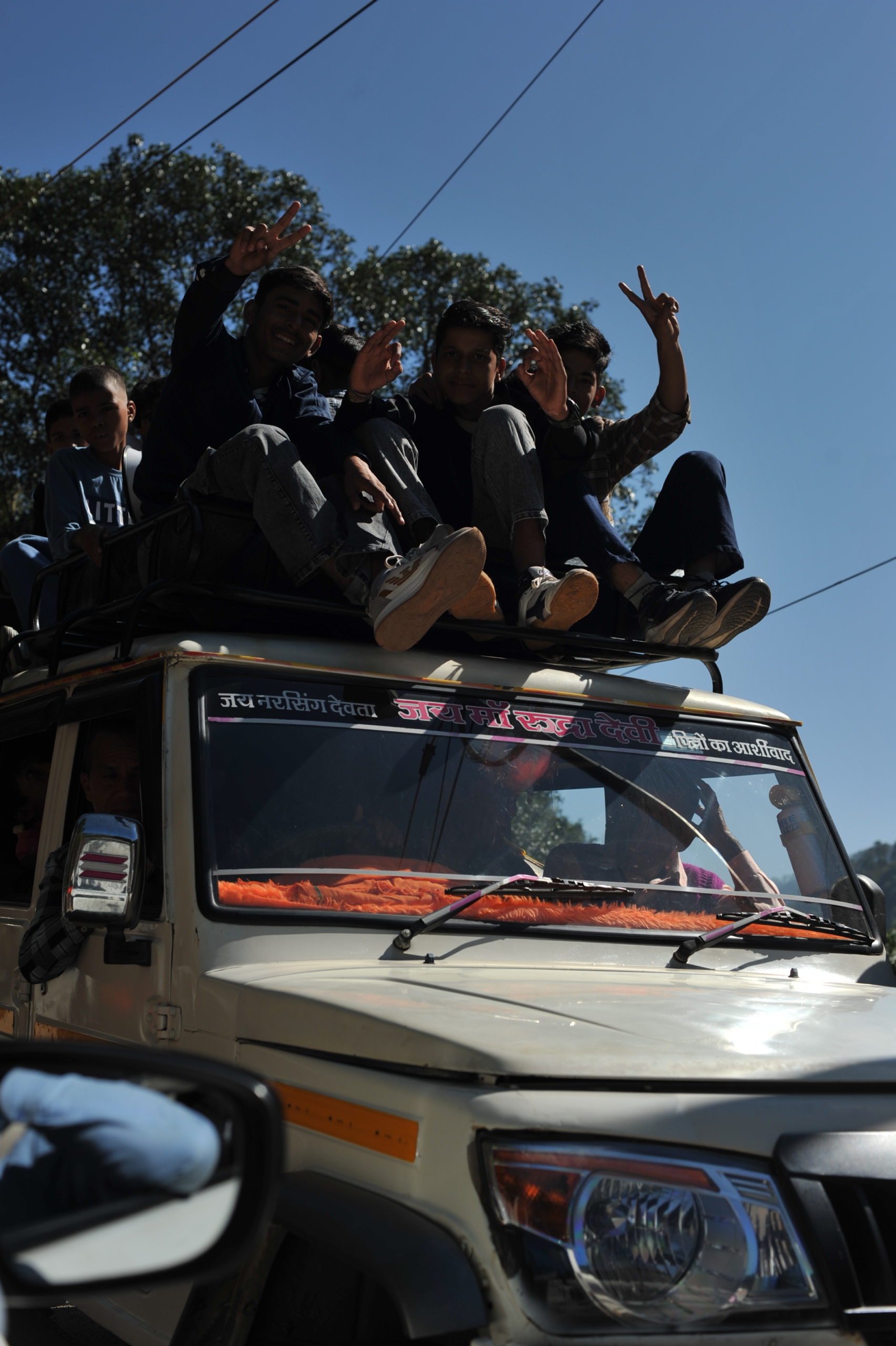
Pilgrims

Raghavendra, captivated by the simplicity of these mountains, says that if he were not already married he could happily settle here in Uttarakhand. Venky immediately brings him back to reality. In Bangalore, he reminds him, everything is close at hand. Life here would be far more complicated, and there would still be the winter to contend with.
I listen to them discussing the matter while looking at the scattered houses clinging to the slopes. I do not know whether I could truly live in a place like this.
Then again, whenever I imagine myself growing old, it is almost always somewhere among the mountains.

It is already below freezing when I reopen my notebook.
The pen moves reluctantly across the page, but there is one thing I feel I must write down immediately. In the end, we made it to Kedarnath. On foot.
To avoid the crowds, we had decided to set off before dawn. At four o’clock we leave the hotel and find Raman already waiting to drive us to Sonprayag, the last place we can reach with our car. Even in the middle of the night, the town is teeming with people, four-wheel drives and market stalls. It feels like a funnel into which every road and every pilgrim bound for Kedarnath eventually flows. From here, it makes little sense to continue on foot. The few kilometres to Gaurikund are constantly travelled by shared vehicles that raise clouds of dust and fill the air with the sharp smell of diesel engines. For a few rupees, they carry pilgrims to the true beginning of the trail. Raman drops us by the roadside and we make our way through the market. It feels like broad daylight. The market never closes and sells everything a pilgrim might need for the climb, from bamboo walking sticks to small oxygen canisters for those worried about the altitude. A little farther on, we reach the queue for the shared jeeps. Drivers shout destinations and count passengers, trying to fill every available seat. One vehicle happens to be missing exactly three people. Us. We squeeze into the already crowded cabin, the tailgate closes with difficulty, and we set off once again into the night, surrounded by dust and the headlights of the vehicles ahead. At Gaurikund another maze of shops and market stalls awaits us. Venky and Raghavendra each buy a bamboo staff. That is the entirety of their trekking equipment. Despite the darkness, it is not cold down here yet. We are at roughly nineteen hundred metres above sea level. To reach Kedarnath, we still have another sixteen hundred metres to climb.
We pass through the gateway of Gaurikund, which marks the official beginning of the pilgrimage, and begin gaining altitude at a slow, steady pace. In some sections the darkness is complete. The few lights along the trail do little to reveal the obstacles scattered across the stone paving, so I switch on my headlamp.
Raghavendra struggles to find a rhythm and is already stopping frequently by the first series of switchbacks. At this pace, it will take him a long time to reach the top, yet he shows no inclination to give up. Venky progresses more easily. Proper shoes and a walking stick prove to be a considerable advantage over Ragha’s flip-flops.
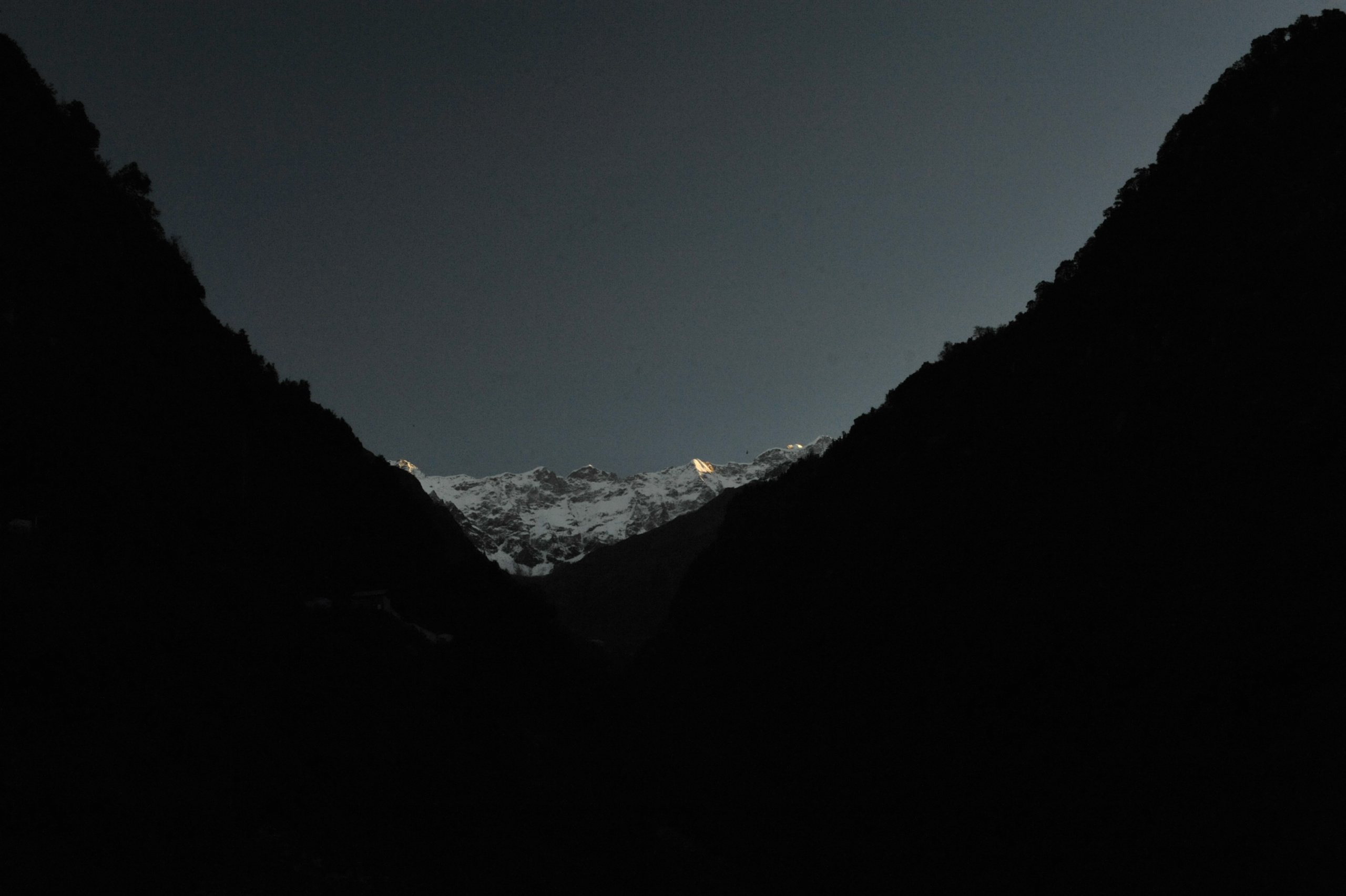
Little by little the sky begins to brighten and the peaks above us catch fire in the first light of day. With daylight, however, come the long lines of horses and mules. The trail quickly fills and we find ourselves constantly choosing where to place our feet to avoid ending up in the animals’ path.
Eventually the first distance markers appear. Twelve and a half kilometres to the temple.

Trail to Kedarnath

If the signs are correct, we have already covered almost a third of the route without really noticing. For the first time, reaching Kedarnath before dark begins to seem entirely realistic.
We have been on our feet for hours and still have not had breakfast. I am beginning to feel hungry, but Venky and Ragha refuse to eat for fear of feeling heavy during the climb. Even the Ritter bars I brought from Italy fail to convince them, as neither is entirely certain that they contain no animal-derived ingredients. Fortunately, just as on the trail to Yamunotri, stalls and small kiosks appear all along the route. In the end, I manage to persuade them to stop for at least a little fruit.
We stay together until roughly halfway up the climb. By then the distance markers finally settle the matter: the route is eighteen kilometres long, exactly as the official guides claim, and not the feared twenty-five. The destination suddenly feels much closer. The day is clear and windless. We walk in the cool shadow of the mountain and, despite the altitude, the ascent progresses without too much effort. Above us, helicopters have already begun their constant shuttle between the valley and the temple. Those who arrive by air reach Kedarnath in a matter of minutes, but they never experience this slow immersion in the landscape.
Little by little I increase my pace. Venky manages to keep up, while Ragha continues at his own rhythm and gradually falls behind. We stop several times to wait for him, looking back down the trail and expecting him to appear around the next bend, but in the end we will not meet again until we reach the top. From that point on, we continue as a pair. I walk ahead, stop occasionally to take photographs, wait for Venky to catch up, and then set off again.

Pilgrims on the trail to Kedarnath

The higher we climb, the more the mountains seem to move towards us. The peaks grow closer, immense and imposing. On the paved trail, however, the crowds of people and animals show no sign of thinning. Wherever the switchbacks tighten, the route resembles a great moving spiral, a continuous stream of pilgrims making their way up the mountainside.
I find myself thinking about something I had read before leaving Italy. During the Char Dham season, which is now drawing towards its conclusion, nearly two million pilgrims will make their way to Kedarnath. They come from every corner of the subcontinent for what many of them simply describe as “touching God”.
Watching that endless procession winding its way up the mountain, their devotion ceases to be a number and becomes something visible.
As so often in this part of the Himalayas, everything eventually leads back to Shiva.
Destroyer and renewer, he is the deity who dissolves all forms so that a new cycle may begin. He is also the god who received Ganga in his tangled locks and prevented her celestial waters from destroying the world.
The Mahabharata tells the story of the five Pandava brothers, who seek redemption after the war against the Kauravas. Only Shiva can grant it, but the god wants nothing to do with them and hides among the mountains of the Himalayas in the form of a bull.
The brothers eventually recognise him near Kedarnath. Shiva attempts to escape by disappearing into the earth, but Bhima, the strongest of the Pandavas, seizes him and tries to hold him back. Moved by their determination and convinced of the sincerity of their repentance, Shiva finally forgives them. Before vanishing, he allows part of his body to remain above ground at the place where the sanctuary will later be built.
It is the smooth black stone enshrined within the temple, a natural formation whose unusual shape is said to resemble the back of an animal.
I will not see it until the following day, in the middle of the crowd.
Using shortcuts whenever we can, Venky and I eventually reach the base camp. The stalls become even more numerous and a large open area crowded with horses and mules resembles a livestock market. Under a tent, we stop for a steaming plate of vegetable Maggi.
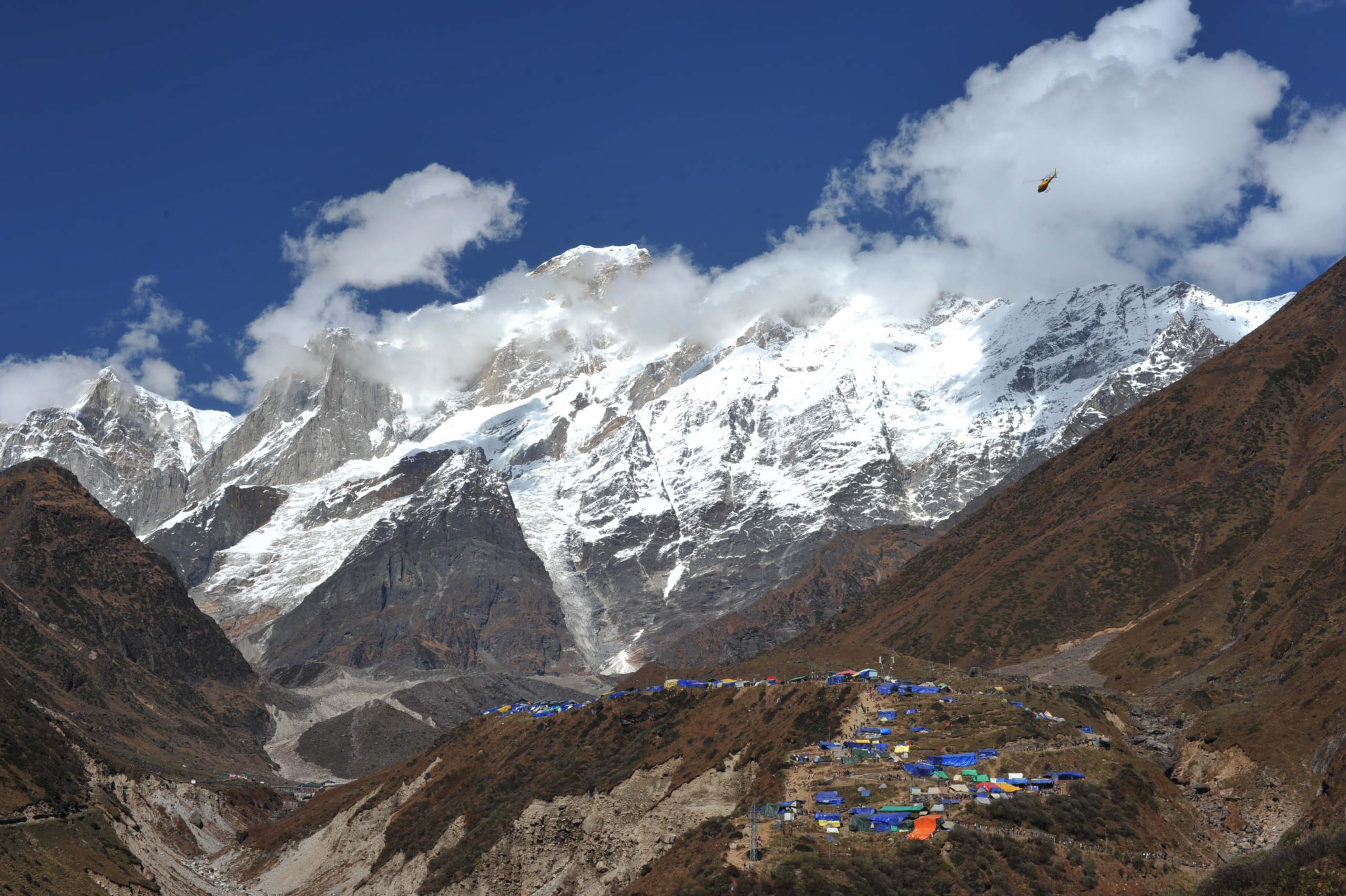
Trail to Kedarnath

Even on the climb to Kedarnath, I do not escape my occasional moments of celebrity. Some students ask me to record a video, while others stop me to find out where I come from. I soon discover that answering “Italy” is not always enough. If I pronounce the name as I would in Italian, with the stress on the first syllable, many people fail to understand. I have to shift the emphasis towards the final y and barely let the a emerge.
While Venky and I are eating our noodles, a group of Nepalese boys sitting under the same tent strike up a conversation. They tell us they have Italian friends. From what I can gather, they met some travellers from South Tyrol who had come to Nepal, but I understand little more than that. One of them invites me to visit Kathmandu. Before we part, we exchange phone numbers.
A little later we finally reach the temple. The square is crowded with pilgrims taking photographs of themselves and with false sadhus dressed as Shiva, ready to pose in exchange for a few rupees. It is not yet time to enter. The darshan will have to wait until the following morning.

Base Camp in Kedarnath

We find our accommodation for the night and Raghavendra joins us about an hour and a half later, as calm as ever. The three of us will share the same room. That in itself does not worry me. What worries me more is discovering that Venky and Ragha intend to wake up at two in the morning for their ablutions and present themselves at the temple by four, before the queue becomes unmanageable. If all goes according to plan, they expect to be finished by seven or eight.
In the meantime, we try to book seats on a helicopter for the descent, but everything is already sold out for the following day. We will have to leave the temple as early as possible and walk back down as well. It promises to be an eventful night. Perhaps, squeezed together in the same room, we will cope better with the temperature outside, which has already fallen to nine degrees below zero.
I cannot sleep. Venky is awake too, and every now and then we exchange a few words in the dark while Raghavendra seems to be sleeping peacefully beside us. We would only find out later that he was awake too. My head aches and my heart seems to be beating faster than it should, probably because of the altitude.
The plan had been to get up at two, yet nobody stirs until four. Then Ragha begins his ablutions and Venky follows suit. I remain under the blankets for a few more minutes. The schedule has already changed. We will go to the temple around five and, once we are finished, make one final attempt to find a seat on a helicopter.
By half past five we are standing in the square. A priest, in exchange for money, leads us towards a side queue that is supposed to move a little faster. I am not entirely sure what is happening. By now, I simply follow the others without asking too many questions.
We enter a maze of metal barriers watched over by soldiers. There are far too many people for the available space and within minutes we find ourselves pressed tightly against one another. One of the guards insists that I remove my socks, even though many others are clearly still wearing theirs. For the next two and a half hours we stand barefoot on frozen stone in temperatures of minus nine degrees Celsius. I think of Venky, who only a short while earlier had been visibly shivering despite his lightweight jacket, and try not to complain. Every now and then I rub my gloved hands across my toes in an almost futile attempt to restore some warmth. Eventually the barriers give way to the actual queue through a narrow gate controlled by another soldier. Our group is split apart. Venky and Ragha make it through. I do not.
There is no possibility of deciding where to go. You move only when the crowd moves.
Standing beside me is a tall, broad-shouldered man. He smiles and asks where I come from. I tell him that I am from Italy and travelling with two friends from Bangalore. To my surprise, he is from Bangalore too. We talk briefly about the parts of the city I know and, without any encouragement from me, he decides to take me under his protection.
“Don’t worry, I will take care of you.”
He makes his way through the gate, but when my turn comes the soldier suddenly stops the flow of people and refuses to let anyone else through. Within seconds I find myself trapped once again on the wrong side of the barrier. The man from Bangalore notices immediately. He turns around and begins shouting something in Hindi towards the soldiers. I cannot follow most of it. The only words I understand are “Italian friend”. A moment later the gate opens again and I am finally allowed through. Once on the other side, he helps me find Venky and Ragha again.
A few minutes later, however, we are separated once more.
The entrance to the temple is barely a metre and a half wide, yet people converge on it from every direction. There is nothing for us to do except surrender to the current.
By now we are almost in the presence of Shiva. Everyone is carrying a small bag of offerings or a container of yellow powder. When I reach the last step, I hand my offerings and fifty rupees to one of the priests. He blesses them, or at least I assume he does, and returns them to me.
Inside, the chaos intensifies. Pilgrims entering from different directions merge into a single flow around the central shrine. Once again I lose sight of my companions.
Then, almost like an apparition, the man from Bangalore reappears. “Don’t worry.”
By now he has a mission. Taking me gently by the arm, he guides me into the innermost chamber, where the stone associated with Shiva is kept. It is not large. Dark and smooth, it reminds me for a moment of the stone we touched in the cave at Prakateshwar, although I later learn that the two are entirely different in origin and significance.
A low border surrounds it, holding back the offerings left by generations of pilgrims. Flowers, grains of rice and coloured powders are layered one upon another across its surface.
I empty the contents of my small packet onto the stone and scatter some of the yellow powder. Then, amid the constant movement of the crowd, I reach out with both hands and finally touch it, letting them slide gently across its surface in something close to a caress.
A moment later the current carries me away. Venky and Ragha reappear shortly afterwards.
Together we return to the square and begin searching for our shoes among the hundreds of pairs scattered across the ground.
Unfortunately, I never see my guardian angel from Bangalore again. By then he has already disappeared into the crowd.

Our visit to the sacred places of Kedarnath was not quite over.
Behind the temple stands an enormous boulder that has acquired an almost legendary status since the catastrophic floods of 2013. During those days of torrential rain, landslides and destruction, thousands of people lost their lives throughout Uttarakhand. According to the account repeated by pilgrims and local residents alike, the boulder broke away from the mountainside and came to rest only a few metres behind the temple. Because its width closely matches that of the sanctuary, many believe it diverted the torrent of water and debris around the building, sparing it from the devastation that swept through the valley.
For those who tell the story, its position can scarcely be attributed to chance.
A short distance away stands the memorial dedicated to Adi Shankaracharya, the philosopher who played a decisive role in the revival of Hinduism during the eighth century. It too had been damaged during the floods and later rebuilt.
Eventually we returned to our room, gathered our belongings and made one final attempt at the heliport. The result was entirely predictable. There was not a single place available.
Venky and Raghavendra had little enthusiasm for walking the entire eighteen kilometres back down to the valley and decided instead to hire horses. They encouraged me to do the same but, by then I had spent enough time watching the animals struggle on the trail to know that I could not really enjoy the experience. I was tired myself, but not tired enough to change my mind. I had not eaten dinner the previous evening or breakfast that morning, yet I still had a couple of sesame bars at the bottom of my backpack. After eating one of them and drinking some water, I felt surprisingly ready to set off. We said our goodbyes and went our separate ways. They headed towards the horse station while I started down the trail. Once I found my rhythm, the descent became unexpectedly enjoyable. Without consciously deciding to do so, I gradually accelerated until the walk became something close to a run. Freed from the uncertainty of the climb and no longer concerned about reaching the top before dark, I found myself moving quickly along the stone path, stepping around pilgrims on their way up and occasionally stopping to admire the view. I covered the entire distance in a little over three hours, stopping only once.

Gaurikund

By the time I reached the gate at Gaurikund, my feet were beginning to complain, but otherwise I felt remarkably well. I sat down near the entrance and waited. Venky and Raghavendra arrived nearly an hour later. The horses, as it turned out, had not provided quite the effortless descent they had imagined. Both admitted that several hours in the saddle on mountain trails had proved considerably less comfortable than expected.
We called Raman, boarded one of the shared jeeps and soon found ourselves back in Sonprayag, where he was already waiting beside the Suzuki.
The journey, however, was not over yet. Before reaching our hotel there was one last detour.
High above Sonprayag stands the ancient temple of Triyuginarayan, a place that bears a striking architectural resemblance to Kedarnath. Tradition attributes its restoration, or perhaps even its construction, to Adi Shankaracharya. Its significance, however, lies in a much older story. According to Hindu mythology, this is where Shiva and Parvati were married in the presence of Vishnu, also known as Narayan, to whom the temple is dedicated. In the courtyard burns an eternal flame that, according to tradition, has been kept alive ever since that divine wedding ceremony. Whether one takes the story literally or not matters little.
What is immediately apparent is the affection with which the place is regarded by pilgrims.

After visiting Triyuginarayan and taking part in yet another puja, we resumed our journey towards what my companions jokingly referred to as our “upgrade”.
To compensate for a few unpleasant surprises we had encountered at the hotel in Haridwar, the agency had arranged for us to spend a night in a luxury resort before continuing to Badrinath. By the time we arrived it was already dark. The resort stood in a beautiful location, surrounded by forest and facing the mountains we had spent the previous days exploring. Even in the fading light, traces of snow could still be seen high on the peaks surrounding the Kedarnath valley. The place felt almost unreal after the previous nights spent in modest hotels and pilgrim lodgings. More than anything, however, it was quiet. After the crowds of Kedarnath, the silence felt like a gift. Venky and Raghavendra seemed delighted by the change of scenery. As for me, I found myself lingering outside before dinner, enjoying the cool evening air and looking back towards the mountains. Not far away, Raman was talking to two men. Seeing me standing alone, they immediately decided that I ought to join the conversation.
The older of the two appeared to be in excellent spirits, helped perhaps by a generous quantity of alcohol. After the usual questions about where I came from and what I was doing in India, he unexpectedly began singing Twinkle, Twinkle, Little Star with great enthusiasm.
His younger companion was no less memorable. He told me that he would soon be travelling to Italy. Naturally I asked where he intended to go. His answer caught me completely off guard. “I’m going with you.” Raman, who had been listening from a discreet distance, immediately began smiling. I tried to explain that immigration procedures were somewhat more complicated than he appeared to imagine. This did not discourage him in the slightest. After several minutes of discussion, I eventually gave him my phone number, largely because it seemed the easiest way to conclude the conversation. For a while he remained convinced that he would soon be coming to Italy to work for me. Only gradually did he accept that this plan might face certain practical obstacles. When he finally walked away, he looked genuinely disappointed. Raman found the entire exchange enormously entertaining.
After dinner I collapsed into bed and fell asleep almost immediately. For the first time in several days there was no need to set an alarm for the middle of the night, no pilgrimage queue to join before dawn and no freezing stone courtyard waiting for us before sunrise.
The following morning I woke properly rested. The mountains outside the resort looked spectacular in the early light. Several summits dominated the skyline, but one in particular immediately caught my attention. When I asked one of the hotel staff about it, he pointed towards the highest peak and replied with a certain pride, “Chaukhamba.”
Only then did I learn that the mountain rises above seven thousand metres. Seen from the resort, it completely dominated the horizon.
The helicopter traffic to Kedarnath had already begun by six o’clock and continued without interruption throughout the morning. A helipad stood not far from the resort, and aircraft came and went every few minutes. Someone mentioned that Prime Minister Modi was expected to visit Kedarnath that day. For us, however, there was no urgency. We allowed ourselves a couple more hours in the sun before returning to the road. The final Dham still awaited us. Badrinath.

Chaukhamba

The drive would be another long one. By this stage, however, we had all settled into the rhythm of the journey. My stomach had finally adapted to Raman’s driving, or perhaps I had simply stopped paying attention to it. Venky and Raghavendra had recovered from their digestive troubles, and nobody seemed particularly affected by altitude anymore. For the first time since leaving Haridwar, everything felt easy. There is often a moment during a long journey when travel ceases to feel unusual and becomes normal life. New routines establish themselves, unfamiliar places become familiar and the effort required simply to be there fades into the background. It seemed to me that we had finally reached that point.
Ironically, it happened just as the journey was beginning to draw to a close. Only a few days remained before our return.
Along the way my companions explained what awaited us at Badrinath. In some respects it was every bit as important as Kedarnath and considerably easier to reach. No long trek was required. The temple stands directly within the town itself, although the town lies at more than three thousand metres above sea level. Pilgrims arrive in enormous numbers. Perhaps even more than at Kedarnath.
Badrinath is associated with Vishnu, who according to tradition withdrew there to meditate for the welfare of humanity. The story tells that he entered such a profound state of contemplation that he became completely indifferent to the cold and remained motionless among the snows. Lakshmi, his consort, took pity on him. To protect him from the elements she transformed herself into a great wild berry tree, known locally as badri, sheltering him beneath her branches. When Vishnu finally emerged from meditation and realised what she had done, he declared the place sacred. From that moment onward, according to tradition, Badrinath became a place of extraordinary tranquillity.
My companions told me that local people say thunderstorms make no noise there and that even the dogs are unable to bark. I had no way of verifying either claim. Still, after everything we had already seen during the pilgrimage, I had learned not to dismiss such stories too quickly.

The road to Badrinath offered no shortage of opportunities to stop along the way.
Before reaching the town, we visited two more temples: the Kashi Vishwanath Temple near Guptkashi and the Shri Narsingh Mandir in Joshimath. The latter becomes particularly important during the winter months, when the idol of Vishnu is moved there after Badrinath closes for the season. Joshimath itself occupies a significant place in the sacred geography of Hinduism. It is one of the four great spiritual centres established across the Indian subcontinent. What delayed us there, however, was not philosophy. It was traffic. For more than two hours we could not move for whatever reason. All vehicles travelling towards Badrinath, and all those returning from it, are subject to strict controls because of roadworks, checkpoints and several narrow bridges. Given the terrain, there is little alternative but to wait patiently for your turn.
Eventually we left the town behind and passed the final checkpoint. From that moment on, Raman found himself free from most external constraints and resumed driving in the energetic style to which we had by now become thoroughly accustomed. Overtaking opportunities were seized without hesitation, cows were avoided with impressive precision and mountain bends were approached with the confidence of a man who had travelled these roads far more often than the rest of us. After more than ten hours on the road, we finally arrived. It was already dark by the time we reached Badrinath. The temperature had dropped considerably and the cold felt sharper than anything we had experienced in the valleys below.

It was already dark and bitterly cold. For a few euros I rented a small heater for my room and told Raman that he was welcome to join me if he would rather sleep somewhere warm. After all, I had a large room for myself, and it hardly seemed fair that he should spend another night in the car with temperatures well below freezing. At first, he seemed surprised by the offer. He steps back outside and for a while I cannot tell whether he intended to accept it or not. Then, sometime later, I heard a knock at the door. I opened it and welcomed him in as though we were old friends. Before going to sleep, I finished writing the notes from the day in my notebook. Raman was already half asleep and, almost as a way of thanking me, told me that I should return to Uttarakhand the following year with my family. He said he would take care of everything. Not long afterwards, we were both asleep.

Like Kedarnath, Badrinath begins long before sunrise. The following morning we rose in darkness and made our way towards the temple. Pilgrims were already gathering despite the cold and the streets were far more crowded than I had expected. Although reaching Badrinath required no trek, the shrine attracted enormous numbers of visitors, perhaps even more than Kedarnath itself. Here too, the ultimate goal was the darshan, the opportunity to stand before the deity and receive the blessing of Vishnu. Before that could happen, however, another ritual awaited us, and this time I was fully prepared.
Unlike Kedarnath, there is an additional step before the darshan. This time, however, I already know what to expect. Before being allowed to see Vishnu, pilgrims must first undergo a purification ritual in a pool fed by sulphurous hot springs. We arrive very early, undress and make our way towards the pool, towels in hand, through the biting cold that precedes dawn.
A young lady, dressed in traditional clothing and wearing a woollen hat, takes charge of our shoes and backpacks, watched over by Raman, who won’t be joining us in the pool. The contrast with the air temperature was astonishing. Outside, the cold penetrated every layer of clothing. In the pool, the water was almost uncomfortably hot. Remaining immersed for more than a few minutes required a certain determination. Eventually I noticed what appeared to be an empty stone ledge near the edge of the pool and sat down gratefully, hoping to escape the heat for a moment. Unfortunately, the ledge turned out not to be a ledge at all. It was a sacred rock. A pair of ascetics immediately informed me of this fact, with considerably more enthusiasm than tact. Within seconds I was back in the water while they carefully washed the stone with hot water, apparently concerned that my brief contact with it might have compromised its purity. To my great relief, I soon discovered that I was not alone in committing this mistake.
Several other pilgrims repeated it during the following minutes and received treatment remarkably similar to my own. There is a certain comfort in collective embarrassment.

Badrinath

Once the bath was completed, the familiar process began again. We searched for a priest.
We searched for a shorter queue. And we attempted to understand a system that seemed designed specifically to resist understanding. After several unsuccessful attempts, Venky and Raghavendra eventually found the appropriate intermediary and we joined a smaller queue near one of the side entrances. Military personnel were responsible for keeping order. Among them was a woman who appeared to exercise a level of authority that everybody, including the soldiers, accepted without question. At one point a dispute erupted somewhere in the crowd. Raised voices followed, and for a few minutes nobody moved. Then the woman signalled calmly for us to wait. A short time later the queue began moving again and we were allowed through. We climbed a few steps and reached an opening from which we could finally see into the sanctuary. There, illuminated in the interior of the temple, stood the image of Vishnu.
The darshan lasted only moments. Almost as soon as we arrived, a large silver door swung shut with surprising force.

For Venky and Raghavendra, the glimpse of Vishnu inside the temple was not quite enough.
They had come all this way hoping for a closer darshan and decided to join the queue once more. Considering the number of pilgrims still arriving, I admired their determination but had little desire to follow their example. After standing barefoot on frozen stone for much of the morning, my feet ached enough to persuade me that discretion was the better part of devotion. I left the temple and found Raman waiting outside. Together we retrieved my shoes and backpack before looking for a place that could provide a hot cup of chai. We settled down to wait for the others, who eventually emerged from the temple looking satisfied with their second audience with Vishnu. Once everyone had reunited, we collected our luggage from the hotel and set off again.

Pilgrims in Badrinath

There was one place we absolutely had to visit before leaving Badrinath. Mana.
Today it is often called the first village of India, although not so long ago it was better known as the last. Either description makes sense, depending on the direction from which one arrives.
The village lies only a few kilometres from the Chinese border. The frontier itself is approximately twenty-five kilometres away, while Mount Kailash, the sacred mountain associated with Shiva and revered in Hinduism, Buddhism and the Bon tradition, stands less than two hundred kilometres away as the crow flies. From Mana, however, there is no route to Kailash. The frontier is heavily militarised and completely closed.
Kailash has long been my weak spot. Long before the Char Dham, it had already become something of an obsession, an impossible place that seemed forever out of reach. On more than one occasion I have toyed with the idea of organising the journey, and for a brief moment it even seemed as though it might become reality. Finding myself so close to it, yet unable to reach it, feels almost like a small form of torture. Perhaps I have come all this way partly for that reason, simply to sense its presence and test the ground.
Who knows whether the Char Dham Yatra will bring with it something useful for a future Yatra to Kailash. With that thought in mind, I return to the present and find myself once again in this small valley among the snow-covered peaks, a place no less charged with energy than the one my thoughts keep drifting towards.

Alaknanda valley

Mana is not a large village. In fact, it is remarkably small. Yet its importance, both cultural and spiritual, far exceeds its size. As happens so often in Uttarakhand, everything here seems to revolve around water. The branch of the Ganges associated with Badrinath is fed by two rivers: the Alaknanda and the Saraswati. The latter emerges from a glacier and flows on the surface for less than a kilometre before disappearing beneath the mountain. It reappears dramatically at Mana in the form of a waterfall before plunging into the Alaknanda below. According to Hindu tradition, this is no ordinary river. Many believe it to be the mythical Saraswati of the Vedas, the same river that, after vanishing beneath the mountains, continues its invisible course beneath northern India before finally re-emerging at Prayagraj, where it joins the Ganges and the Yamuna.
Mana’s significance does not end with the Saraswati. According to tradition, this is also the place where Vyasa, the legendary compiler of the Vedas, dictated the Mahabharata. The story tells that his intellect was so vast that no ordinary being could keep up with the flow of his thoughts. Only Ganesh possessed the necessary wisdom and concentration to act as his scribe. Ganesh agreed on one condition: Vyasa must dictate without pause. In order to help maintain his concentration, the sage is said to have caused the nearby river to disappear beneath the mountain, because the sound of its waters was too distracting.

The Saraswati appears

Like many stories associated with the Himalayas, the tale feels inseparable from the landscape itself.
Standing beside the river and hearing the noise of the waterfall, it is easy to understand how such stories might have emerged.
This small village and everything surrounding it leave a deep impression on me. Perhaps it is the most beautiful place I have seen during the entire journey. Maybe it is the proximity of Kailash, or perhaps it is because this is the only time during the pilgrimage that we find ourselves on a high plateau above three thousand metres, a landscape that reminds me very much of the vast, barren plains of Ladakh.
It is a pity that Mana comes at the very end of the journey and that there is so little time to explore it properly. I would gladly spend several days here, wandering through the narrow lanes that wind between the handful of houses. I would like to stop at every stall, watch the women quietly spinning wool outside their shops, and perhaps buy a shawl, a jacket or a hat made only moments before. I would like to leave the village behind and look for one of the trails leading towards the glaciers. Unfortunately, we only have a few hours. Fatigue is beginning to catch up with me, but so is a certain anxiety about the journey home. We still have a long way to travel before reaching our final stop, and we must pass once again through the bottleneck of Joshimath.
Unfortunately, I am made this way. It is probably one of my weaknesses. For me, it is often all or nothing.
I should follow the example of Venky and Ragha, who today look more like tourists than pilgrims. They stop to buy natural products and gifts to take home. I let them drag me along to Vyasa’s Cave and to the small temple beside the spot where the Saraswati emerges from the rock, but for reasons I cannot quite explain, I already feel a certain urgency to leave.
In the end I let them continue their visit and return to the car park, where Raman is asleep inside the Suzuki. I recline the passenger seat and fall asleep as well, remaining there until the others return.

Reluctantly, we left Mana behind and began the return journey. Our final overnight stop would be Rudraprayag, one of the sacred confluences of Uttarakhand.
The following morning brought an unexpected addition to the programme. Although nothing had been planned, Venky and Raghavendra decided that one final ritual bath was necessary before leaving the mountains. They asked Raman to drive us down to the confluence itself.
Their intention was simple enough: to enter the water precisely at the point where the two rivers meet. We arrived early. The place was almost deserted. At the top of the steps leading down to the river stood a small stall selling tea, snacks and the familiar packets of offerings that seemed to appear everywhere throughout the pilgrimage. Apart from the vendor and one or two other visitors, there was no one about. We descended towards the water.
Venky and Raghavendra began preparing for their bath while I wandered along the shore with my camera. The atmosphere was remarkably peaceful. After the noise of the roads, the crowds of the temples and the constant movement of pilgrims, the silence felt almost surprising. What struck me most was the meeting of the two rivers.
The water descending from Badrinath flowed more calmly, while the current arriving from Kedarnath remained noticeably faster and more turbulent. For some distance the two streams remained distinct from one another, separated by a line of stones and subtle differences in colour and movement. Gradually, however, the separation disappeared.
The currents intertwined, resisted one another for a moment and then became part of something larger.
Venky and Raghavendra remained in the river for quite some time, although the current prevented them from venturing very far from the shore. Every attempt to move deeper into the confluence proved impractical. Meanwhile, other visitors began to arrive. At first just a handful. Then several more. Within a matter of minutes, the solitude that had greeted us disappeared and the riverbank began to fill with people. The change did not really matter.
We had already enjoyed the best part of the morning, almost in solitude.

Rudraprayag

Back at the hotel, breakfast gradually merged into what was closer to an early lunch. By the time we finally resumed our journey, it was almost midday. I suspected Raman would need all of his considerable driving skills if we were to reach the airport on time. Before leaving the mountains behind completely, however, there were still two final places to see.
We watched Devprayag, where the Bhagirathi and Alaknanda merge and officially become the Ganga, from the top of the steep riverbank. The second site was the temple of Dhari Devi, perched beside the river and regarded by many as the guardian of the Char Dham pilgrimage. Dedicated to a manifestation of the goddess Kali, the shrine is the subject of a well-known local belief. Many people attribute the devastating floods of 2013 to the government’s attempt to relocate the temple away from its traditional position on the river. According to this interpretation, the disaster represented a reaction by the forces associated with the goddess and the natural world.

Dhari Devi

As we descended from the mountains, the landscape gradually changed. At last, reality begins to reassert itself. Following the course of the Ganga downstream, we leave behind the atmosphere of the high valleys. A giant bungee-jumping tower and dozens of rafts lining the riverbanks signal a different world. Little by little, the signs of spirituality that seemed so evident farther upstream begin to fade.
We arrive in Rishikesh. I have never been here before, but my first impression is of a far more westernised town, one that feels worlds away from the environment we have been immersed in until only a few hours earlier, despite its reputation as a centre of spirituality and yoga.

I will not have the chance to change my first impression of Rishikesh this time. As we crawled through traffic, a loud bang forced us to pull over immediately. One of the tyres had exploded. We climbed out of the vehicle and joined Raman in changing the wheel while curious onlookers gathered around us. A few children appeared almost instantly, asking for money and watching the operation with great interest. The tyre was not merely punctured.
It had torn apart completely. Looking at it lying on the roadside, I could not help reflecting that we had been fortunate. Had it happened a few hours earlier on one of the mountain roads, the consequences might have been considerably more serious.
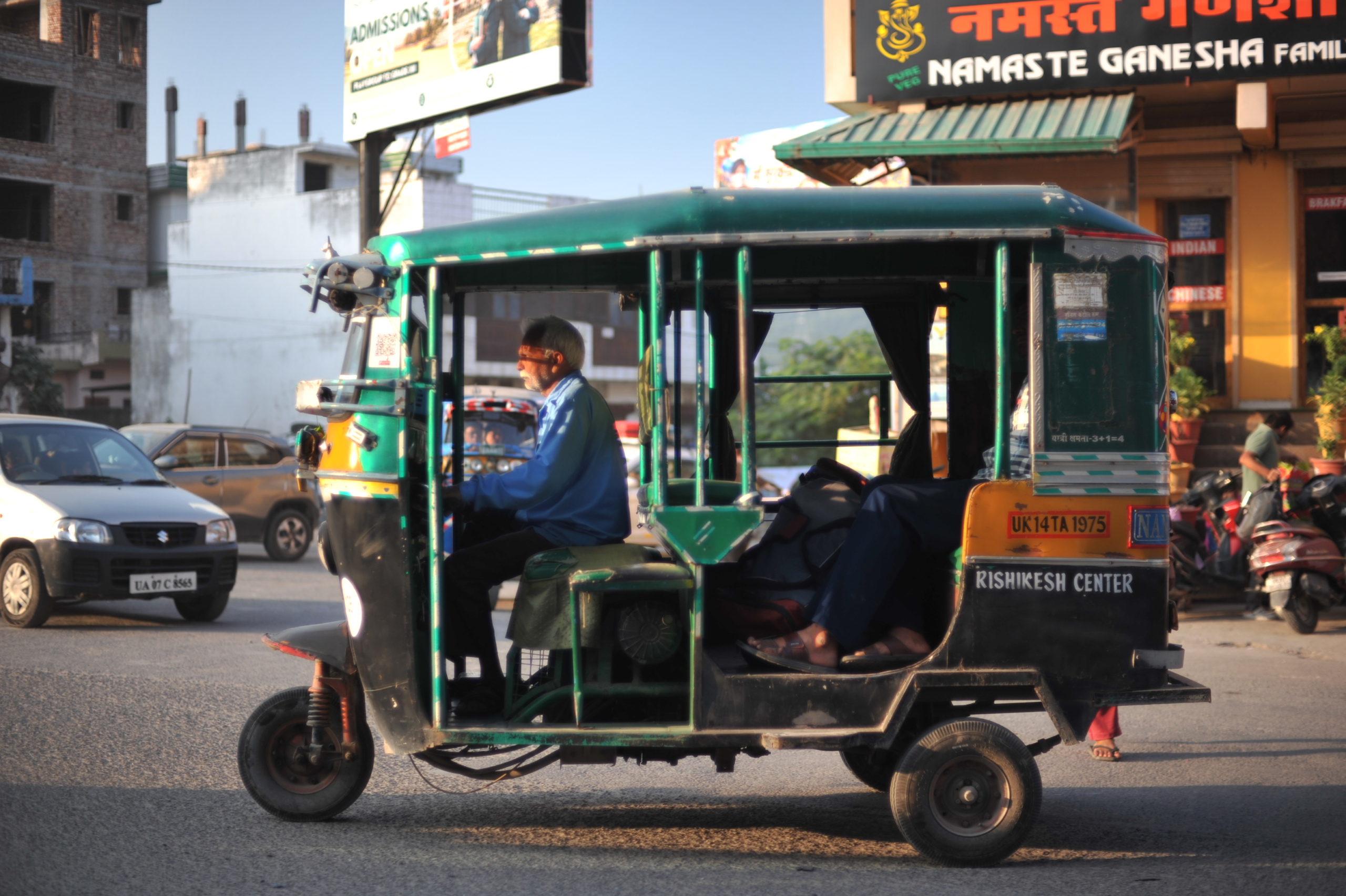
Rishikesh

Our Yatra had finally come to an end.
Each of us had set out with different expectations. Venky and Raghavendra had embarked on a sacred pilgrimage with a clear religious purpose. I, on the other hand, had begun the journey without any particular expectations beyond the desire to embrace an opportunity that had unexpectedly appeared after years of waiting. In that sense, the pilgrimage had given me exactly what I had hoped for.
If there is a wish I still carry with me, it is that this journey may prove to be a new beginning, a way of resuming a path that had been left unfinished many years ago.
That possibility, more than any specific revelation or insight, is what remains with me.
As we covered the final kilometres towards the airport, I found myself looking back towards the hills that surround the city. The mountains were no longer visible. A veil of haze hung over the landscape and the humid air softened every outline. Even so, I thought I could still see the snow among the distant ridges.
Perhaps it was only imagination. Or perhaps not.

Back home


Ganges Map


See all the photos


In Badrinath

Acknowledgments

This story would not exists without three people.
Venky, who connected all the pieces together.
Raghavendra, who gave meaning to many of them.
Raman, who carried us from one place to the other and who, somewhere along the, became a friend.


Read other Stories


Camino de Santiago

A (Very) Delayed Chronicle of a Bicycle Camino de Santiago

Travel Journal (Lucio Magi, March 2013)

Looking back at how this adventure began, I still remember Catia arriving one summer day and saying:
“Why don’t we cycle to Santiago de Compostela?”
I thought she was joking. Or provoking me.
A cycling journey had always been one of my dreams.
I looked at her and replied,
“Are you sure? Because if you say it, we’ll actually do it!”
And so, only a few weeks later, after organizing the few things we needed and preparing the bicycles, we set off.

More than two years have passed since then, and many things have changed.
Enrico was born, and until now there has never been enough time to write about that incredible experience.
Today I find myself sitting at my desk at six in the morning, trying to piece together a story from memories and the few notes I scribbled in my travel journal along the way.
Even after all this time, I realize that all it takes is rereading a hastily written sentence to unleash a flood of memories.
So I decide to try anyway.

Preparation, as with any journey, is essential.
There are, however, a few details that I would strongly advise nobody to overlook in this particular case:

  • Get proper bicycle panniers and make sure you know how to protect their contents from rain and dust.
  • Do not forget anti-chafing cream. Unless you’re the sort of cyclist who rides 1,000 kilometres a month and already has the appropriate calluses, you will need something soothing. Nappy cream works wonderfully.
  • Think carefully about logistics, especially how you’re getting home afterwards.

Apart from that, no special equipment, high-tech clothing, or miracle supplements are required.
All you really need is a good bicycle, strong legs, a willingness to adapt, and absolutely no hurry.
Everything else can be improvised along the way.
Two days before departure, however, I managed to develop a particularly painful attack of sciatica.
Thanks to the advice of Jury, my physiotherapist, and a generous dose of complete rest, we decided not to change our plans.
The idea remained exactly the same: drive from home to the Pyrenees and cycle from there all the way to Santiago.

The drive to Roncesvalles was incredibly long. We did it in one go and arrived late in the evening.
We had chosen Roncesvalles rather than Saint-Jean-Pied-de-Port as our starting point to avoid tackling the climb from the French side of the Pyrenees on the first day.
The contrast between the two places could not have been greater. Saint-Jean seemed full of people, bars, and hotels. Roncesvalles was deserted.
The village consisted of little more than a handful of buildings, including, fortunately, the only inn where food could be found.
To this day I am not entirely sure why the Camino appears to have two beginnings, one in France and one in Spain.
What I do know is that I was delighted to start here instead. The village felt dark, mysterious, steeped in history and legend.
There was something genuinely medieval about it, untouched by tourism.
We found a room in the only large hotel in town, somewhat out of place in such surroundings, and tried to rest.
Between my back problems and countless other doubts, we felt unsure about what lay ahead.
We were waiting to begin something, an adventure whose significance we would only fully understand much later.
The following morning the sky was dark. A fine drizzle fell steadily and the air was cold.
My back had not miraculously healed during the night, especially after eighteen hours in a car, and several times we seriously questioned whether we should continue at all.
Eventually we made our decision. After breakfast at the inn, we set out to complete the only task that absolutely had to be done before departure.
It could only be done here or in Saint-Jean. We had to visit the Oficina de Peregrinos to collect our Credencial, the pilgrim’s passport that would allow us to gather stamps along the Camino and eventually obtain the famous Compostela certificate in Santiago. We decided to move forward.
The first challenge was protecting our luggage. Our highly sophisticated waterproofing system consisted of black rubbish bags wrapped around the panniers.
Crude but remarkably effective. Since those bags contained virtually everything we owned, we had little choice.
One major issue remained unresolved: what should we do with the car? And, more importantly, with the keys?
We initially decided to leave the car in a roadside parking area among the few other vehicles. As for the keys, we came up with what seemed at the time a brilliant idea.
We would leave them at the hotel reception. In an envelope. For fifteen days. Without any receipt.
The moment we stepped outside, nearly ready to start cycling, we immediately realized that it is always better to be responsible for your own misfortune than to entrust it to someone else.
We rushed back inside and informed the bewildered receptionist that we had changed our minds.
Without the slightest reaction, she retrieved the envelope we had handed her only minutes earlier and gave it back to us.

Roncisvalle

Roncisvalle

With that crisis resolved, we finally climbed onto our bicycles.
And then a new question emerged: where exactly were we supposed to go? How do you recognize the Camino de Santiago?
Do you simply follow road signs pointing to Santiago? Were there red-and-white trail markers like those used on mountain paths in Italy?
We had no idea. We only knew that we needed to get to Pamplona. So we started pedalling. Still under the rain.
Before long we discovered that the Camino is marked everywhere by yellow arrows and symbols of the Concha, the scallop shell that represents the Atlantic destination awaiting pilgrims far to the west. We tried following them. The route soon left the road and entered forest trails. My back, however, was less enthusiastic about these rough detours.
Reluctantly, we returned to the asphalt. We passed through several villages, surrounded by incomprehensible road signs and Basque-language place names.
A couple of short but demanding climbs tested us along the way. Nevertheless, we reached Pamplona surprisingly quickly and in reasonably good shape.
By then the rain had finally stopped. The city welcomed us with sunshine and warmth. Simply arriving there felt like an achievement.
Only now did we begin to understand what we had started. We wandered through the city for a while, found something to eat, and decided not to spend the night there.
There were simply too many people.

By five o’clock in the afternoon, carried along by the enthusiasm of the first day, we chose to continue. Leaving Pamplona, the Camino became a dirt track once more, winding through farmland towards the hills ahead. The climb to the Alto del Perdón was anything but easy, even on mountain bikes.
The trail was steep and covered in loose stones. For the first time we became truly aware of the extra weight hanging from our bicycles.
In some particularly difficult sections we were forced to dismount and push. The view from the top, however, made every effort worthwhile.
Dozens of wind turbines turned slowly in the emptiness. Beside the famous Monument to the Pilgrims we met a solitary walker from Germany.
He was smiling. He planned to spend the night there in a tent. It was the first encounter we had with a pilgrim travelling on foot.
And, as would happen many times later, I felt an immediate sense of admiration. Beyond that almost mystical encounter, I also realised that a miracle had occurred.
My back had suddenly healed. The pain vanished. And it would not return for the rest of the journey.
The Alto del Perdón had forgiven me too.

A local mountain biker pointed us towards Puente la Reina. It was already late afternoon, but the route was almost entirely downhill.
We reached the pilgrims’ albergue just outside town, where we managed to secure two bunk beds in a dormitory and a hot meal.

Concha

Concha

Alto del Perdon

Alto del Perdon

Sleeping in an albergue is a bit like sleeping in a hostel.
The dormitories can be enormous, as was the case here, and are filled with people who snore and produce all sorts of nighttime noises that are less than ideal for light sleepers.
Our beds happened to be located right next to the washing machines and directly opposite the bathrooms.
Fortunately, we were so exhausted that it hardly mattered.
Another peculiarity of the albergues is that, by eight o’clock in the morning, sometimes even earlier, everybody has to leave.
We were complete beginners and knew nothing about this.
The next morning we were abruptly awakened by the employee on duty, who switched on every light available, started the washing machines, and began shouting incomprehensible instructions while we stared back in confusion. The only word that seemed understandable was “ocho.” Eight o’clock. Time to go.
Someone informed us that if we wanted breakfast before leaving, we had better hurry. We could not understand what all the rush was about.
Less than half an hour later, we were literally evicted so that cleaning and preparations for the next wave of pilgrims could begin.
We found ourselves outside in the garden, bicycles, bags, and belongings scattered everywhere.
Taking our time, we packed up and set off again, saying goodbye to the handful of pilgrims who were still there, perhaps because they intended to stay for another night.
We stopped briefly to admire the Roman bridge that gives Puente la Reina its name and then continued.
The route was mostly on paved roads.
We passed through Estella, Los Arcos, and several other villages. The sun was already burning our skin.
The final stretch proved long and exhausting, but we had no desire to stop in a larger town.
We imagined that a small village might offer quieter accommodation and fewer snoring roommates.
That is how we arrived in Sansol, at the tiny albergue run by Raquel.
She told us that she had originally come here on holiday, fallen in love with a local man, married him, and never left.
She rented out rooms in her narrow multi-storey home. The only other guest sharing our room was a cyclist named Henry.
He was travelling alone and had ridden all the way from Belgium.
After what was unquestionably the best plate of spaghetti with tomato sauce of our entire lives, and after discovering that washing our own dishes was apparently part of the package (“that’s how things work here,” explained Raquel), we went out for a walk.

Sansol was tiny. Practically the entire village gathered outside the only bar, eating ice cream and enjoying the evening coolness.
It was there that Henry told us his story. So far we had been carried along by the enthusiasm of our own adventure.
It had never crossed our minds that someone might undertake the Camino to pray for the recovery of a seriously ill brother.
He told us about setting off a month earlier and about the hardships of crossing France by bicycle, where infrastructure and accommodation for pilgrims were far less developed.
Spain, he assured us, was much easier.

The following morning we left fairly early.
Henry chose to follow the road because his bicycle was not particularly suited to off-road trails.
As long as possible, we preferred the paths. They were quieter and kept us away from traffic.
We passed through Viana and stopped in Logroño, the second major city on the road to Santiago.
Approaching from the outskirts, we saw construction sites, cranes, concrete, and urban sprawl.
Following the yellow arrows, we found ourselves on smaller roads encircling the city, avoiding the traffic and pollution of the main thoroughfares.
Along the way we overtook a pilgrim mother walking with two children while pushing a stroller carrying a third member of the family.
Speculation about her story occupied us for quite some time.
Logroño turned out to be a beautiful city. We spent some time wandering its streets and recovering our strength.
After crossing the stone bridge, running parallel to the iron one, we visited the chapel dedicated to Saint James.
The atmosphere felt relaxed and unhurried. Pilgrims were relatively scarce because they operated on schedules very different from ours.
Leaving the city centre behind, the Camino wound through parks filled with greenery and children’s playgrounds before emerging into the countryside among vast vineyards.
We had entered La Rioja.
Naturally, we helped ourselves to a few grapes. The berries were hard, juicy, and delicious.
Beyond Navarrete, the Camino continued through endless vineyards.
What struck us most was that the landscape was not green but dry and dusty.
It seemed almost impossible that one of Spain’s most celebrated wines was produced in such an arid environment.
Accumulating more and more dust, we eventually reached Nájera, a curious town squeezed beneath dramatic red cliffs and divided by a river. It appeared almost deserted.
Looking for somewhere to drink and clear the dust from our throats, we entered what seemed to be the only open establishment.
It turned out to be a social club populated almost entirely by elderly men drinking and playing cards.
They regarded us with considerable suspicion. The bartender, however, was wonderfully friendly, and we stayed to rest for a while.
The Camino soon returned to dust. For miles we rode alongside access roads used by construction vehicles and excavators working on what appeared to be a major motorway project.
Dust upon dust. Eventually we escaped both the motorway and the construction sites.
We hoped to stop in Cirueña, but none of the albergues had vacancies. Or they were closed. It was, after all, the end of the season.
I had imagined the Camino as something more spiritual and less subject to the rules of tourism.
Many places had already shut their doors for the year. Our final hope was a small hostel that was supposed to be open.
Unfortunately, the owner had already decided to close up for the weekend and head to the city.
Since hardly any pilgrims were expected so late in the day, our arrival was not enough to persuade him otherwise.
We had no choice but to continue all the way to Santo Domingo de la Calzada.
Fortunately, the route was downhill.
We arrived in no time. We headed straight for the pilgrims’ hostel run inside a convent and managed to secure two beds.
That evening, during dinner, we ran into the Spanish father-and-son cycling team we had met the previous day at the Fuente del Vino near the Monastery of Irache.
I had assumed they were considerably faster than us. Apparently not. Maybe we weren’t doing so badly after all.
Exhausted and increasingly sunburned, we climbed into our bunk beds. The lights went out early. Silence was expected.
Yet we refused to abandon our newly established tradition. Every evening, no matter how tired we were, we played a few hands of cards by the light of a headlamp.

Peregrinos

Peregrinos

At 7:45 sharp, everyone out. No exceptions.
The formidable lady in charge tolerated no delays, and once again we found ourselves unceremoniously shown the door.
After one of our increasingly leisurely breakfasts in yet another of the wonderful bakeries that seem to appear all along the Camino, selling enormous and delicious pastries, we visited the museum of Santo Domingo and its famous live rooster before setting off on what would prove to be the toughest stage of the entire journey.
There were no major climbs before the Montes de Oca.
The real enemy was the wind. A relentless headwind that never seemed to ease.
Pilgrims continued to appear along the trail, alone or in small groups. Even though walking is undoubtedly hard work, they looked less exhausted than we felt at that moment, cooked by the sun and marinated in dust.
At last we reached Villafranca, at the foot of the hills, completely spent.
Consulting the guidebook, we found two possible routes to Burgos. One followed the Camino trail. The other stayed on the road. Given our condition, we opted for the road.
Unfortunately, it proved almost as difficult. The climb itself was manageable. The real problem was the constant stream of lorries thundering past us at alarming proximity. Every encounter felt slightly dangerous. We could not wait to reach the summit.
Finally we made it and returned to the forest trail. Before descending, however, we treated ourselves to a rustic lunch beneath a tree: bread and tuna.
One of those simple moments that somehow remain etched in memory forever.
The descent towards Burgos was enjoyable, mostly on gentle dirt tracks.
Perhaps I had been too enthusiastic with the brakes, however, because my bicycle suddenly began making alarming noises and no longer seemed particularly interested in stopping when requested.
Near the end of the forest we encountered the group of cyclists who had flown past us earlier in the day, drafting against the headwind like professionals.
We asked for help. Their mechanic inspected the bike but could not identify the problem.
A proper workshop would be required. Fortunately the wheel was not locked, and I could still use the front brake.
Carefully. Upon reaching Burgos we quickly located a bicycle shop. Unfortunately, the owner was not particularly familiar with disc brakes either.
So we carried on. By then it was late and we were exhausted. Instead of searching for distant albergues, we surrendered and checked into a hotel.
That evening we found enough energy to go out for dinner. The city centre was wonderful. Bustling streets, lively squares, cafés, and people everywhere.
The perfect place to recover strength over an excellent bowl of Sopa Castellana.

Burgos

Burgos

The next morning the receptionist kindly directed us to another bicycle mechanic.
His diagnosis was immediate: new brake pads and cylinders for both my brakes, and a new rear tyre for Catia’s bicycle.
Another small detail that perhaps should not be forgotten before leaving on a long cycling journey: bike maintenance.
While the remarkably efficient young mechanic worked his magic, we spent the morning exploring Burgos. Another magnificent city.
The Camino, although conceived as a pilgrimage route, is also a journey through parts of Spain that are less famous, at least to us, yet extraordinarily beautiful and deserving of much more time than we were able to give them.
By late morning the bicycles were ready. After many thanks and farewells, we continued west. From that point onward came days of solitude and wonder.
Leaving Burgos behind, we passed the inevitable suburbs. Rows of houses. Industrial areas. Construction sites. Then, suddenly, nothing.
Our first encounter with the Meseta. And it was love at first sight. The landscape stretched uninterrupted all the way to the horizon.
Flat, reddish earth covered with sparse shrubs. An endless plain. The late-August sun beat down mercilessly.
Cycling there felt almost mystical. A few solitary pilgrims appeared from time to time. No cyclists.
After several hours immersed in little more than silence and open space, Hontanas emerged almost magically from the plateau.
The village remained invisible until one was practically inside it. A handful of mud-brick houses baked by the sun.
A couple of albergues where pilgrims sat peacefully in the shade. And, thankfully, a fountain.
Leaving this almost mirage-like village behind, we continued across the Meseta.
The ruins of San Antón appeared along the way, once a famous pilgrim hospital.
Then came Castrojeriz, dominated by its hilltop castle.
A little farther on stood the only significant climb of the day: the Alto de Matamulos.
The surface was rough and stony. Once again we had to dismount and push our bicycles. Fortunately the ascent was short.
At the top stood a small wooden kiosk and a sign warning cyclists about the dangerous descent. That gave us some concern.
Our heavily loaded mountain bikes were not exactly renowned for elegant handling.
The luggage itself was not excessive, perhaps ten kilograms per bicycle, but it transformed the bikes into very different machines.
We descended cautiously through what felt like a river of loose stones. In the end it was almost fun.
The view remained extraordinary. Dust, rock, and heat stretched endlessly in every direction.
Then, almost without warning, green returned. Trees appeared.
We had reached the Canal de Castilla, an eighteenth-century waterway built to connect these parched plains with Santander by boat.
Long abandoned, it has now found a second life. We were entering the Tierra de Campos.
Following the canal, occasionally crossing it by floating bridges, we eventually reached Población de Campos.
There we found lodging in a rural guesthouse run by Señora Carmen.
What struck us immediately was not the accommodation itself but her warmth.
Despite our limited ability to communicate, a genuine atmosphere of hospitality and kindness quickly emerged.
The sort of hospitality that remains in one’s memory long after details of routes, stages, and distances have faded away.

Hontanas

Hontanas

Mudhouse

Mudhouse

The following morning, Carmen informed us that she was preparing paella for a large group arriving for lunch. She invited us into the kitchen to watch. Naturally, we accepted.
No opportunity to learn the sacred order in which ingredients must enter a paella can be missed.
After delaying our departure as long as reasonably possible, we eventually had to leave. We said goodbye to Carmen with genuine affection.
It felt as though we were leaving behind a friend rather than the owner of a guesthouse.
This would be our longest stage, around ninety kilometres, but also one of the easiest, almost entirely flat and assisted by a favourable wind.
The Meseta returned.
We passed through Calzadilla, San Nicolás, and countless kilometres of dusty trail running alongside the road. Then, quite unexpectedly, our friend Henry reappeared.
We stopped beneath a tree to eat something together. He looked exhausted. After more than two thousand kilometres on a bicycle and with little training, it was hardly surprising.
In fact, I think we unintentionally dealt him a psychological blow. He confessed that he had assumed we were far behind him and seemed genuinely surprised to see us again.
We offered him one of our sandwiches because he appeared to be running short on supplies.
After resting for a while, we continued our separate ways. Henry told us that he intended to stop in Sahagún because he was simply too tired.
We, on the other hand, planned to continue all the way to Mansilla de las Mulas.

The dusty path seemed endless. Far off to our right, mountains stretched along the horizon from east to west.
They could not be the mountains of Galicia that we knew awaited us later. They must have been the Cantabrian Range.
By now my left arm was completely sunburnt while my right remained almost pale.
I had never really thought about it before, but when you spend every day cycling westward under the sun, certain asymmetries inevitably develop.
We stopped in one of those surreal villages that seem to exist only along the Camino: Burgo Ranero.
The village takes its name from a large pond populated by countless frogs.
Needless to say, the place appeared completely deserted. Only a couple of dogs were sleeping in the shade. We desperately needed something to eat.
The only grocery shop did not open until five in the afternoon. Inside there was plenty of food.
We bought only oversized pastries, which seemed sufficient to carry us to our destination.
By evening we reached Mansilla de las Mulas. We found a room above a bar and restaurant.
When we went out for dinner, we noticed that nobody else seemed interested in eating. It was simply too early. Everyone was gathered around drinks, bocadillos, and a football match on television. Obtaining one of the famous Pilgrim Menus felt strangely complicated.
Afterwards we wandered through a local festival, among market stalls and the crowd gathered around a makeshift orchestra.
The diversion was pleasant, but it could not distract us from one important fact: we had reached the halfway point.
Roughly 450 kilometres in six days. And already it felt as though Santiago were too close.
The following morning was cold. We left Mansilla quite early and wore every layer we possessed.
As the fog lifted and we approached León, the sun returned and so did the familiar warmth that had become normal life.

León was enchanting. Perhaps the last great city before Santiago.
The approach was not particularly elegant, passing once again through industrial areas and roadworks, but the city centre more than compensated.
We sat outside a café on the main square, enjoying the sun, a little rest, and our now indispensable pastries accompanied by café con leche.
We visited the magnificent Basilica of San Isidoro and then continued westward. This was the final stage before the mountains.

For much of the day, there was little to report. Roads. Paths. Fields.
Until we reached Santibáñez, where we made what may not have been our wisest decision.
Instead of following the easier route towards Astorga, we took a trail climbing steeply up a hill.
It was hell. Not because of the gradient alone. The real problem was the flies. Millions of them.
For kilometres they swarmed around us relentlessly.
When we finally reached the top we found a broad plateau, a welcome breeze, and several improvised albergues standing alone in the countryside.
The descent eventually carried us towards Astorga. Or so we thought. There were still several kilometres to go.
Passing abandoned houses and lonely stretches of road, we finally saw the city before us, perched atop a hill.
One last effort. Astorga greeted us warmly. People filled the streets. For once we decided to indulge ourselves and booked a room in a small two-star hotel.
Far more luxurious than our standards allowed. Far more expensive too. But after days on the road, a proper bed felt miraculous.
That evening we ate in a crowded, noisy restaurant on the main square. At last we were able to try the famous tortilla española.
The following two stages, at least according to every guidebook, would be the hardest of the entire Camino:
Astorga to Ponferrada via the Cruz de Hierro, and then O Cebreiro, the gateway to Galicia.

We set off early. Catia was not feeling her best. Without rushing, we reached Rabanal del Camino. The landscape was already beginning to change.
Dense pine forests replaced the arid scenery of the previous days. We stopped in Rabanal for a break before tackling the main ascent.
And there, astonishingly, Henry appeared once again. Even more exhausted than before. We shared a coffee.
Realising that this might be our last meeting, I asked for his email address. Only then did we discover that his name was actually André.
We had misunderstood it from the very beginning. Too late. For us, he would always remain Henry.
We parted warmly. He continued ahead while we took things more slowly.

The climb to the Cruz de Hierro was steady rather than difficult.
For anyone accustomed to cycling, it was perfectly manageable.
Beautifully rideable switchbacks carried us higher and higher into the mountains. Eventually we arrived.
The famous iron cross stood above its mound of stones, each carried there by a pilgrim. Two Dutch women were resting nearby.
They explained that they had cycled from Amsterdam in two separate journeys. The first year they had reached Tours. This year they were completing the route to Santiago.
They looked cheerful and completely untroubled. Their bicycles resembled armchairs more than bicycles. Technologically perfect and infinitely comfortable.
After exchanging photographs and good wishes, they continued. We followed not long afterwards.

Contrary to what many people imagine, the Cruz de Hierro does not immediately mark the beginning of the descent.
Instead the route continues across high open ground before reaching Manjarín, home of the eccentric hermit who claims to be the last Templar.
We entered his shelter seeking another stamp for our Credencial. He remained largely hidden from view.
He gruffly pointed us towards the stamp and gave every impression of wanting us gone as quickly as possible. From there, the long descent finally began.
Molinaseca. Then Ponferrada.
For the first time since leaving Roncesvalles, we reached our destination before five o’clock in the afternoon.
Ponferrada was wonderful. A true Templar town, crowned by its remarkably preserved castle. That evening we wandered the streets at leisure.
The next day awaited us. O Cebreiro.
From the moment I first opened the guidebook, that name had seemed mysterious and exotic. And intimidating. Because I knew it marked the hardest climb of the Camino.

Cruz De Hierro

Cruz De Hierro

We left Ponferrada well rested and in high spirits.
The route to Villafranca del Bierzo was uneventful, passing through a succession of villages and mostly following paved roads.
Dark clouds hung in the distance. We watched them anxiously, hoping they would drift elsewhere.
So far the weather had treated us kindly. We did not want it changing its mind on the day of the hardest climb of the Camino.
The road entered a narrow valley and followed a stream upstream.
Then the rain arrived. We continued for a while before stopping at a hostal for something to eat. The rain persisted. Not heavy, just a fine drizzle.
It was the first rain we had seen since leaving Roncesvalles.
After a short debate about whether to wait or move on, we chose to continue. So we climbed towards O Cebreiro under the rain.
Slowly. Calmly. At Vega de Valcarce the road finally began to rear upwards.
A little farther on came the junction where more adventurous cyclists could continue on the trail. We naturally chose the road, leaving the dirt track to those even crazier than we were.
For roughly twelve kilometres the climb and the rain continued together without interruption. Yet it was surprisingly pleasant.
The rain was light. The temperature mild. There were almost no vehicles. Massive motorway pillars rose above us as we climbed.
Far overhead, cars and lorries glided across viaducts like suspended toys. They crossed the mountain. We went around it.
Eventually we reached Laguna de Castilla, where we turned left towards O Cebreiro. The rain stopped.
There was still some climbing to do, another mountain to skirt, though this one seemed far less intimidating.
On the map it looked insignificant. Our legs disagreed.
The final kilometres followed gentle gradients along roads opening onto the Galician side of the mountains.
At last we arrived. Slowly. Under sunshine. The tiny village of O Cebreiro appeared before us.
A solitary Dutch cyclist was passing through and kindly agreed to take our photograph.
The place immediately captivated me. Stone houses topped with thatched roofs stood scattered among the mist. It looked more like Ireland than Spain.
We had arrived early enough, but discovered that access to the albergue would not be allowed until seven in the evening.
Priority was reserved for walkers who might still arrive late because of the weather. The prospect of waiting held little appeal.
All we wanted was a hot shower and dry clothes. So we found a room in a rural guesthouse and disappeared indoors.

Cebreiro

Cebreiro

The following morning we woke enveloped in fog.
We visited the tiny church of O Cebreiro, one of the most atmospheric places along the entire Camino.
Legend has it that the yellow arrows which guide pilgrims today were invented here.
The story goes that the parish priest, tired of searching for lost pilgrims, borrowed yellow paint from road workers and began marking the route himself.
Before leaving, we met the two Dutch women again. They greeted us enthusiastically and immediately asked about Henry. They too had become attached to him.
None of us had seen him for several days.

We dressed ourselves in every dry garment we still possessed and set off.
After passing the Alto do Poio, where the monument to the pilgrim gazes towards Santiago, the long descent began.
Eventually we reached Hospital da Condesa, where the air became noticeably warmer.
We stopped at a small grocery store before continuing. From there to Sarria, there was mostly road.
We passed the Monastery of Samos and considered stopping, but everything appeared closed.
Meanwhile I noticed that my left arm had become intensely red and covered with small spots.
Given that it had spent ten days facing south and receiving uninterrupted sunlight, I blamed sunburn.
A pharmacist seemed to agree and prescribed a corticosteroid cream. By the time we reached Sarria, however, matters had not improved.
The Camino left the main road and climbed through the upper part of town.
From there, in my opinion, began one of the most beautiful sections of the entire route.
Dirt tracks and narrow country lanes bordered by stone walls connected countless tiny villages, each with its own albergue and bar.
Between them stretched an endless patchwork of fields and countryside.
After the mountain stages, cycling suddenly felt pleasurable again.
We eventually reached Portomarín. My arm looked worse than ever. The elbow was swollen and inflamed.
I attempted to visit the local medical clinic, but it was already closed. The following morning the doctor had no doubts. “Picadura. Picadura. Pulga!”
A flea bite. To this day I’m not fully convinced that we acquired fleas in the guesthouse at O Cebreiro. I’ve slept in far worse places.
Nevertheless, the prescribed treatment was clear: flea spray. For animals. And a complete washing of every item of clothing at the highest temperature possible.
The laundry facilities at the albergue were closed. I would simply have to endure the itching until evening. And so, itching and all, we set off once more.

We had entered the final hundred kilometres of the Camino. The minimum distance required to earn the Compostela.
And suddenly everything changed. The lone walkers, sunburned and dusty from weeks on the road, began to disappear. In their place came organised groups.
People without backpacks. People carrying almost nothing. Groups chatting loudly as they occupied the entire width of the trail.
Buses appeared. Guides appeared. Even the cyclists looked different. Their bicycles were spotless. Their bags tiny.
It did not take much equipment to cover only the final hundred kilometres.
I remembered the two Italian cyclists we had encountered days before. The ones with aerodynamic bikes, action cameras on their helmets, and support vehicles carrying their luggage.
For the first time we found ourselves missing the “real” pilgrims.
Even travelling by bicycle, compared with those walking, had often made us feel slightly guilty. Yet this felt different.
Many of these newcomers seemed to have removed one of the essential ingredients of the Camino: fatigue.
The German pilgrim we had met in Santo Domingo returned to my mind. He had been heartbroken because he could no longer continue due to the terrible blisters on his feet.
I remembered feeling almost guilty simply because I had a bicycle.
Starting the Camino from the final hundred kilometres seemed, somehow, like cheating.
Though I suppose these “closing-time pilgrims,” if I may call them that without offence, contributed rather generously to the local economy.
The path was so crowded that, in places, it looked almost like a demonstration.
We often switched to the road. It made little difference. The terrain appeared easy but was actually a relentless succession of climbs and descents.
A constant “mangia e bevi”, as Italian cyclists would call it. A profile designed to wear down already tired legs.
The sun finally returned at Melide.
There an old man sitting outside a restaurant invited us in. Hungry, we required little persuasion. That was where we discovered pulpo gallego.
Huge octopuses, already boiled, were pulled from metal containers, chopped into pieces, grilled briefly, drizzled with olive oil, and served on wooden platters.
It was magnificent.

A little farther on we spotted the two Dutch ladies again enjoying a drink at a small hotel.
We joined them. They were in no hurry at all. They wanted to savour the ending.
They had heard that Henry had finally reached Santiago and then encountered all sorts of difficulties trying to get back home to Belgium.
We continued on. That evening we stopped only twenty kilometres short of Santiago.
Primarily because a sign announced something we desperately needed: LAVADORA Y SECADORA. Washing machine and dryer.
At that moment, nothing in the world sounded more luxurious.

Now that I had been both forgiven and apparently flea-free, I felt ready for the finish. It still seemed impossible that we had almost made it.
We could hardly believe that we had covered all those kilometres in so few days. Too few, really. That is always the problem when time is limited.
An experience like this, which is much more than a journey, ought to be undertaken without deadlines, with all the time it requires, and as slowly as possible.
But we had to be content with what we had.
A few kilometres later, through the thick Galician fog, we passed the airport and entered the outskirts of Santiago.
There were many people on the road, especially walkers.
We climbed the Alto do Gozo, the final ascent of the Camino, from where the city is supposedly visible.
Unfortunately, there was very little to see that morning. The fog was too dense.

Among the crowds we spotted our friends from the Fuente del Vino and exchanged greetings.
In a sense, we had travelled together from the very beginning.
Even now I often find myself thinking about the people we met along the way.
The moments we shared were brief, yet somehow sufficient to imprint faces, voices, mannerisms, and riding styles permanently in memory.
The two Dutch ladies appeared to have completed the Camino from the comfort of an armchair.
They never seemed discouraged, never troubled by climbs or headwinds, always carrying a smile.
The Spanish father and son were clearly experienced athletes, yet without a trace of competitiveness.
They seemed to have approached the Camino with admiration, humility, and serenity.
Henry carried a burden all the way to Santiago, and it showed. Even in the way he pedalled.
Despite his excellent equipment and comfortable bicycle, there was a tension in him.
He was not riding because he wanted to. He was riding because he had to.
He had one goal and one goal only: reach Santiago.
There was little room for rest or contemplation when every day mattered to someone he loved.
We never learned how his story ended.
We exchanged emails later and shared a few photographs, but I never found the courage to ask about his brother.

From the Alto do Gozo there was no risk of getting lost anymore. The route was obvious.
Sometimes we followed the pilgrims. Sometimes the yellow arrows and scallop shells.
As always, they all pointed west. Into Santiago.
The city was only just beginning to wake up as we entered its streets.
Eventually the route led us through the old town’s narrow alleys and finally delivered us to our destination: Praza do Obradoiro.
We were happy. And deeply moved. The feeling is difficult to describe. A mixture of joy and sadness.
There were many people in the square, though not as many as I had expected. Backpacks. Bandanas. Walking sticks. Smiles.
We leaned our bicycles against a wall and sat down directly in front of the cathedral façade.
For a long time we simply sat there in silence. Watching. Thinking. Remembering.
It was a strange sensation. There was almost a reluctance to move closer.
Eventually we shook ourselves awake and headed towards the Oficina del Peregrino to collect our Compostela.

We had heard that there were two versions of the certificate. One for those who had completed the Camino for spiritual or religious reasons.
Another, somewhat less prestigious version, for those motivated by something else.
When our turn finally came, we proudly presented our Credencial, covered in stamps all the way from Roncesvalles.
Then, shamelessly, we declared that we had undertaken the Camino for spiritual reasons.
The reward was immediate: the deluxe version of the Compostela, complete with our names written in Latin.

Leaving the pilgrim office, we suddenly felt a little lost.
Until that moment the objective had always been clear: keep cycling west. Now what?
For the first time, we had to think about returning home. Should we continue to Finisterre by bicycle? Or not?
We spent the rest of the afternoon exploring Santiago while trying to solve the logistical puzzle.
Returning to Roncesvalles turned out to be far more complicated than reaching Santiago.
The direct bus to Pamplona stopped running on the thirty-first of August.

The train required an absurd number of changes, some of which did not even guarantee bicycle transport. Flying was prohibitively expensive.
That left only one option: a rental car. Unfortunately, it was Saturday afternoon and the Europcar office was closed.
Since there was nothing else we could do, we searched for accommodation.
Santiago was delightful. A maze of narrow streets filled with restaurants, bars, cafés, and people from every corner of the world.
We found a room above a restaurant on Rua do Franco, where we were even allowed to store our bicycles indoors.

There was, however, one final experience we desperately hoped not to miss.
The Botafumeiro. Seeing the famous blessing of the pilgrims is largely a matter of luck. Masses are held constantly. The giant censer is not.
Nobody seemed able to tell us precisely when it would be used.
After making inquiries in several places, we overheard someone mention that it might happen during the six o’clock mass.
That was good enough for us. We went.
The service progressed normally. The enormous censer hung motionless from the ceiling. Then suddenly several priests approached.
The ropes were released. Clouds of incense began to rise. The priests started pulling.
The great Botafumeiro swung above our heads. Farther. Higher. Faster. The cathedral filled with smoke. The scent of incense spread everywhere.
It was extraordinary.
One of those moments that can never really be explained. Only experienced. In that moment, somehow, we too felt blessed.
We emerged from the cathedral intoxicated by incense and atmosphere alike.

Later, while wandering the streets, I noticed an internet café and had the bright idea of booking the rental car online. Success.
In two days we would be able to begin making our way home.
One final recommendation.
If you ever visit Santiago, do not miss Gato Negro. An old-fashioned tavern where food is served on wine barrels and rough wooden tables.
No frills. Just empanadas, ham, grilled octopus, and red wine. Exactly as things should be.

Santiago

Santiago

The following day brought rain.
With it disappeared any lingering thought of cycling all the way to Finisterre (or Fisterra, as the locals call it).
We would have needed at least two or three more days, and neither of us felt like turning the final chapter of the journey into an exercise in stubbornness.
We left our hostal and headed towards the bus station.
There we discovered that bicycles and large bags could be left in storage.
After wrestling with locks, luggage, and tickets, and despite cutting things rather fine, we managed to board the bus in time.
For once, we were travelling in considerably greater comfort than usual.
The beauty of this corner of Galicia revealed itself unexpectedly.
Fishing villages. Rugged coastlines. Small harbours. Nets hanging out to dry. Colours and light everywhere, despite the gloomy weather.
The radio murmured in the background while the other passengers chatted among themselves.
Listening carefully, we realised that Galician sounded very different from Spanish.
Even the place names looked different. Letters seemed to shift, familiar words becoming subtly altered.
Everything here moved at a gentler pace. There never seemed to be any particular hurry.
Along the road we noticed curious stone constructions raised above the ground. At first glance they looked almost like tombs.
We later learned that they were hórreos, traditional grain stores elevated on pillars to protect their contents from animals and humidity.
Many were no longer in use, but they remained a distinctive part of the landscape.
Eventually we arrived in Finisterre. A small fishing town wrapped around a sheltered bay.
We lingered for a while, enjoying the warmth of the sun and the profound sense of calm.
There were hardly any pilgrims. Hardly any people at all. The tourist season was effectively over.
The lighthouse, with its famous kilometre-zero marker, lay outside the town.
We walked there along the roadside as the road climbed above the Atlantic.
The lighthouse gradually came into view, poised high above the cliffs.
We passed the milestone marking the true end of the Camino and continued towards the cape.
Beside the lighthouse stood a metal framework covered with shoes, clothing, and countless other objects.
The traditional ritual for pilgrims arriving at Finisterre was to burn an item of clothing carried throughout the Camino.
A sign explained that, due to the many forest fires that had affected the region, the authorities had prohibited the practice.
Pilgrims had responded by leaving items hanging from the metal structure instead, hoping perhaps that the symbolic gesture would work just as well.
We returned to town.
There Catia fulfilled one of her personal ambitions. She went swimming in the Atlantic Ocean.
Afterwards we boarded the bus once more.
Instead of returning directly to Santiago, however, we stopped at Muros, one of the small coastal towns scattered along the shoreline. The place was deserted. Summer was over.
For us, that was perfectly fine. Silence had become something we appreciated.

Finisterre

Finisterre

Soon afterwards we returned to Santiago, reclaimed our bicycles and bags from storage, and collected the rental car waiting for us.
We decided to drive back towards Pamplona by a different route, following Spain’s northern coast.
The road took us through Gijón, where we spent the night, then onwards past Santander, near the Picos de Europa, through Bilbao, Vitoria, and eventually back towards Pamplona.
Along the way we occasionally spotted solitary pilgrims walking beside the road.
They belonged to the Camino del Norte, the coastal route that serves as an alternative to the Camino Francés.
And then, eventually, we found ourselves approaching Roncesvalles once more.
The very road we had travelled by bicycle only days before.
All that remained was to discover whether our car was still there.
Along the way we passed countless cyclists who were only just beginning their own Camino.
New panniers. Fresh legs. Expectant faces.
Watching them pedal towards the horizon, there was only one thing we could think:
What envy.

See the Photos

Read other Stories

Ladakh

Ladakh

Travel Journal (Lucio Magi, January 2008)

Once you reach the pass, everything looks different.
The climb has been extremely hard, but we made it. Looking down over the valley from above is an extraordinary feeling.
I believe this moment represented the true destination of our journey.
We crossed much of northern India from south to north, travelling by bus and four-wheel drive, traversing the western section of the great Himalayan chain and crossing passes above 5,000 metres.
For two weeks we followed the Indus River from east to west, tracing its course through the mountains, and eventually reached the Nubra Valley near the Karakoram, crossing the mighty Khardung La and travelling almost to the Pakistani border.
Yet the greatest emotion is here, at the summit of Stok La.
After two days of trekking that have tested our determination as much as our physical endurance, we have finally reached our true goal.

passo

For me it has always been this way.
Every journey has its climax, its defining moment, its emotional peak.
Sometimes you know what it will be even before you leave. At other times, and these are naturally the most rewarding journeys, you discover it unexpectedly along the way.
Perhaps in this case it is the satisfaction of having reached the pass with nothing more than our own legs. Perhaps it is the grandeur of the landscape surrounding us.

The mountains seem endless.
On one side they plunge steeply towards the tiny green valley of Rumbak. On the other they become sharper, crowded with ridges, pinnacles, and jagged peaks.
This small mountain pass, where the only signs of life are Tibetan prayer flags fluttering in the wind and tiny stone stupas scattered here and there, is one of those places where you feel small and important at the same time.
One of those places that are worth every step it takes to reach them.

passo

We left very early this morning.
Yet Rumbak, the tiny village of four houses where we spent the night, had been awake long before us. The shepherds had already driven their goats towards the pastures.
The valley that cradles Rumbak feels almost miraculous.
Surrounded by barren mountains, it is a true oasis.
The morning sunlight outlines the buildings and casts long shadows across the surrounding slopes.

rumbak

We slept here as guests of one of the families participating in the Ladakh homestay programme, opening their homes to the few travellers who pass through these mountains.
The village can only be reached in summer, either on foot or by pack animal. During winter, every family moves down to Leh, leaving it completely deserted.
Yesterday, after our first day of trekking from Zinchen, a seemingly endless and exhausting march, Rumbak appeared before us like a mirage made real.

Several difficulties and setbacks had almost convinced us to give up.
The lingering effects of dysentery, an accidental fall into an icy stream, the relentless sun, and the altitude had left us completely drained.
The prospects for today were not particularly encouraging either.
We already knew that another thousand metres of ascent stood between us and Stok La.
But a restorative night’s sleep, the generous care of our hosts, and our determination have made today a good day to continue.

Step by step we move forward at a very slow pace.
Once again the altitude makes itself felt, and there is no possibility of rushing.
Eventually, at the end of the valley, we find ourselves facing what looks like a wall.
We begin climbing, accompanied by another small group of trekkers.
Not much farther ahead, however, two of them finally surrender after a long hesitation and decide to turn back.
We continue.
By now we move almost automatically, concentrating solely on placing one boot in front of the other.Slowly.
We stop whenever necessary and still manage to appreciate the landscape around us.
Every step comes at a cost. But every step is also richly rewarded. And it is exactly in this way, step after step, that we reach our climax.

rumbak

The journey had begun in a completely different world.
Instead of the mountains and crystal-clear air of Little Tibet, our first encounter with India had been Delhi.
For anyone visiting India for the first time, I would strongly recommend reading the short section in the Lonely Planet Guide to North India that describes arriving in Delhi.
Every word of it is true. The chaos of the city, streets overflowing with life and every imaginable means of transport, and the overwhelming humidity are the first things to greet visitors and put their endurance to the test. Wandering through the alleys of Old Delhi offers a glimpse of the real India, a world that would undoubtedly deserve far more exploration.

But our goal lay elsewhere. We wanted to reach the Land of High Passes, hoping to find a corner of Tibet that remained as intact as possible. And so we moved on.
The journey from Delhi to Leh is a journey within the journey.
The eighteen-hour bus ride to Manali, along comparatively normal roads, is merely the beginning. The real adventure starts beyond.

Beyond Manali there is only one road leading to Ladakh, travelled either by regular buses or by the countless four-wheel drives that operate as shared taxis to Leh.
Just outside Manali, the ascent begins immediately towards the first of many unavoidable mountain passes: Rohtang La.
The road is little more than a muddy, landslide-prone track, battered relentlessly by the monsoon rains that spare nothing south of the Himalayas.
The brightly painted Tata trucks and overcrowded buses make it even more dangerous, and during many periods, even in summer, the road is closed to tourists altogether.
This time we are fortunate, and we are allowed to continue.
We enter the region of Lahaul and find ourselves at the very foot of the great Himalayan chain.
It is here that the truck travelling ahead of us in a narrow canyon decides, for reasons known only to its driver, to reverse without checking what might be behind. Rear-view mirrors are virtually non-existent on vehicles in this part of India.
The result is not ideal. Half of our bonnet is crushed, the starter motor damaged, and the radiator hose torn apart.
We are introduced firsthand to the rather “straightforward” local procedures for dealing with road accidents: compensation is settled immediately and directly, usually by handing over whatever cash happens to be in one’s pocket. Unfortunately, money alone does not solve our problem. We are stranded.
The vehicle refuses to move, and all we have at our disposal are a few tools and a certain amount of imagination.
Armed with a jack and two rocks, we begin reshaping the bonnet, the starter motor and the radiator as best we can.
The damaged hose is patched together with adhesive tape. Necessity is a remarkable teacher.
In circumstances like these, ingenuity sharpens quickly, and we discover mechanical talents we never suspected we possessed.
Eventually, incredibly, we are moving again. Not for long, however. A little farther on we have to stop once more because the engine is making alarming noises.
At that point the rope becomes useful. It is the only thing, apart from a few rupees, that the truck driver has left us.
We tie one end to the radiator and the other to a tree. Then, by carefully reversing, we somehow complete the repair.
Against all expectations, it works.
Apart from one further delay, while army engineers blast away an unstable section of mountainside with explosives, we eventually succeed in crossing the Himalayas via Baralacha La.
The following day provides another reminder of how distant this place is from the world of mobile phones, constant communication, and meaningless text messages.
At Tso Kar, our second driver is supposed to be waiting for us with camping equipment, food supplies, and a cook. He is not there. We can do nothing but wait.
There is no telephone signal, no internet, and no means of contacting anyone apart from the occasional traveller camping near the lake.
The jeep never arrives. In the end there is only one option left. We continue directly towards Leh.
To do so, we must cross Taglang La, one of the highest motorable passes in the world. The altitude makes its presence felt rather forcefully.
Only three days later do we finally discover what happened.
Our driver and cook had misunderstood the agreed meeting point and spent the entire time waiting for us at Tso Moriri. Eventually, after running out of food, they gave up and returned to Leh.

bus

Travelling these roads, one cannot help but think about the immense effort undertaken by the famous Road Tamers of Project Himank, the organisation responsible for connecting the far north of India to the rest of the country.
They have built roads in environments that seem utterly impossible. Roads that constantly shift, collapse, and require endless maintenance.
Every summer entire families arrive from Nepal and from some of India’s poorest states, such as Bihar, to spend months digging earth, moving rocks, and breathing dust at altitudes where many visitors struggle simply to walk.
Perhaps as a way of lightening the burden of such difficult work, or perhaps to remind travellers of the dangers they face, the Border Roads Organisation decorates the roadsides with countless yellow signs carrying messages such as:

“LEFT IS RIGHT”
“LOVE YOUR NEIGHBOUR, BUT NOT WHILE DRIVING”
“IF YOU ARE MARRIED, DIVORCE SPEED”

The men of Himank continue their work tirelessly.
New roads are opened every year, and already there is talk of a future route that will link Zanskar directly to the Manali-Leh highway.

strada

Finally, we arrive in Leh.
Instead of the remote and undiscovered corner of Tibet we had imagined, we find ourselves in a lively, cosmopolitan town that is wonderfully welcoming.
The streets of the old centre are lined with guesthouses, cafés, small restaurants and market stalls.
Yet despite its growing popularity, Leh remains an immensely pleasant place.
It is the perfect base camp from which to explore the rest of Ladakh.
Although our journey is an itinerant one, Leh becomes its true centre of gravity.
Every excursion begins here and eventually returns here.
For that reason, we have the opportunity to appreciate fully its relaxed atmosphere and extraordinary sense of calm.
Although Ladakh is not an especially large region, our limited time and the road conditions, which rarely allow average speeds greater than 30 km/h, force us to make choices.

We decide to leave the entire western part of Ladakh and Zanskar for another journey and instead concentrate on the Changthang plateau, the Nubra Valley, the Dha Valley, and, of course, Leh itself and the region’s most important Buddhist monasteries.
I honestly cannot remember a single place that disappointed me.
Yet I do not want simply to repeat here what can already be found in every guidebook or travel website about Ladakh.
There are, however, a few images that I believe deserve to be remembered.
One is the view from the Shanti Stupa or from the terraces of Shey.
From these vantage points, the lush green valley of the Indus stretches below, perfectly defined against the barren mountains that surround it on all sides.
It appears almost unreal. An oasis suspended in a desert of rock.

valle

Another unforgettable place is the point where Ladakh’s two great rivers meet.
The turbulent, muddy Zanskar rushes forward impatiently to merge with the calm and crystal-clear Indus.
For a moment they struggle with one another.
One may feel slightly disappointed upon discovering that it is the Zanskar that ultimately prevails, imposing its character upon one of the world’s great rivers.
Yet the spectacle remains unique.

fiumi

Every place visited, every monastery, every mountain, every village possesses its own distinctive character.
What impresses the attentive traveller most, however, is the sense of harmony and serenity that seems to envelop this enchanted land.
Everything appears suspended within a timeless dimension, a place where it becomes easier to think, to be alone with oneself, and to reflect.
Thanks to Jigmet, our wonderful guide, we were also able to experience something deeper than the landscapes alone.
He allowed us to move a little further “inside” Ladakh and closer to its people.
The tranquillity, optimism, and warmth they shared with us left a lasting impression.
The many setbacks and misadventures we encountered, both large and small, were always resolved in the best possible way thanks to their hospitality and friendship.

Because of them, we felt at home. And because of them, we were able to experience this extraordinary journey to the fullest.
I believe that every one of us received something valuable from this trip.
Some were fortunate enough to rediscover feelings they had already encountered elsewhere.
Others discovered entirely new emotions and perspectives.
Whatever each of us found along the way, I am certain that it will remain alive within us for a very long time.
Julley! Julley!

See the Photos

Read other Stories

Scandinavia by Motorbike

Nordkapp and the Norwegian Fjords on a Motorbike

Travel Journal (Lucio Magi, October 2006)

We are on the road, heading north.
We have not once felt the need to switch on the intercom, and there is plenty of time to think. That is one of the things I enjoy most about travelling by motorcycle: following the road while, at the same time, following your own thoughts.
I think about how this journey came about almost by accident, without too much planning.
The idea had been there for some time, but I had always been rather sceptical about riding so many kilometres. As much as I love motorcycles, I am not a road purist. To me, a motorcycle is simply a different way of travelling, another point of view.
I had other travel plans in mind for that year, but in the end I believe it was curiosity that finally convinced me. The chance to experience a road adventure from a different perspective. And not just any adventure, but the one that for so many people represents the journey.
By the second day, however, I think I had already cursed that curiosity more than once.
Ten hours of relentless rain on Germany’s flawlessly maintained motorways are enough to sweep away any poetic aspirations. At this stage of such a long trip, uncertainty still lingers. Thoughts such as “if this keeps up, we’ll turn towards Spain instead” cross everyone’s mind.
Fortunately, we leave Germany under blue skies, accompanied by sunshine as we board the ferry to Gedser, and with it our enthusiasm for the road returns.
We pass through Copenhagen, cross southern Sweden, and reach Stockholm, where we have planned our first extended stop, with the sun still faithfully travelling alongside us.

Stockholm

Stockholm

From there we continue along the Gulf of Bothnia, pass Umeå, and arrive in northern Finland.
The road through Lapland is magnificent. Sunshine and unexpectedly mild temperatures accompany us through forests, lakes, and countless stretches of water.
Along the way we encounter many other travellers heading to, or returning from, the Far North by every conceivable means of transport. Greetings between motorcyclists become so frequent that, on some stretches of road, it is almost impossible to keep your left hand on the handlebar.
Many ride alone, especially Harley riders, often carrying so much luggage that the motorcycle itself is barely visible beneath the bags and parcels, all of them pursuing a dream.
We stop in Inari.
Russia is very close here. You can sense it, and not only because of the road signs pointing towards Murmansk. The people seem different from those in Sweden or Denmark, just as the sounds of their language differ markedly from those of the other Scandinavian peoples.
Everything feels less tidy, less orderly. You have the distinct sensation of being in a more remote land, a frontier region.

In some respects the landscape resembles Canada, while many scenes remind me of northern Mongolia. I find myself amusingly searching for similarities between the Sámi people and the Tsaatan, the Reindeer People.
My imagination begins to wander, picturing some ancient “horizontal migration” across the top of the world thousands of years ago. It seems the only way to explain why the same cone-shaped tents appear in places so far apart, and why people bearing the same distinctly Mongolian features ended up spread across three different continents.

Inari

Inari

Beyond Inari, settlements become increasingly scarce.

As we continue north, the landscape grows steadily more barren. The temperature drops, and perched on our seats we begin to feel the cold.

Then, near Lakselv, we meet the sea once again and follow the immense fjord that will lead us to the island of North Cape.

I must admit it is nothing like I imagined.

Its beauty is wild.

Kirkeporten, the sheer cliffs plunging into the sea, the fishing villages scattered along the coast: everything feels timeless. And, as often happens when visiting a place like this, you find yourself wondering whether it is possible to strike some kind of balance between the relentless pace of modern life and the almost surreal tranquillity that reigns here.

We have reached the furthest point, the top of the world.
The feeling is a strange one.
You wonder what drives so many people to come all the way up here, since there is nothing truly unique or spectacular about the island itself. Yet watching cyclists struggle against the wind, their bicycles loaded with gear, inevitably makes you think.
And then it becomes clear.
The real myth is not the destination but the journey itself. And the greater the effort required to reach it, the greater that myth becomes.

True Nordkapp

True Nordkapp

At North Cape, the first part of our journey comes to an end.
Because I am convinced that what we are undertaking is really two journeys.
The first is the one that brought us here in a single week, almost at a rush.
The second is the one that will take us home again at half the pace, through the fjords of Norway.

Despite having planned a rough itinerary, our lack of familiarity with the region and its vast distances forces us to change our route several times.
We would like to reach Tromsø, but we simply cannot make it. Not only are the distances far greater than we had estimated, but a thunderstorm slows us down as well. We eventually stop for the night in Skibotn, a tiny village facing enormous glaciers that plunge directly into the sea.
The following morning we set off again and begin the final stretch before reaching the Lofoten Islands.
These islands entered my imagination almost twenty years earlier. While travelling through another part of Norway on an Interrail trip, I had heard about a town called Narvik, the end of the railway line and the departure point for whale-watching excursions. I never managed to get there back then, but I always promised myself that one day I would.
Unfortunately, I will not see any whales this time either.

Yet from the very first views that reveal themselves as we board the short ferry crossing from Melbu to Fiskebøl, it becomes clear that this archipelago alone is worth the journey north.
Mountains rise everywhere before us.
Many peaks and narrow channels, wherever the sun reaches them less directly, remain covered with permanent ice. These are young mountains, jagged and sharp, not unlike our own Alps. And they emerge from a sea of almost unbelievable blue, crystal clear and brilliantly transparent.
It is a unique spectacle.

Lofoten

After so much travelling, we allow ourselves a couple of days simply to wander through the islands.
Everything is connected by bridges and tunnels, the roads are flawless, and riding is an absolute pleasure.
We visit Nusfjord, Flakstad and Ramberg with their white-sand beaches, and Å, the village at the edge of the world, perched on the southern tip of Moskenesøya.
The sun seems unwilling to die, and we take advantage of these endless days to see as much as possible.
There are not many people around. The tourist season is drawing to a close, and that allows us to enjoy even more deeply the peaceful routine of Kabelvåg, the village we have chosen as our base.
They are quiet days.
For the first time in a long while, we finally have the chance not only to spend time but also to waste it.
The bungalow where we stay is comfortable, set within a campsite surrounded by nature. Dinner at the local pub, followed by a game of billiards, gradually becomes a pleasant ritual.
But, unfortunately, our stay here must come to an end as well.

Svartisen

Svartisen

Rain bids farewell to us as we leave the Lofoten Islands behind.
Slowly we resume our relentless journey southward along the E6.
For a couple of days now the weather has been growing colder. We cross the Saltfjellet-Svartisen National Park beneath a light drizzle that follows us even beyond the Arctic Circle. We pass Mo i Rana and eventually reach Trondheim.
The feeling is a strange one.
After spending nearly a week surrounded by little more than nature, returning to a proper city feels oddly unsettling. It is not easy to adapt again to traffic, to pedestrians strolling along the streets, or to the students filling the cafés and bars of this remarkably pleasant town.
Many kilometres already lie behind us, yet riding itself is not particularly tiring.
What weighs more heavily is the constant moving from place to place: unpacking and repacking the panniers, taking rain gear off only to put it back on again.

Still, we set off once more.
When we wake up, Trondheim is wrapped in fog. Clouds have settled deep inside the fjord and seem to promise nothing good.
But as soon as we leave behind the wall that contains them and begin climbing, they disappear. Blue sky and sunlight return, lifting our spirits more than a little.
We reach Åndalsnes.
And here begins one of the most extraordinary stretches of road I have ever seen in my life.
We turn off towards Trollstigen, and the road funnels itself between two mountain walls that, together with the valley running through them, resemble the bowl of a gigantic spoon.
Their slopes are not sheer and vertical. Shaped by glaciers over countless ages, they are rounded and graceful, guiding the eye gently towards the summits above.
Then, suddenly, a wall appears before us, blocking the way.
To our left and right, waterfalls plunge down the mountainsides. Above them, patches of snow and ice still linger. Ahead, we can make out vehicles slowly climbing the face of the mountain.
We begin the ascent ourselves.
The motorcycle is heavily loaded, and the hairpin bends are so tight that at times it feels as though we must almost come to a complete stop in order to negotiate them. As if that were not enough, every encounter with an oncoming car, and especially a coach, becomes a small drama of its own.
Only once you reach the top do you truly understand what you have crossed.

Trollstigen

Trollstigen

A road of irregular, asymmetrical geometry, yet somehow perfect in its own way, the kind of road that would have delighted Ultimo Parri, the dreamer of roads in Alessandro Baricco’s This Story.

We descend again, cross the Storfjord, and climb once more, looking down upon Geiranger, nestled deep within the fjord that bears its name.
The water here is a pure, intense blue.
Considering the countless waterfalls that tumble directly from the glaciers above into the fjord, it could hardly be otherwise.
Climbing higher still, we emerge onto a plateau.
The soft light makes the colours of ice, water, and earth, blending seamlessly together, even more beautiful than before.
Once again it feels as though we are forced to flee through a landscape rather than experience it, anxious to reach our destination at Lom. And so, unfortunately, we cross this scenery, impossible to describe either in words or images, without being able to savour it fully and at the pace it deserves.
Lom is the gateway to Jotunheimen National Park, a place that alone would justify an entirely separate journey.
Leaving the magnificent road towards Skjolden, we follow signs for Galdhøpiggen, one of the highest mountains in all Scandinavia.
The road begins climbing immediately and is paved only at first.
Soon it turns into gravel and continues winding upward through sparse woodland.
Then, suddenly, the landscape opens.
You feel entirely at the mercy of nature.
We rise above the clouds. Mountains stretch in every direction as we follow an unprotected track in the wind, suspended high above the valleys below.
The road ends directly beneath the glacier, where a small lake carries miniature icebergs that have broken away from the frozen mass above.

Jotunheimen

Jotunheimen

Groups of hikers set off from the refuge beside the lake, beginning the climb towards the summit.
Unfortunately, this time, in our role as motorcyclists, all we can do is watch them and envy them until they disappear into the fog.
We return to the main road and continue our journey.
Crossing the Sognefjord, we pass through Voss and eventually arrive in Bergen.
The city occupies a magnificent setting, cradled between mountains and sea, and it becomes our home for a couple of days.
The atmosphere is delightful, even if a few details make it feel slightly too tourist-oriented.
The harbour district and Bryggen are enchanting.
The Italian salesmen at the fish market, somewhat less so.

Bergen

Bergen

We take the funicular up Mount Fløyen and walk back down into the city.
Only then do we realise how completely the mountain belongs to Bergen itself. Entire neighbourhoods are built directly onto its slopes, and many streets seem to end precisely where hiking trails begin.
Leaving Bergen behind, we head south towards Stavanger, from where we take the ferry to Tau.
We have decided to change our plans.

Rather than follow the long stretch of “unnecessary” asphalt that, once we reached Oslo, would have eventually led us back down towards Malmö and the same route we had taken northwards, we choose to continue further south instead.
Our destination is Jørpeland and the famous Preikestolen, the Pulpit Rock.
Here, once again, I am reminded of how often expectations betray reality.
Given its worldwide reputation, I had imagined the usual tourist infrastructure: hotels, restaurants, crowds, and facilities designed to cater to constant streams of visitors.
Instead, we find a sleepy little village that seems almost abandoned.
Even at the entrance to the park there is little more than a parking area, the trailhead leading up to the cliffs of Lysefjord, a hotel, and very little else.

Preikenstolen

Preikenstolen

From Jørpeland we continue towards Kristiansand, following the magnificent coastal road that runs from Egersund to Flekkefjord.
We are in a hurry because we have already booked the ferry.
Once on board for the crossing to Denmark, we realise that, almost without noticing it, we have reached the very end of our journey.
In just a few days, we will be home.

As we make our way back, the intercom falls silent once again, this time involuntarily because of a broken wire, and there is nothing left to do but think.
We think about everything we have seen, and about everything that merely passed before our eyes.
A flood of images drifts through the mind, perhaps too many. Some remain blurred, others only half-formed.
It takes time to make sense of it all, but one certainty already emerges:
there is not the slightest desire to go home.
At that point, I think I could have kept riding forever, simply to remain on the road.

to Gedser

to Gedser

Yet there is something that continues to trouble me, something that keeps returning to my thoughts.
Perhaps I am impossible to satisfy.
What we have just experienced is a wonderful journey, one that for many people would represent the trip of a lifetime.
And yet I feel that I missed a little of the authentic connection with the places we visited, and above all with the people who live there.
Perhaps we would have needed twice as much time to truly appreciate an itinerary of this scale.
What remains, however, is an overwhelming desire to return.
To explore the fjords of southern Norway more thoroughly, to lose myself wandering through one of the many fishing villages.
To camp in Jotunheimen, perhaps bringing along a mountain bike.
To paddle a canoe across one of the lakes of Lapland.
And there is still another wish that remains.
Who knows?
Perhaps one day I will finally manage to see the whales.

See the Photos

Read other Stories

Mongolia

Mongolia

Travel Journal (Lucio Magi, September 2005)
Nowhere

Nowhere

We’re almost there.
We found the paved road again only a little over half an hour ago, and with it the first signs of “civilization.” Road signs and billboards, written partly in English and partly in Cyrillic, tell us that we have nearly reached our destination.
The asphalt carries our four-wheel-drive van up a small hill, a ridiculous pass compared to those we have grown accustomed to over the past few weeks.
By now I expect it, we all do.
As soon as we reach the summit, it feels as though something is coming to an end. I look beyond the ridge and a lump forms in my throat. The sight of Ulaanbaatar’s smokestacks hits me like a punch to the stomach, leaving me almost breathless for a moment.
This is when you truly understand what a journey like this means.
Entering the city for the first time in weeks, we see a traffic light and are forced to stop because there are other vehicles, too many of them, all needing to use the same road.
The road.
It is the same road that faithfully accompanied us and carried us across mountains, steppes, and desert, yet here it seems to have lost its authenticity, its very essence.
A road exists to take you from one place to another, dusty and unpaved. Outside the capital, on the Mongolian plateau, it constantly divides and rejoins itself, still offering the pleasure, and sometimes the thrill, of getting lost.
Across the steppes and through the desert it forms countless tracks, wheel ruts left by four-wheel drives that at times resemble railway lines converging at a great station. We have travelled along those tracks for weeks, and their sudden disappearance feels strangely disorienting.
We arrived at the hotel exhausted and completely covered in dust, but finally aware that we had experienced something unforgettable.
In many ways, the return is the most intense moment of any journey. Without returning home, it is impossible to fully appreciate the meaning of travel. Yet this return was different. It left me with no desire to speak for several hours.
That had never happened to me before.

The journey had begun roughly three weeks earlier, in that very same place.
The moment we left the capital behind, a city larger than most but, like all Mongolian cities, too orderly, too full of straight lines, it was clear that we were entering another dimension.
At first glance the landscape seemed nothing extraordinary, at least to someone who had already visited other countries of such immense scale. A vast plain suddenly becomes hills, then mountains, before flattening out again. For days on end it feels as if you are riding a gigantic roller coaster.
You cross immense conifer forests, dried-up riverbeds, and mountain passes.
The northern lakes are another spectacle not to be missed. In Lake Khövsgöl, the water is so crystal clear that it changes colour according to its depth.
Eventually the route turns southward. After travelling across the steppe for several days, you head toward Karakorum, the ancient capital of Genghis Khan’s empire, and then farther south still, until you reach the Gobi.
Here even the few remaining points of reference disappear. The outlines of mountains fade away, and you feel strangely adrift. At times there is a sense of complete isolation; at others, it almost seems possible to glimpse the curvature of the Earth or reach out and touch the sky.

Much has already been said and written about Mongolia’s famous blue sky, its immense scale, its seemingly unreal colour, and the clouds that wander across it casting shadows in every direction.
That sky must be closer to the Earth than any other. I can find no other explanation.
At night the sensation becomes even stronger. It is almost possible to feel its weight. An infinite number of stars appear, and the Milky Way reveals itself in unmistakable clarity. It looks as though the stars could come crashing down upon you at any moment.

Nowhere

Nowhere

Then, as the kilometres drift by and your eyes become accustomed to focusing only on distant horizons, as you gradually adapt to this almost magical dimension, a ger or a herd of yaks suddenly emerges from the landscape like an apparition seen through half-closed eyes. The dream is interrupted, and you realise that it is all real.

Travelling across the Mongolian plateau is a little like watching a play with extraordinarily long intervals between each scene.
A few elements of the scenery change, but the stage itself remains the same for days at a time.
Upon that stage appear, one after another, solitary horsemen, herders on motorcycles gathering their livestock, Buddhist monks dressed in brilliant robes, and children running alongside dusty tracks selling airag.

The children here are not yet accustomed to tourists. They never ask for anything.
They approach timidly only when invited and accept even the smallest gift in silence, holding out both hands with their palms facing upward, as though they were receiving a priceless treasure.

Bayanzag

Bayanzag

amarbayasgalant

amarbayasgalant

That is what these people are like: simple and genuine.
But above all, they are free. They are people accustomed to respecting the land rather than possessing it.
They are people accustomed to infinity and to silence.

At Hongoriin Els, in the Gobi, while climbing the sand dunes, I experienced something entirely new, something that for the nomads must simply be part of everyday life. I had wandered alone into a hollow between the dunes, several dozen metres from the others, and I stopped.
There was not the slightest breath of wind.
For the first time in my life, I listened to silence, a silence that I imagine came very close to being absolute.

Mongolia is all of this.
It is an honest land, still largely untouched by tourism, where travelling requires patience and a willingness to adapt.
Fortunately, it is not yet a country ready to welcome busloads of visitors. Because of that, it must be experienced slowly and attentively, allowing yourself to be carried along kilometre after kilometre, savouring the emotions, images, and music it offers when you least expect it.

See the Photos

Read other Stories


Mali – Travel Stories

Travel Journal (Lucio Magi, January 2004)

My first time in Africa has left a lasting impression.
Almost instinctively, I find myself listening to “Talking Timbuktu”, Ali Farka Touré’s most famous album, and thinking back to the incredible journey that ended little more than a week ago.

One of the things that struck me most about Mali was the intensity with which sounds, tastes, and colors are experienced.
The sounds of Africa are not something you easily forget.
One night, in the Dogon village of Banani, after pitching our tent on the flat roof of one of the mud houses, everything was quiet. Following a day spent hiking at the foot of the escarpment, the only sounds were those of our hosts preparing dinner and the local boys still trying to sell a few masks to the handful of tourists in the village. Then, suddenly, after sunset, we were engulfed by voices and drumming coming from a funeral vigil in the upper part of the settlement. The rhythm of the drums and the hypnotic chants accompanied us throughout the entire night. Although they probably robbed some people of their sleep, I cannot imagine a better way to spend our last night in Dogon Country.

baloon

baloon

The music of Africa, which I have loved for as long as I can remember, is even more beautiful when heard live.
One evening we ended up having dinner at one of the restaurants along the Niger River in Mopti. We had chosen the place almost at random, with no particular reason in mind, but once again luck was on our side. As the evening went on, the patio began to come alive, filling with local people gathering around a very long table for a celebration. Everyone was wearing their finest clothes, mingling with backpackers in Peruvian wool hats and other tourists dressed up in their best “safari” outfits.
Then a band arrived and started playing live music, and to say that it was captivating would be a serious understatement. After dinner I found myself leaning against the foot of a staircase, unable to tear myself away as I listened and tried to follow the rhythm.
It was simply wonderful.

djenne

djenne

What can I say about the scent of spices in the markets, the sweet fruit juices that so often accompanied our meals, or even the less pleasant smells, at least for us Europeans, such as fish left to dry in the fishermen’s villages and along the ports of the Niger? They became part of our memories before we even realized it, without ever asking our permission.
Yet I believe that nothing will stay with me more vividly than the colors of this land.

During the day everything is bathed in an intense, almost blinding light, and only in the early morning or at sunset can the full richness of the colors truly be appreciated. The thing is, even when hidden, the colors are always there. It is impossible not to notice them.

The red earth of the savannah among the giant baobab trees, a landscape that often reminded me of the Australian bush, blends at times with the colors of the desert as it advances relentlessly. Even the dust is everywhere, with its almost neutral hue, as if it had been placed there on purpose to help the light restrain the explosion of all the other colors.

The women’s brightly coloured clothes, the multicoloured plastic buckets balanced on their heads, the blue turbans of the Tuareg, the rainbow of Djenné’s market and Mopti’s river port are images that alone make every hardship of the journey worthwhile.

I like to think that people face the many difficulties and challenges of this land with the help of color as well. There is a joy, a warmth, and a simplicity in Mali that touched me deeply. Everywhere we went, from Bamako to the villages of the nomadic fishermen along the Niger, we were never denied a smile or a friendly greeting.

I believe that this journey is not merely a way of learning more about fascinating cultures and admiring breathtaking landscapes up close. Nor is it simply an opportunity to make a small contribution to the projects that local volunteers pursue so courageously despite countless obstacles.

Above all, this journey has been a chance to meet and learn from an extraordinary people, and to discover just how much we still have to learn from one another.

I’ve already fallen under Africa’s spell.

The Sotramà – Lucio Magi (January 2004)

One experience that should not be missed in the capital of Mali is a ride on a Sotramà.

Ada and I, together with the more “experienced” Michele, ended up on one almost by accident after two taxis were called instead of three, and we needed a way to catch up with the rest of the group at the artisans’ market.

Sotramà is the name given to the shared minibus taxis that effectively serve as the city’s buses in the Bamako urban area. A description of the vehicle itself, a green-painted van whose ability to keep moving is often open to question, would deserve a chapter of its own. What truly makes the fare worthwhile, however, is the service provided.

When we climbed aboard, we were the only three passengers. The door-man, the local equivalent of a ticket inspector, ushered us in while muttering a few incomprehensible words in the Bambara dialect. The door-man, as the name itself suggests, literally serves as the van’s door, which, along with the window glass, is entirely nonexistent.

His job is to use his own body to prevent passengers from getting on or off without paying the fare. Besides that, he also acts as a sort of recruiter. Throughout the journey he shouts the route and final destination to pedestrians, hoping to attract as many passengers as possible. Competition between vehicles is fierce. The vans follow each other at extremely close range, practically bumping into one another, and it is not uncommon to see two door-men arguing or even fighting over potential customers.

As it crawled along the road, the van gradually filled up. Then, once nearly full, it suddenly launched itself at breakneck speed down one of the many unpaved, pothole-ridden roads. Remaining seated without hitting your head on the roof or being thrown forward into another passenger’s arms is an achievement that requires the full use of both hands.

One hand must grip the wooden bench on which you are sitting, while the other is needed to hang on to one of the metal bars running along the roof in order to stay upright. When, under these circumstances, one of the women seated nearby began breastfeeding her child, I truly felt like a helpless tourist far from home.

Meanwhile, people continued getting on and off, sometimes carrying enormous sacks that inevitably had to be squeezed under everyone’s feet. At one point, and I swear there was no room left inside the van, the door-man, who was in fact only a twelve- or thirteen-year-old boy, managed through sheer experience to find space for two more passengers by forcing everyone else to squeeze together beyond what seemed physically possible.

Or so I thought.

A minute later, defying the irritation of all of us already on board, he somehow managed to create enough space for one final passenger. Fortunately, our stop arrived shortly afterwards. As you can easily imagine, however, getting out of a Sotramà is no simple task.

Bent nearly double to avoid hitting our heads, trying at the same time not to step on other passengers’ feet or on the sacks piled on the floor, and terrified that the vehicle might pull away before we could escape, we finally managed to climb out.

That’s part of the charm of this country too…

See the Photos

Read other Stories