
Char Dham Yatra
A Pilgrimage tale (Lucio Magi, October 2026)
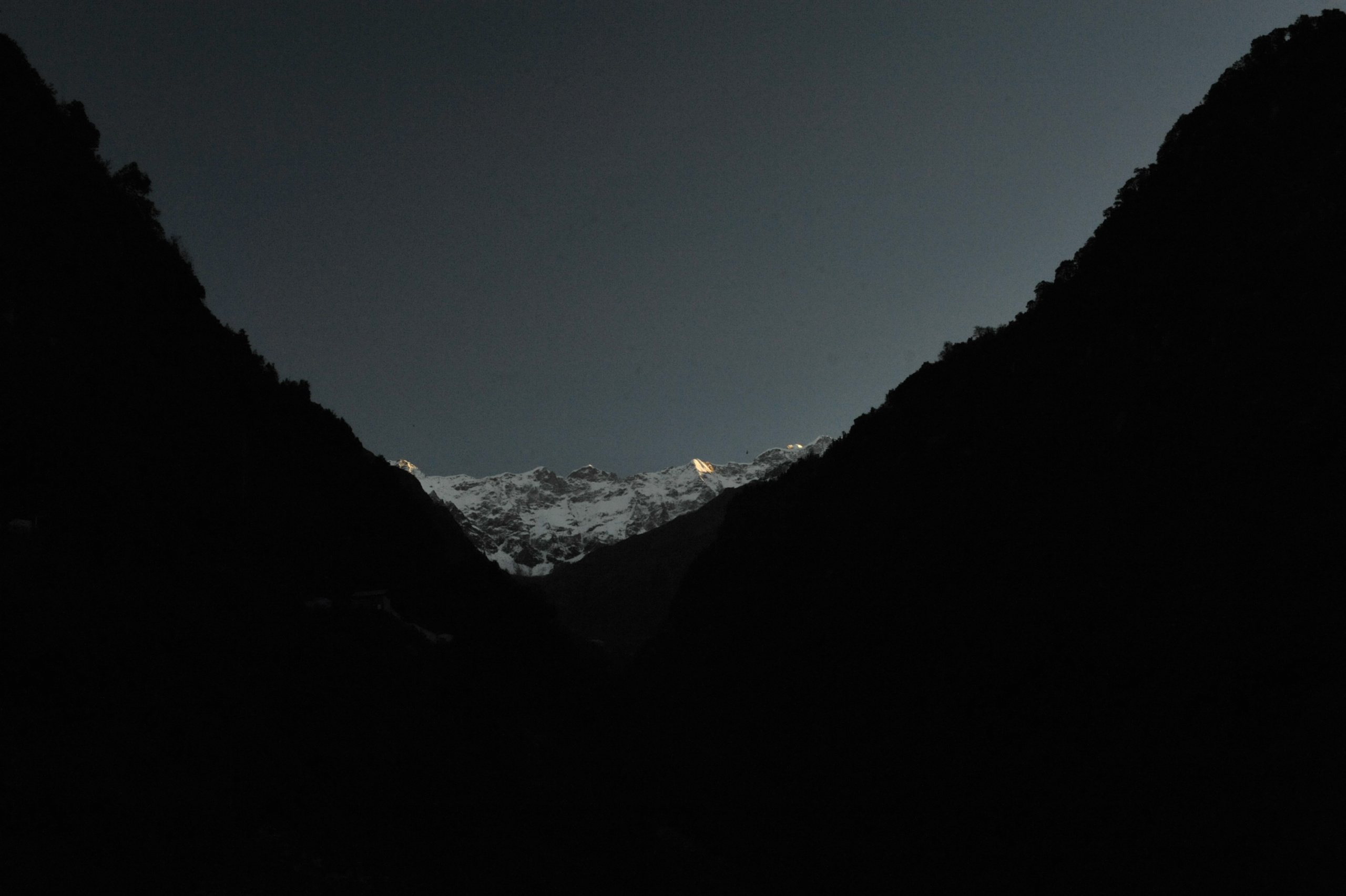
Trail to Kedarnath
For several years I had been preparing for this journey, without knowing if or when I would ever have the chance to leave.
By then, my desire to explore the world had long been confined to its preliminary stages: studying, reading, researching and, above all, imagining. I had grown accustomed to travelling to distant countries only in my mind, occasionally watching other people’s adventures with a touch of envy. Their stories became a substitute for my own journeys, just as I learned to be content with the wonderful, if less remote, trips I shared with my family.
And yet, I never stopped planting seeds, sometimes deliberately and sometimes without even realising it. It came naturally. One of those seeds had been planted many years earlier, somewhere among the Himalayan mountains that had left such a deep impression on me. Even after I had almost resigned myself to the idea that I might never return, a part of me still believed that the journey was not truly over, and that sooner or later something would begin to move again.
My curiosity had drawn me towards Eastern philosophy and spirituality long before that. The connection deepened through several journeys across Asia and was nourished over the years by continuous reading and study, eventually growing into a strong desire to visit some of Hinduism’s most sacred places.
During a number of work trips to India, I began to realise that this dream might actually become possible. Even so, I never imagined that a promise exchanged with a friend, one of those promises people make without really expecting them to come true, would one day turn into reality. There never seemed to be a right moment. There were always too many pieces that needed to fall into place.
In truth, all it took was for a single strand in the web of connections that shapes our lives to be set in motion.
It took years, but eventually those seeds germinated and grew into an experience that may come only once in a lifetime.
One day in August, I received a phone call from Venky ─ Venkanagouda, a colleague and friend from Bangalore. My first thought was that something had gone wrong at work. Probably one of the usual headaches involving the network connection between our offices in India and Italy.
Instead, the voice on the other end of the line was bursting with excitement.
«No sir, no sir, we are planning Yatra!»
It took a few moments of back-and-forth before I understood what he was actually trying to tell me. Venky and another colleague, Raghavendra, whom I had never met in person, were organizing a Char Dham pilgrimage and wanted to know whether I would be interested in joining them. We had talked about the idea several times before. In fact, the original plan had been to undertake the pilgrimage together with another former colleague, who had eventually managed to complete it without us. So, the proposal did not come entirely out of nowhere. Even so, it caught me off guard. My immediate reaction was enthusiasm. Of course I wanted to go. I could already picture myself planning the journey for the following spring, before the arrival of the monsoon season. Then I realized they were talking about October. This October. Excitement instantly collided with a familiar fear: the fear of letting a rare opportunity slip away. In a matter of seconds, my mind filled with obstacles, responsibilities and unanswered questions. Work could probably be organized. My children would be already back to school, but they were old enough not to need me every moment. My mother’s health was no longer as worrying as it had been a year earlier. One by one, the objections began to fall apart. And as quickly as they had appeared, they left behind a simple realization: this was a once-in-a-lifetime opportunity. The kind that rarely comes twice. Before I had time to overthink it, I heard myself replying:
“I’m going with you. No doubt!”
The following weeks were strangely suspended between excitement and uncertainty. I still did not know the exact itinerary or even how we would be travelling. In truth, that part hardly mattered to me. Venky explained that a travel agency in Bangalore would take care of almost everything. Even so, I refused to let myself become too enthusiastic. I kept repeating that nothing was certain until I was actually on a plane heading for India. I told my family about my plans and received nothing but encouragement. Yet for the next two weeks I remained convinced that something would go wrong and that the trip would collapse before it even began. Then a message arrived on WhatsApp. Attached was a document from the agency. The itinerary had been finalized. Dates, costs and logistics were all there. For the first time, the journey felt real. The race began immediately. Flights had to be booked. A visa had to be obtained. Registration for the Yatra itself, mandatory for all pilgrims, had to be completed.
I dusted off old checklists that had not been used in years and started gathering what I would need for a journey that, however carefully organized, was unlikely to be comfortable.
I wondered whether I still had the appetite for it. Whether I was still capable of dealing with the inconveniences that used to be a normal part of travel. The exhaustion. The unpredictable schedules. The different food. The abrupt changes to habits that, over the years, had become reassuringly fixed. There would be overnight flights, endless hours in vehicles on rough mountain roads and a couple of demanding treks. The altitude would not be extreme, but it would still be high enough to command respect. None of it would be easy. And yet, if all the pieces were finally falling into place after so many years, perhaps there was a reason.
No more hesitation. No more excuses. This time, I was really going.
Before continuing with the journey itself, it may be worth explaining what the Char Dham Yatra actually is.
The name literally means “the pilgrimage of the four sacred abodes.” It refers to four major Hindu shrines located high in the Indian Himalayas, in the state of Uttarakhand: Yamunotri, Gangotri, Kedarnath and Badrinath. The pilgrimage follows the courses of four Himalayan rivers. Yamunotri is associated with the Yamuna, Gangotri with the Bhagirathi, Kedarnath with the Mandakini and Badrinath with the Alaknanda. Another fundamental element of the sacred journey is represented by the river confluences known as prayags. For many pilgrims, a special energy is believed to reside wherever the forces of different waters come together. The most important of these are Devprayag, where the Bhagirathi and the Alaknanda merge to form the Ganga ─ the Ganges ─ and Prayagraj, home to the Kumbh Mela, one of the largest religious gatherings in the world, where the Ganges meets the Yamuna and the mythical Saraswati.
For Hindus, the river is far more than water flowing from the mountains. The Ganges is believed to possess a profound purifying power, capable of washing away the burden of past actions and helping devotees move closer to moksha, liberation from the endless cycle of rebirth. Undertaking the Char Dham Yatra is therefore seen as both a physical and spiritual journey. For many pilgrims, it is quite literally the journey of a lifetime.
Traditionally, the pilgrimage progresses from west to east, beginning at Yamunotri before continuing to Gangotri, Kedarnath and finally Badrinath. Each sanctuary is dedicated to a particular deity and connected to specific myths, legends and manifestations drawn from the vast tapestry of Hindu tradition.
For me, reaching these places represented the fulfilment of a dream I had carried for years.
Experiencing them alongside two genuine pilgrims would make the journey something even more special.
Once the practical arrangements had been settled with surprisingly little drama, I turned my attention to equipment, clothing and, perhaps most importantly, my camera gear. I was ready. Late October seemed like the ideal time to go. Temperatures would certainly be colder but cold had never worried me much. If anything, it should have worried my companions more, both of whom came from the warm climate of southern India. The greater concern earlier in the season would have been the monsoon. Only a few weeks before our departure, severe floods had stranded more than fifteen hundred people on the route to Kedarnath. By travelling later in the year, we would hopefully avoid that risk. As usual, I packed light. One habit that years of travel had firmly taught me was to avoid checked luggage whenever possible. Fewer bags meant fewer opportunities for things to go wrong.
The plan itself was straightforward. I would fly to Bangalore, meet Venkanagouda and Raghavendra, and together we would catch a domestic flight to Dehradun, at the foot of the Himalayas. The internal flight had already been arranged by the agency. Simple enough. At least, that was the plan. The journey, however, had other ideas. My flight out of Bologna was delayed. Not by much, but enough to make me miss my connection in Munich by five minutes. I was mad they would not wait for me for five minutes. Instead of Bangalore, I found myself rerouted directly to Dehradun via Delhi. Not exactly the beginning I had imagined. On the other hand, it was oddly reassuring to discover that I could still navigate the kind of travel disruption that once seemed routine. There had been a time when missed connections, sudden changes and improvised solutions were simply part of the adventure. Apparently I had not completely lost the knack.
I arrived in Dehradun several hours before my friends. The airport was brand new, bright and surprisingly relaxed. The air felt warm and gentle. For the first time in days there was nothing to hurry for. I simply waited. Then, at last, Venky and Raghavendra appeared. Within minutes, the fatigue and frustrations of the journey faded into the background. Although I had not seen Venky for many months and had never met Raghavendra in person, we immediately felt like old friends who had travelled together countless times before. The final member of our small expedition soon joined us.
His name was Raman, and he would be our driver for the entire pilgrimage. Now, finally, we were complete. We left the airport and headed towards Haridwar, “the Gateway to the Gods,” our first stop and the place where we would spend the night.

Ganges at Haridwar
Haridwar is one of the holiest cities in Hinduism and the traditional starting point of the Char Dham pilgrimage. Even its two names, Hardwar and Haridwar, reflect the deities who would accompany us throughout the journey: Shiva, in his form as Hara, and Vishnu as Hari.
It is here that the Ganges emerges from the foothills of the Himalayas and begins its long passage across the vast plains of northern India. For countless pilgrims, the Yatra truly begins in Haridwar with a ritual immersion in the sacred river. Our own journey would begin the same way. We barely had time to leave our bags at the hotel before my companions announced that our first appointment awaited us: a purifying bath in the Ganges, followed by an evening blessing at sunset. Raman drove us to the river and dropped us near one of the great ghats, the broad stone stairways descending to the water’s edge. And just like that, I found myself immersed in India once again. For Venky and Raghavendra, this world was ordinary, familiar, simply home. For me, even after several previous visits, India remained what it had always been: an overwhelming assault on the senses.
The river seemed to permeate everything. Here the Ganges does not flow through a single channel. Instead, it divides into countless branches that separate and reunite across the landscape. Along many of them, ghats have been built so that pilgrims can descend to the water. The one we reached was large and crowded. The river broadened here, but the current remained surprisingly strong. At the base of the stone steps, heavy chains had been anchored into the riverbed, each ending in a large metal ring. Pilgrims held onto them while bathing to avoid being swept away by the current. We joined them. The water was cloudy but not particularly cold. Holding one of the rings with both hands, I searched the riverbed with my feet and found only the uneven remains of a submerged wall. Then a group of young men plunged into the river nearby. Unlike the pilgrims gripping the chains, they surrendered themselves completely to the current, laughing as they were carried downstream at astonishing speed. Within seconds they disappeared from sight.
After leaving the ghat, we headed toward one of the hills overlooking the city.
At its summit stood the Temple of Mansa Devi, the serpent goddess who, according to tradition, was born directly from the mind of Shiva. We reached it by cable car. Inside, the temple was crowded. I looked around and quickly realized that I was the only non-Indian there. This was not the first Hindu temple I had visited. In the past, however, I had always entered as a tourist, moving quickly through sacred spaces with the detached curiosity of an outsider. This time was different. Venky and Raghavendra encouraged me to participate.
And I did my best to follow their lead. After leaving our shoes at the entrance, we passed through a succession of shrines fragrant with incense and overflowing with flowers. Images of the goddess were housed in small chambers, while others stood upon altars circled continuously by pilgrims moving in a clockwise direction. When the time came for a blessing, we entrusted ourselves to one of the temple priests. He sprinkled us with water. Then, into the palm of my right hand, he placed a mixture of coloured powders, grains of rice, flower petals and coarse crystals of sugar. Next came the mark upon the forehead, a streak of red and yellow pigment. Finally, he lit a small flame and began reciting ritual verses while we returned a portion of the offering to the fire. I understood neither the words nor many of the gestures.
Yet for the first time, I did not feel like a spectator. What struck me most was the feeling of being welcomed. Throughout the journey I would often attract attention. People frequently asked to take photographs with me, curious about the foreigner travelling among them. Yet never once did I encounter suspicion. I was free to participate or simply watch from the side. Either choice was entirely acceptable. No one seemed concerned about what I believed. No one appeared interested in drawing boundaries around who belonged and who did not.
At one point, Raghavendra explained that, according to his understanding of Hinduism, there are very few absolute obligations. Everyone is free to follow their own path, provided they respect others and all forms of life.
«The first rule…» he told me, «…is not to cause harm. Everything else can be adjusted. »
It was one of those simple statements that linger in the mind long after the conversation ends.
Before long, both Venky and Raghavendra became invaluable guides in a world that, despite all my reading, I still only partially understood.
Raghavendra came from a Brahmin family and possessed an impressive knowledge of rituals, mythology and tradition. Venky, meanwhile, excelled at explaining how those traditions lived within everyday life. He had a gift for making complex customs feel practical and human.
But above all, I saw in them two close friends. Watching them together often made me think about the distance between inherited social structures and the relationships people actually build. I was hardly in a position to draw conclusions about India’s caste system. Still, their friendship quietly challenged some of the assumptions I had carried with me.
As sunset approached, we returned to the Ganges. This time we settled along a different branch of the river, looking for a priest willing to perform an evening blessing. It was the first of many such encounters. One thing immediately surprised me: the age of the priests. Many were remarkably young. My companions explained that priesthood is often passed down through families, requiring years of study beginning in childhood. In pilgrimage centres where thousands of devotees pass through every day, youth and stamina can be advantages.
We sat on broad steps facing the river. The banks on both sides were packed with people.
Soon the evening Ganga Aarti began. A line of priests dressed in red positioned themselves beside the water. As ritual chants echoed from loudspeakers and were taken up by the crowd, they lifted enormous oil lamps and began moving them in sweeping circles through the air.
The flames traced glowing arcs above the river. Their reflections shimmered across the darkening water. The effect was mesmerizing. When the ceremony ended, the lamps were lowered and the flames gradually disappeared.
Some devotees descended once more into the river, completing their purification in the fading light. Later I was told that this ritual takes place every evening throughout the year, here, in Varanasi and in Rishikesh, rarely interrupted even by the harshest weather.
It was only in that moment that I realized what kind of magnificent adventure I had gotten myself into.
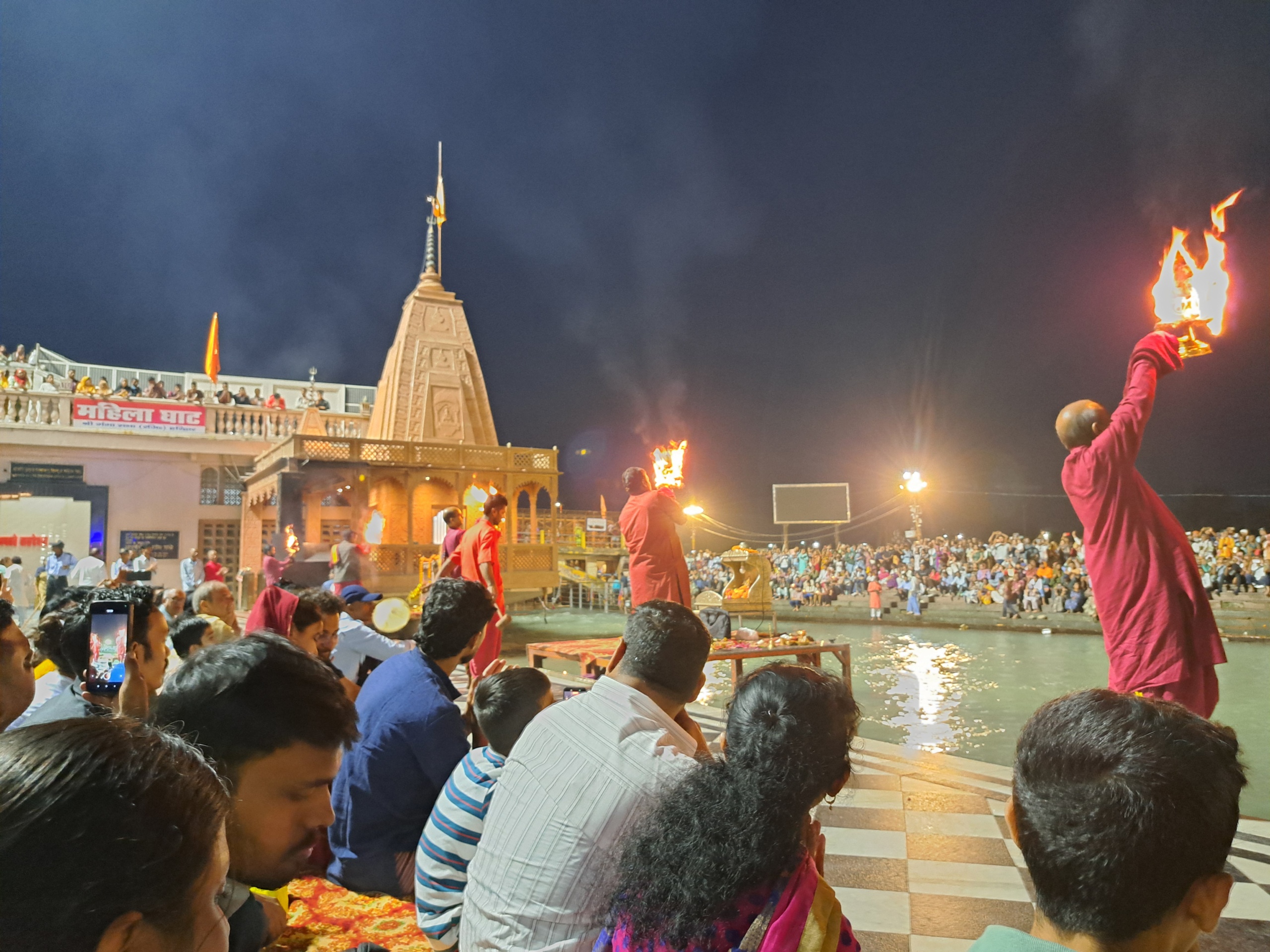
Ganga Aarti
The real Yatra began the following morning.
Haridwar was already buzzing before sunrise. Families loaded luggage onto cars. Royal Enfield motorcycles, scooters, buses and Tata Travellers lined the streets, preparing for the long journey into the mountains. Many vehicles seemed impossibly overloaded, their roofs piled high with bags and supplies. We, however, were in no hurry. As I would soon discover, travelling with Venky and Raghavendra meant accepting a very different relationship with time. Morning prayers and ablutions came first. Only when everything had been completed properly could we set off. As long as we remained on the plains, progress was reasonably smooth. But the moment the road began to climb into the hills, everything changed.
Two-lane roads became a luxury. Patches of asphalt appeared and disappeared. Landslides became part of the scenery. Yet traffic somehow continued to move. Where debris blocked the road, bulldozers compressed it into a temporary surface. Where floods had eaten away entire sections of the roadbed, workers carved out new tracks along the cliffs.
Like the roads I had once seen in Ladakh, these routes existed thanks to the constant labour of the Border Roads Organisation. Everywhere we travelled, crews were clearing rockfalls, repairing retaining walls and rebuilding embankments under clouds of dust.
It felt like an endless battle against the mountains, one that would begin all over again after every winter.
To be fair, until Mussoorie, the road treated us kindly. Along the way, it had been a pleasure to reacquaint myself with all the scenes I remembered as being part of everyday life on Indian roads: people sitting on the roofs of vehicles, cows standing in the middle of the road, and brightly painted trucks bearing the words “blow horn” across the back.
I was equally entertained by the animated conversations in Hindi between my travelling companions and Raman. I understood none of it, except for those rare and mysterious moments when a small fragment of the discussion would suddenly be translated into English.
We stopped at a couple of attractive temples beside the highway and spent some time at Kempty Falls before continuing deeper into the hills. Then the ordeal began, and everything else became little more than a film unfolding beyond the window. The distance to Barkot was only two hundred kilometres. It took more than eight hours. I was still carrying some fatigue from the long journey from Italy, and my stomach was struggling to appreciate Raman’s driving style. He attacked the mountain roads with the enthusiasm of a rally driver and seemed permanently focused on the next bend. The road, meanwhile, showed no interest in forgiving mistakes. By the time we arrived, we were exhausted. As soon as the sun disappeared behind the mountains, the warmth of the plains vanished with it. Temperatures dropped quickly, despite the relatively modest altitude. Fortunately, we would be spending two consecutive nights in the same hotel. That simple fact felt like luxury.
The next morning we set off for our first destination of the pilgrimage: Yamunotri.
The roads remained challenging, but a good night’s rest made the bumps and endless curves easier to tolerate. And then, at last, the real mountains appeared. The peaks towering above us were no longer hills. Many rose beyond six thousand metres, their snowy summits hanging high above the valley. We followed the deep gorge of the Yamuna upstream.
The road clung to the mountainside, sometimes seeming to float above the abyss. Streams cascaded down sheer rock faces, occasionally crossing the road itself before plunging into the valley below. Towering conifers dominated the landscape. Most were pines. Every so often, however, they gave way to the magnificent Himalayan cedars known as deodar, trees that seemed perfectly at home among these immense mountains.
At last we reached the end of the road. A large parking area marked the point beyond which vehicles could go no farther. From there, the pilgrimage would continue on foot. Six kilometres remained. And six hundred metres of elevation gain. Our first real test.
The trek to Yamunotri would also provide an indication of what awaited us later at Kedarnath, where the climb would be nearly three times longer and considerably higher.
Neither Venky nor Raghavendra were experienced mountain hikers. In fact, Raghavendra seemed determined to make things as difficult as possible. Despite all attempts at persuasion, he refused to wear proper footwear. He intended to complete the entire hike barefoot but eventually settled on flip-flops.

Kandi
The trail itself bore little resemblance to what I would normally call a mountain path.
Almost entirely paved with stone, it carried a constant stream of thousands of pilgrims.
Very few wore technical hiking gear. Most climbed in everyday clothing. Many wore traditional dress. Some walked in sandals. Others were barefoot. We would be spending the day above three thousand metres, and although the forecast looked promising, I still packed enough equipment to cope with a sudden change in weather. Almost nobody else seemed similarly concerned. Many pilgrims appeared completely unaware of altitude, temperature or mountain conditions. Several had little more than a light jacket. Venky and Raghavendra had each brought only a thin down jacket, to be worn over a short-sleeved cotton polo shirt if absolutely necessary. Fortunately, the weather seemed willing to cooperate.
The path had been designed to accommodate an extraordinary volume of traffic. Great granite paving stones, polished smooth by countless feet and hooves, stretched all the way to the shrine. Not everyone chose to walk. Some pilgrims rode horses or mules. Others travelled in dandis, sedan chairs carried by four men. The most striking option, however, was the kandi: a large basket strapped to a porter’s back and supported by a band across the forehead.
The human determination behind such arrangements was impressive. The treatment of some of the animals was less inspiring. Long trains of horses and mules moved continuously up and down the path, often burdened with both riders and cargo. Their handlers did what they could, but controlling them was not always easy. It was common to find yourself suddenly standing in the middle of their path, forced to jump aside at the last moment. Many animals struggled on the wet stones. Their metal shoes slipped regularly, and occasionally both animal and rider fell. Watching this, I could not help noticing the contradiction between such scenes and the Hindu principle of respect for all living beings.
More than a mountain trail, the route felt like a village stretched across a mountainside. Stalls and temporary cafés appeared every few metres. Workers moved constantly among the crowds of pilgrims, carrying supplies up and down the mountain. Some stalls sold little more than chai and the omnipresent Maggi noodles. Others offered full meals and plenty of seats. Most consisted of simple structures wedged against the rock face or sheltered beneath large colourful tarpaulins secured with ropes and wooden poles. There was no rush. We stopped frequently, resting whenever anyone needed a break. Raman was walking with us and had already adapted to our leisurely pace. From time to time he would smile and call out his favourite phrase: «Let’s go!»
By the time we reached Yamunotri, the afternoon was already advanced. The temple stood nestled against the mountainside beneath snow-covered peaks and beside a series of waterfalls. The actual source of the Yamuna lay much higher still, hidden among glaciers roughly a thousand vertical metres above the sanctuary.
According to Hindu tradition, the river is the earthly manifestation of the goddess Yamuna, daughter of Surya, the Sun God, and sister of Yama, the god of death. Bathing in her waters is believed to free devotees from the fear of death and its suffering. For that reason, the ritual bath at Yamunotri holds particular significance. And, as I was about to discover, there was something rather unexpected waiting for us there.
A cloud of steam rose from the stream below the temple, a clear sign that hot springs lay hidden beneath the mountainside. We crossed a small bridge and made our way towards one of the large stone pools fed by the thermal waters. I had brought nothing to change into. No towel. No spare clothes. As far as I was concerned, that settled the matter. Raghavendra convinced me that skipping the bath was simply not an option. Within minutes all three of us were standing at the edge of the pool, wondering how much discomfort we were willing to endure in the name of tradition. Then we climbed in. Raman remained outside, guarding our clothes and bags. The water was astonishingly hot and the pool was already crowded. Several families were bathing, along with a number of children who immediately noticed the pale-skinned foreigner sitting among them. Within moments they had surrounded me. Questions began flying in hesitant English. The water was soothing. The atmosphere had become almost playful. But there were others waiting for space in the pool, and eventually we surrendered our places and climbed back out into the cool air. After drying off as best we could, we looked for a priest and joined the queue for the day’s puja.
When the ritual ended, Raman immediately reminded us of a less spiritual reality. It was getting late. And he had absolutely no desire to drive the mountain road back to Barkot in complete darkness. Raman and I started down the path first, hoping to set the pace. We descended quickly, trying to recover some of the time that had slipped away during the afternoon. By the time we reached the parking area, dusk had turned to darkness. The others were nowhere to be seen. Raman and I retrieved the Suzuki and drove to the trailhead to wait.
More than an hour passed before Venky and Raghavendra finally emerged from the darkness. We returned to Barkot late that night. I was too exhausted to think about dinner.

Yamunotri temple
That evening, back at the hotel, one subject dominated the conversation. Kedarnath.
Until then it had been a distant objective, a name printed on an itinerary. Now it was becoming real. And the more we discussed it, the more uncertain the details seemed to become.
Depending on whom you asked, the trail was eighteen kilometres long. Or twenty. Or twenty-five. Some estimates included detours added after the devastating floods that had struck the region only weeks earlier. Others did not. Even Raman was unsure. He had never made the trek himself. His advice was simple: “Better to assume the longer distance.” Nobody argued.
The original plan called for spending the night before the trek in Guptkashi and returning there afterward. But when we calculated the timings, it quickly became apparent that this would mean a long drive before dawn followed by an exhausting climb. The possibility of returning by helicopter was also discussed. A regular shuttle service operated between Kedarnath and the valley below, carrying pilgrims who preferred not to tackle the trail on foot. In the end, we agreed on a compromise. We would start before sunrise, walk to the temple and then decide later whether returning by helicopter made sense. At least that was the plan. Experience was teaching me that plans tended to evolve rapidly during this pilgrimage.

Himalayas
Before Kedarnath, however, the pilgrimage still had another sacred destination to offer: Gangotri. The drive there took us through landscapes that seemed to change around every bend.
On the way, we stopped at Prakateshwar Cave, a temple unlike any we had visited so far. The cave had been discovered accidentally in 1998 during excavation work carried out in search of drinking water. Deep inside lay a naturally formed rock with five distinct faces, quickly identified by devotees as a manifestation of Shiva in the form of Panchanan, Lord of the Five Elements. The place was crowded. Only Venky and I went inside, as Raghavendra was struggling with stomach problems that day. As usual, waiting in line became an unexpected social experience. Someone asked where I came from. Someone else wanted a photograph with the lone foreigner. By now, I had become accustomed to both. Eventually, a guard led us through a narrow opening in the rock. The passage was steep, damp and surprisingly slippery. We descended several metres underground before the chamber opened up.
Inside, a small pool reflected the dim light that filtered in from above. Beyond it stood the sacred stone. I could barely make out its shape. It appeared almost black, polished smooth by centuries of touch and moisture. When my hand finally reached it, the surface felt cool and damp beneath my fingers. Scattered across it were offerings of rice and flowers left by generations of worshippers.
There was something deeply intimate about the simplicity of the place. No grand architecture. No monumental statues. Just a cave, a stone and the faith of those who had come before.
Later we continued towards Uttarkashi, where we would spend the next two nights.
The town still lay at a relatively low altitude, and the afternoons remained pleasantly warm.
Our hotel stood outside the centre, overlooking Lake Maneri, a reservoir formed by a hydroelectric dam. Two faded stickers on the glass entrance doors caught my attention. They were remnants of mountaineering expeditions that had passed through years earlier on their way to peaks hidden somewhere among the surrounding mountains. I was immediately fond of the place. After checking in, we sat down with cups of hot chai. Venky disappeared to his room for some much-needed rest. Raghavendra and I stayed outside beside the lake.
As often happened during quieter moments, the conversation drifted away from practical matters. He told me once again how fortunate I was to be there. Not fortunate in the ordinary sense. Not simply lucky. He was convinced our meeting had not happened by chance.
Something, he believed, had brought us together and drawn us into these mountains.
The reasons might remain hidden. Perhaps we would never fully understand them.
But whatever happened during the Char Dham Yatra would eventually ripple outward into other lives. Maybe directly through us. Maybe through someone we met along the way.
Maybe through someone they would later meet. The effects would continue spreading through an invisible network of connections far larger than ourselves. Listening to him describe this web of relationships and consequences, I found myself thinking unexpectedly of Carlo Rovelli, the Italian physicist and writer.
Dinner turned out to be another pleasant surprise. My companions were delighted. The menu, however, remained largely unchanged. By this point I had begun thinking of it as “pilgrim cuisine.” Paneer with chapati. Dal with rice. Cooked vegetables, often cabbage.
Simple food. Strictly vegetarian. Repeated day after day with only minor variations.
Raman joined us and the conversation eventually returned to Kedarnath. I received some reassuring news. The others had spoken with the agency about my concerns regarding the schedule. Originally, we had been due to spend the night before the climb in Guptkashi. Now the plan had changed. We would stay instead in Rampur, much closer to the trailhead. The difference might only save an hour or so of driving, but in mountain travel that hour can feel invaluable. For the first time, Kedarnath seemed slightly less intimidating. Only slightly.
The following morning we set the alarm for six o’clock, intending to leave an hour later.
At least, that was the theory. When I came downstairs shortly before seven, none of my companions were anywhere to be seen. Raman’s Suzuki was parked beneath the hotel entrance. Curious, I walked closer. To my surprise, I found him asleep inside. Wrapped in blankets and stretched awkwardly across the seats, he appeared perfectly comfortable.
When he noticed me, he calmly sat up, adjusted his glasses and climbed out.
«This is my room» he said matter-of-factly. Then he began folding the blankets and rearranging the seats. Only then did I fully realise that he had been sleeping in the vehicle throughout the trip. I asked what he intended to do when we reached the higher-altitude destinations later in the pilgrimage. Raman shrugged. The question seemed irrelevant to him. He simply continued tidying his four-wheeled bedroom. Meanwhile, there was still no sign of Venky or Raghavendra. Back upstairs I could hear voices coming from their room. The sound of running water suggested that the morning rituals were still underway. Once again we would leave later than planned. And once again, somehow, it would not matter. Little by little I was learning that this pilgrimage operated according to a different measure of time. Things rarely happened when they were supposed to. Yet somehow everything happened exactly when it needed to.
The road to Gangotri followed the Bhagirathi River through one of the most beautiful valleys of the journey. At first the landscape was dominated by bare rock and sparse vegetation.
Then came the pines. Higher still, the pines gradually gave way to magnificent Himalayan cedars. The gorge narrowed. The river carved its way deeper into the mountains.
An imposing military-style bridge crossed a vast chasm. Beyond the bridge, the valley widened briefly. Broad expanses of pale sand flanked the river. And beyond them, for the first time that day, snow-covered peaks appeared once more on the horizon. A final endless series of switchbacks carried us to Gangotri. When I stepped out of the vehicle, Raman’s driving was still making itself felt. For a moment I wondered whether the nausea came from the road or the altitude. The fresh mountain air quickly settled the question. Raghavendra, meanwhile, had only one thing on his mind. He wanted to bathe. Immediately. And, as he was about to explain, there was a very good reason why.
As we approached the river, the discomfort slowly disappeared. Raghavendra, meanwhile, was already looking towards the water. Purifying oneself here carried a special significance, he explained. For Hindus, these were not simply mountain waters. They were the waters of Ganga herself, descending from the heavens to the earth. His explanation led naturally into one of the most celebrated stories in Hindu mythology.
King Bhagiratha sought to free the souls of his ancestors, the sons of King Sagara, who had been reduced to ashes after offending a great sage during meditation. Deprived of moksha, liberation from the cycle of rebirth, they were condemned to wander as restless spirits.
To save them, Bhagiratha undertook severe austerities and prayers, hoping to persuade the goddess Ganga to descend from the celestial realms. Only her sacred waters could purify the ashes of his ancestors and grant them release. Yet there was a problem. The force of the heavenly river was so immense that its descent would have destroyed the earth. It was Shiva who intervened. High in the Himalayas above Gangotri, he received Ganga within his tangled locks of hair, breaking her fall and dividing her force into countless streams. Only then could the sacred river descend safely to the world below.
After telling the story, Raghavendra smiled and looked at the river. There was little doubt about what would happen next. Venky and Ragha stepped into the water without hesitation and managed to immerse themselves completely. I followed with considerably less enthusiasm.
The Bhagirathi was born from glaciers, and it felt exactly as I imagined glacial water should feel. After only a few seconds my legs were protesting vigorously. A full immersion remained beyond my capabilities. The cold was so intense that, when I finally climbed out, it felt as though thousands of needles were piercing my skin. For me, that seemed quite sufficient.
My companions appeared unconvinced. While drying off, I watched the activity around us.

Pilgrims in Gangotri
Women wrapped in brightly coloured clothing gathered along the banks, while in the water I could see almost exclusively men. Beyond them rose the snowy mountains. Somewhere up there, beyond the visible ridges and above four thousand metres, lay the glacier from which the river truly emerged. A trekking route followed the valley all the way to its source.
Looking up towards those distant peaks, I found myself wondering what it would be like to follow it. Perhaps, one day, I would.
After the bath, we searched for a priest to guide us through another puja. Like so many others we had encountered, he was remarkably young. We sat in a semicircle around him as he lit a small flame and began the ritual. Meanwhile, Raman continued orbiting around us in increasingly unpredictable ways. Since I had lent him my Nikon, he seemed to have discovered a new passion. I switched the camera to automatic mode and watched him disappear into the crowd, enthusiastically photographing anything and everything that caught his attention. The more I got to know him, the more I liked him. He was young, determined and drove mountain roads with a confidence that occasionally bordered on recklessness.
So far, fortunately, he had yet to miss a corner. A son not yet a year old was waiting for him back home in Haridwar, and I liked to think that fact alone prevented him from taking his driving adventures too far.
After completing the puja, we visit the temple to pay homage to Shiva, the god who prevented the celestial waters from destroying the world.
After buying a few souvenirs, we make our way back to the car. My companions, however, have chosen a rather different kind of keepsake. They are carrying several orange containers filled with sacred water, in every size imaginable. Their plan is to take them home on the plane, where, they explain, the water will later be used in household rituals.

Three pilgrims in Gangotri
On the way back, we stop briefly by the river at a place where the banks broaden and deposits of sand make it possible to walk down to the water without difficulty. The landscape has an almost lunar appearance. Many visitors stop here to take photographs, while others simply stand on the wide sandy riverbed and admire the snow-covered peaks that occasionally emerge between the mountains.
As we drove across the big military-style bridge the scenery reminded me less of India than of the great canyon landscapes of the American Southwest. From the bridge I looked down into the depths below. Layers of rock descended into shadow, illuminated here and there by shafts of sunlight. The scene was extraordinary. I immediately asked Raman to stop. Camera in hand, I climbed out, intending to walk back for a few photographs. I had barely taken a few steps before two soldiers intercepted me. The Nikon immediately attracted their attention. They ordered me away. I tried to explain. They remained entirely unimpressed. Whether they didn’t understand me or simply had no interest in understanding was impossible to tell. Either way, the photographs would remain untaken.
We return to our hotel by the lake and prepare for the following day’s journey. Another long day on the road awaits us, through landscapes that seem to change constantly.
The lower mountains are covered in forests and populated by large grey and brown macaques. They run along the guardrails and, whenever a vehicle approaches too closely, disappear with a single leap down the steep slopes below. The hills, as they are called here to distinguish them from the snow-covered peaks beyond, alternate with lively valleys and small towns crossed by pilgrims travelling by every conceivable means of transport.
There are no tunnels. Every ridge must be climbed or circled, so even short distances often turn into unexpectedly long journeys.
At one point we stop at a small roadside hotel perched on the mountainside.
A four-wheel drive with a flat tyre is parked near the entrance. It belongs to a large family. The men are busy replacing the wheel while four children circle around them in search of something to do. A short distance away stands a young woman, probably their mother, dressed with a quiet elegance that seems at odds with the dust and isolation of the place.
What strikes me is precisely this contrast, the same one I will encounter again later on the trail to Kedarnath. There, people from very different backgrounds travel side by side: pilgrims in brightly coloured traditional clothing, barefoot men and women dressed in worn garments, people with disabilities and others who look impeccably turned out, carrying fashionable bags and wearing expensive shoes.
The children prove equally surprising. After observing me for a few moments, they approach and one of them, speaking flawless English, asks my name, where I come from and where I am going. When I answer, “Italy,” he nods and asks whether I know that two independent states exist within Italy itself: San Marino and Vatican City. He cannot be more than ten years old. All of them seem delighted by the opportunity to speak with a foreign traveller, and their curiosity is contagious.
Meanwhile, I overhear the hotel owner explaining that snow leopards remain a constant threat to livestock in these mountains. The idea surprises me. I had always imagined them confined to the more remote regions of Tibet and Ladakh, beyond these ranges. Eventually, he too asks for a photograph together. He tells me that foreigners are almost never seen here at this time of year and that I am the first he has met in quite a while. Others, he says, will arrive later in the winter as part of mountaineering expeditions and trekking groups.
Descending the opposite side of the mountain, we encounter numerous children on their way home from school, all dressed in dark blue uniforms. Some ride home on horseback alongside the adults, while others have only just stepped off a school bus.
Venky and Raghavendra assure me that the education system works remarkably well in these parts. They say it with a certain pride, as they often do when speaking about their country.
Soon afterwards they ask whether I would ever consider moving to India. According to them, I would adapt easily and could live comfortably without spending very much.
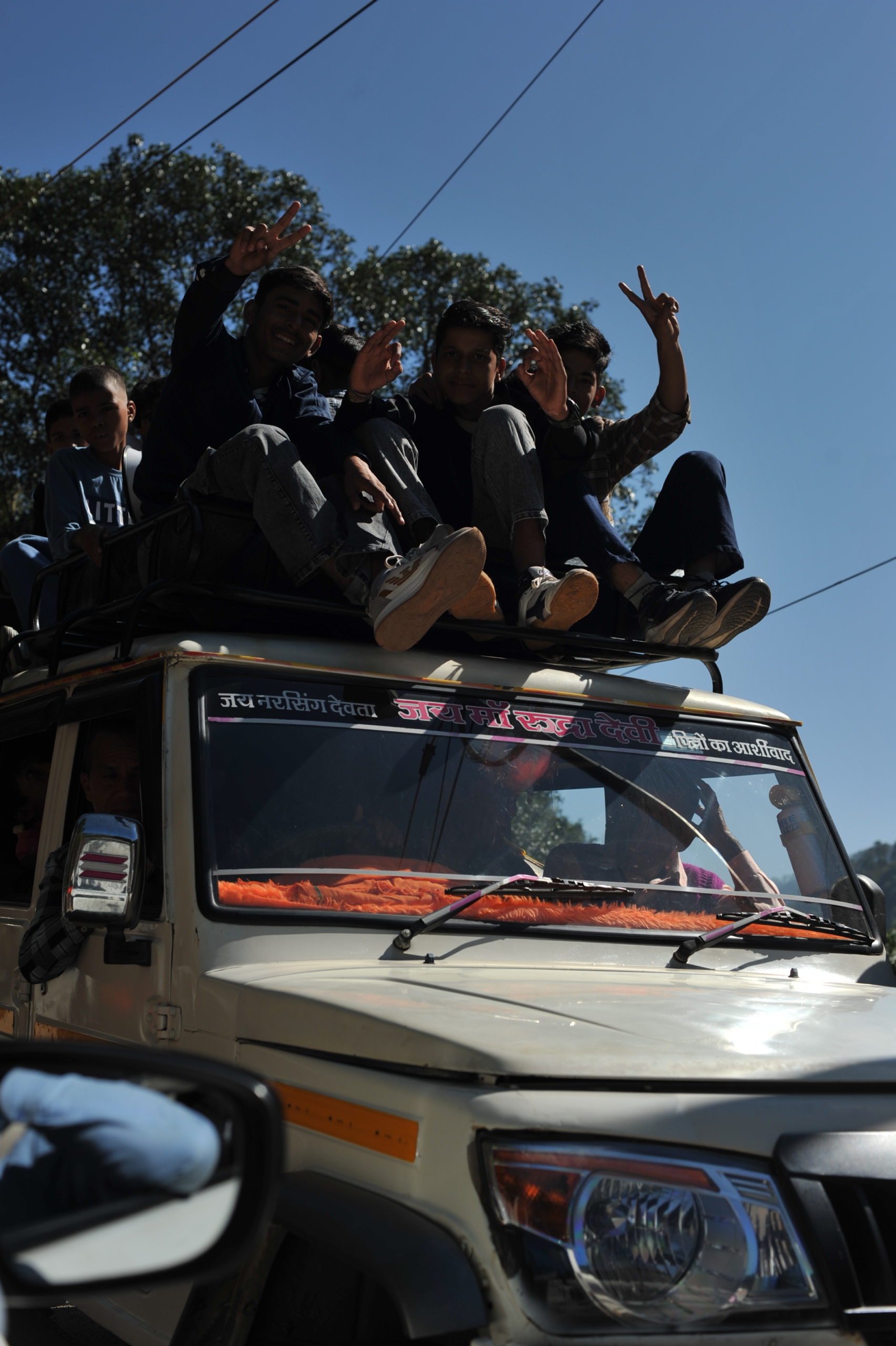
Pilgrims
Raghavendra, captivated by the simplicity of these mountains, says that if he were not already married he could happily settle here in Uttarakhand. Venky immediately brings him back to reality. In Bangalore, he reminds him, everything is close at hand. Life here would be far more complicated, and there would still be the winter to contend with.
I listen to them discussing the matter while looking at the scattered houses clinging to the slopes. I do not know whether I could truly live in a place like this.
Then again, whenever I imagine myself growing old, it is almost always somewhere among the mountains.
It is already below freezing when I reopen my notebook.
The pen moves reluctantly across the page, but there is one thing I feel I must write down immediately. In the end, we made it to Kedarnath. On foot.
To avoid the crowds, we had decided to set off before dawn. At four o’clock we leave the hotel and find Raman already waiting to drive us to Sonprayag, the last place we can reach with our car. Even in the middle of the night, the town is teeming with people, four-wheel drives and market stalls. It feels like a funnel into which every road and every pilgrim bound for Kedarnath eventually flows. From here, it makes little sense to continue on foot. The few kilometres to Gaurikund are constantly travelled by shared vehicles that raise clouds of dust and fill the air with the sharp smell of diesel engines. For a few rupees, they carry pilgrims to the true beginning of the trail. Raman drops us by the roadside and we make our way through the market. It feels like broad daylight. The market never closes and sells everything a pilgrim might need for the climb, from bamboo walking sticks to small oxygen canisters for those worried about the altitude. A little farther on, we reach the queue for the shared jeeps. Drivers shout destinations and count passengers, trying to fill every available seat. One vehicle happens to be missing exactly three people. Us. We squeeze into the already crowded cabin, the tailgate closes with difficulty, and we set off once again into the night, surrounded by dust and the headlights of the vehicles ahead. At Gaurikund another maze of shops and market stalls awaits us. Venky and Raghavendra each buy a bamboo staff. That is the entirety of their trekking equipment. Despite the darkness, it is not cold down here yet. We are at roughly nineteen hundred metres above sea level. To reach Kedarnath, we still have another sixteen hundred metres to climb.
We pass through the gateway of Gaurikund, which marks the official beginning of the pilgrimage, and begin gaining altitude at a slow, steady pace. In some sections the darkness is complete. The few lights along the trail do little to reveal the obstacles scattered across the stone paving, so I switch on my headlamp.
Raghavendra struggles to find a rhythm and is already stopping frequently by the first series of switchbacks. At this pace, it will take him a long time to reach the top, yet he shows no inclination to give up. Venky progresses more easily. Proper shoes and a walking stick prove to be a considerable advantage over Ragha’s flip-flops.
Little by little the sky begins to brighten and the peaks above us catch fire in the first light of day. With daylight, however, come the long lines of horses and mules. The trail quickly fills and we find ourselves constantly choosing where to place our feet to avoid ending up in the animals’ path.
Eventually the first distance markers appear. Twelve and a half kilometres to the temple.

Trail to Kedarnath
If the signs are correct, we have already covered almost a third of the route without really noticing. For the first time, reaching Kedarnath before dark begins to seem entirely realistic.
We have been on our feet for hours and still have not had breakfast. I am beginning to feel hungry, but Venky and Ragha refuse to eat for fear of feeling heavy during the climb. Even the Ritter bars I brought from Italy fail to convince them, as neither is entirely certain that they contain no animal-derived ingredients. Fortunately, just as on the trail to Yamunotri, stalls and small kiosks appear all along the route. In the end, I manage to persuade them to stop for at least a little fruit.
We stay together until roughly halfway up the climb. By then the distance markers finally settle the matter: the route is eighteen kilometres long, exactly as the official guides claim, and not the feared twenty-five. The destination suddenly feels much closer. The day is clear and windless. We walk in the cool shadow of the mountain and, despite the altitude, the ascent progresses without too much effort. Above us, helicopters have already begun their constant shuttle between the valley and the temple. Those who arrive by air reach Kedarnath in a matter of minutes, but they never experience this slow immersion in the landscape.
Little by little I increase my pace. Venky manages to keep up, while Ragha continues at his own rhythm and gradually falls behind. We stop several times to wait for him, looking back down the trail and expecting him to appear around the next bend, but in the end we will not meet again until we reach the top. From that point on, we continue as a pair. I walk ahead, stop occasionally to take photographs, wait for Venky to catch up, and then set off again.

Pilgrims on the trail to Kedarnath
The higher we climb, the more the mountains seem to move towards us. The peaks grow closer, immense and imposing. On the paved trail, however, the crowds of people and animals show no sign of thinning. Wherever the switchbacks tighten, the route resembles a great moving spiral, a continuous stream of pilgrims making their way up the mountainside.
I find myself thinking about something I had read before leaving Italy. During the Char Dham season, which is now drawing towards its conclusion, nearly two million pilgrims will make their way to Kedarnath. They come from every corner of the subcontinent for what many of them simply describe as “touching God”.
Watching that endless procession winding its way up the mountain, their devotion ceases to be a number and becomes something visible.
As so often in this part of the Himalayas, everything eventually leads back to Shiva.
Destroyer and renewer, he is the deity who dissolves all forms so that a new cycle may begin. He is also the god who received Ganga in his tangled locks and prevented her celestial waters from destroying the world.
The Mahabharata tells the story of the five Pandava brothers, who seek redemption after the war against the Kauravas. Only Shiva can grant it, but the god wants nothing to do with them and hides among the mountains of the Himalayas in the form of a bull.
The brothers eventually recognise him near Kedarnath. Shiva attempts to escape by disappearing into the earth, but Bhima, the strongest of the Pandavas, seizes him and tries to hold him back. Moved by their determination and convinced of the sincerity of their repentance, Shiva finally forgives them. Before vanishing, he allows part of his body to remain above ground at the place where the sanctuary will later be built.
It is the smooth black stone enshrined within the temple, a natural formation whose unusual shape is said to resemble the back of an animal.
I will not see it until the following day, in the middle of the crowd.
Using shortcuts whenever we can, Venky and I eventually reach the base camp. The stalls become even more numerous and a large open area crowded with horses and mules resembles a livestock market. Under a tent, we stop for a steaming plate of vegetable Maggi.
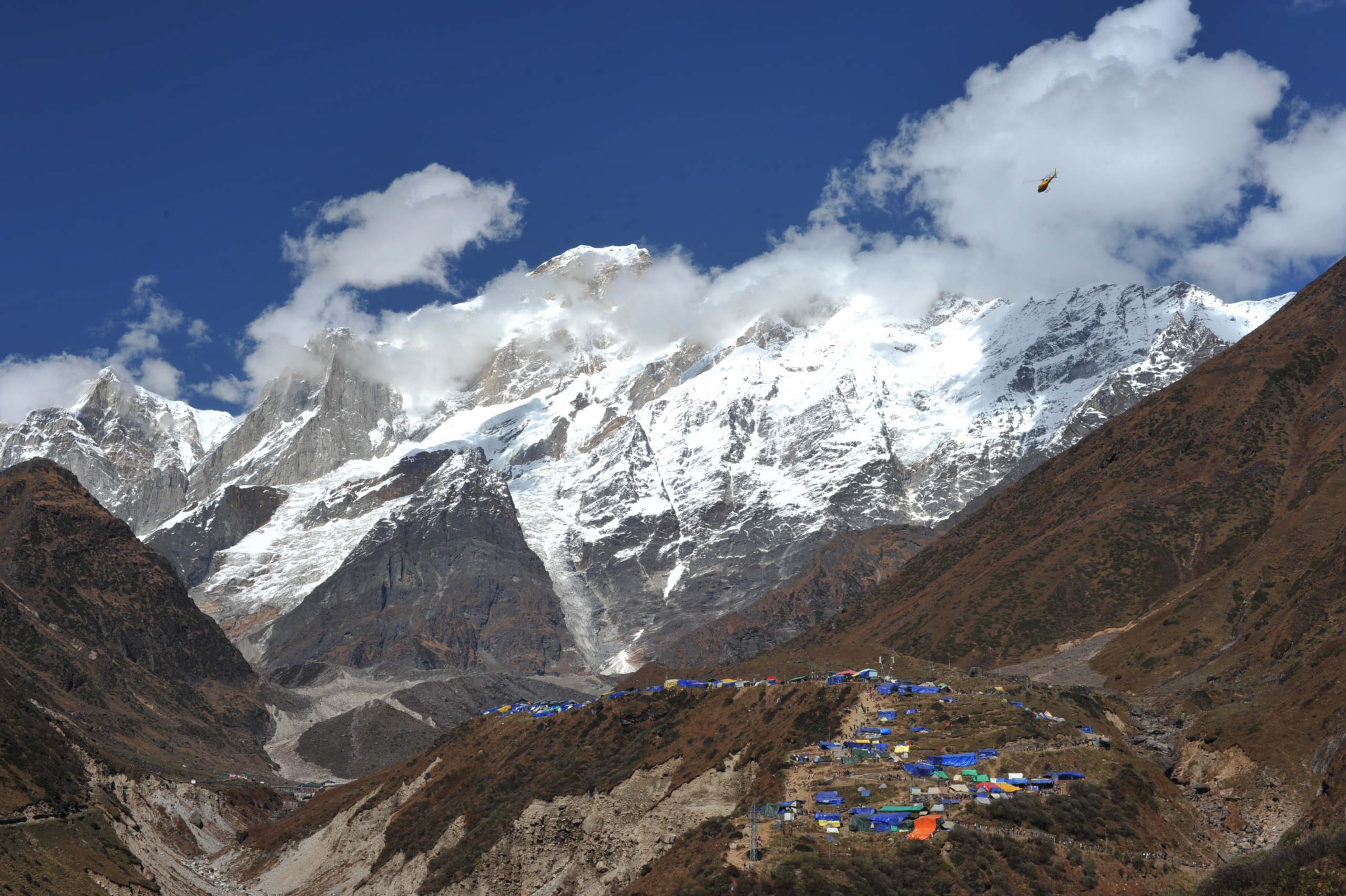
Trail to Kedarnath
Even on the climb to Kedarnath, I do not escape my occasional moments of celebrity. Some students ask me to record a video, while others stop me to find out where I come from. I soon discover that answering “Italy” is not always enough. If I pronounce the name as I would in Italian, with the stress on the first syllable, many people fail to understand. I have to shift the emphasis towards the final y and barely let the a emerge.
While Venky and I are eating our noodles, a group of Nepalese boys sitting under the same tent strike up a conversation. They tell us they have Italian friends. From what I can gather, they met some travellers from South Tyrol who had come to Nepal, but I understand little more than that. One of them invites me to visit Kathmandu. Before we part, we exchange phone numbers.
A little later we finally reach the temple. The square is crowded with pilgrims taking photographs of themselves and with false sadhus dressed as Shiva, ready to pose in exchange for a few rupees. It is not yet time to enter. The darshan will have to wait until the following morning.

Base Camp in Kedarnath
We find our accommodation for the night and Raghavendra joins us about an hour and a half later, as calm as ever. The three of us will share the same room. That in itself does not worry me. What worries me more is discovering that Venky and Ragha intend to wake up at two in the morning for their ablutions and present themselves at the temple by four, before the queue becomes unmanageable. If all goes according to plan, they expect to be finished by seven or eight.
In the meantime, we try to book seats on a helicopter for the descent, but everything is already sold out for the following day. We will have to leave the temple as early as possible and walk back down as well. It promises to be an eventful night. Perhaps, squeezed together in the same room, we will cope better with the temperature outside, which has already fallen to nine degrees below zero.
I cannot sleep. Venky is awake too, and every now and then we exchange a few words in the dark while Raghavendra seems to be sleeping peacefully beside us. We would only find out later that he was awake too. My head aches and my heart seems to be beating faster than it should, probably because of the altitude.
The plan had been to get up at two, yet nobody stirs until four. Then Ragha begins his ablutions and Venky follows suit. I remain under the blankets for a few more minutes. The schedule has already changed. We will go to the temple around five and, once we are finished, make one final attempt to find a seat on a helicopter.
By half past five we are standing in the square. A priest, in exchange for money, leads us towards a side queue that is supposed to move a little faster. I am not entirely sure what is happening. By now, I simply follow the others without asking too many questions.
We enter a maze of metal barriers watched over by soldiers. There are far too many people for the available space and within minutes we find ourselves pressed tightly against one another. One of the guards insists that I remove my socks, even though many others are clearly still wearing theirs. For the next two and a half hours we stand barefoot on frozen stone in temperatures of minus nine degrees Celsius. I think of Venky, who only a short while earlier had been visibly shivering despite his lightweight jacket, and try not to complain. Every now and then I rub my gloved hands across my toes in an almost futile attempt to restore some warmth. Eventually the barriers give way to the actual queue through a narrow gate controlled by another soldier. Our group is split apart. Venky and Ragha make it through. I do not.
There is no possibility of deciding where to go. You move only when the crowd moves.
Standing beside me is a tall, broad-shouldered man. He smiles and asks where I come from. I tell him that I am from Italy and travelling with two friends from Bangalore. To my surprise, he is from Bangalore too. We talk briefly about the parts of the city I know and, without any encouragement from me, he decides to take me under his protection.
“Don’t worry, I will take care of you.”
He makes his way through the gate, but when my turn comes the soldier suddenly stops the flow of people and refuses to let anyone else through. Within seconds I find myself trapped once again on the wrong side of the barrier. The man from Bangalore notices immediately. He turns around and begins shouting something in Hindi towards the soldiers. I cannot follow most of it. The only words I understand are “Italian friend”. A moment later the gate opens again and I am finally allowed through. Once on the other side, he helps me find Venky and Ragha again.
A few minutes later, however, we are separated once more.
The entrance to the temple is barely a metre and a half wide, yet people converge on it from every direction. There is nothing for us to do except surrender to the current.
By now we are almost in the presence of Shiva. Everyone is carrying a small bag of offerings or a container of yellow powder. When I reach the last step, I hand my offerings and fifty rupees to one of the priests. He blesses them, or at least I assume he does, and returns them to me.
Inside, the chaos intensifies. Pilgrims entering from different directions merge into a single flow around the central shrine. Once again I lose sight of my companions.
Then, almost like an apparition, the man from Bangalore reappears. “Don’t worry.”
By now he has a mission. Taking me gently by the arm, he guides me into the innermost chamber, where the stone associated with Shiva is kept. It is not large. Dark and smooth, it reminds me for a moment of the stone we touched in the cave at Prakateshwar, although I later learn that the two are entirely different in origin and significance.
A low border surrounds it, holding back the offerings left by generations of pilgrims. Flowers, grains of rice and coloured powders are layered one upon another across its surface.
I empty the contents of my small packet onto the stone and scatter some of the yellow powder. Then, amid the constant movement of the crowd, I reach out with both hands and finally touch it, letting them slide gently across its surface in something close to a caress.
A moment later the current carries me away. Venky and Ragha reappear shortly afterwards.
Together we return to the square and begin searching for our shoes among the hundreds of pairs scattered across the ground.
Unfortunately, I never see my guardian angel from Bangalore again. By then he has already disappeared into the crowd.
Our visit to the sacred places of Kedarnath was not quite over.
Behind the temple stands an enormous boulder that has acquired an almost legendary status since the catastrophic floods of 2013. During those days of torrential rain, landslides and destruction, thousands of people lost their lives throughout Uttarakhand. According to the account repeated by pilgrims and local residents alike, the boulder broke away from the mountainside and came to rest only a few metres behind the temple. Because its width closely matches that of the sanctuary, many believe it diverted the torrent of water and debris around the building, sparing it from the devastation that swept through the valley.
For those who tell the story, its position can scarcely be attributed to chance.
A short distance away stands the memorial dedicated to Adi Shankaracharya, the philosopher who played a decisive role in the revival of Hinduism during the eighth century. It too had been damaged during the floods and later rebuilt.
Eventually we returned to our room, gathered our belongings and made one final attempt at the heliport. The result was entirely predictable. There was not a single place available.
Venky and Raghavendra had little enthusiasm for walking the entire eighteen kilometres back down to the valley and decided instead to hire horses. They encouraged me to do the same but, by then I had spent enough time watching the animals struggle on the trail to know that I could not really enjoy the experience. I was tired myself, but not tired enough to change my mind. I had not eaten dinner the previous evening or breakfast that morning, yet I still had a couple of sesame bars at the bottom of my backpack. After eating one of them and drinking some water, I felt surprisingly ready to set off. We said our goodbyes and went our separate ways. They headed towards the horse station while I started down the trail. Once I found my rhythm, the descent became unexpectedly enjoyable. Without consciously deciding to do so, I gradually accelerated until the walk became something close to a run. Freed from the uncertainty of the climb and no longer concerned about reaching the top before dark, I found myself moving quickly along the stone path, stepping around pilgrims on their way up and occasionally stopping to admire the view. I covered the entire distance in a little over three hours, stopping only once.

Gaurikund
By the time I reached the gate at Gaurikund, my feet were beginning to complain, but otherwise I felt remarkably well. I sat down near the entrance and waited. Venky and Raghavendra arrived nearly an hour later. The horses, as it turned out, had not provided quite the effortless descent they had imagined. Both admitted that several hours in the saddle on mountain trails had proved considerably less comfortable than expected.
We called Raman, boarded one of the shared jeeps and soon found ourselves back in Sonprayag, where he was already waiting beside the Suzuki.
The journey, however, was not over yet. Before reaching our hotel there was one last detour.
High above Sonprayag stands the ancient temple of Triyuginarayan, a place that bears a striking architectural resemblance to Kedarnath. Tradition attributes its restoration, or perhaps even its construction, to Adi Shankaracharya. Its significance, however, lies in a much older story. According to Hindu mythology, this is where Shiva and Parvati were married in the presence of Vishnu, also known as Narayan, to whom the temple is dedicated. In the courtyard burns an eternal flame that, according to tradition, has been kept alive ever since that divine wedding ceremony. Whether one takes the story literally or not matters little.
What is immediately apparent is the affection with which the place is regarded by pilgrims.
After visiting Triyuginarayan and taking part in yet another puja, we resumed our journey towards what my companions jokingly referred to as our “upgrade”.
To compensate for a few unpleasant surprises we had encountered at the hotel in Haridwar, the agency had arranged for us to spend a night in a luxury resort before continuing to Badrinath. By the time we arrived it was already dark. The resort stood in a beautiful location, surrounded by forest and facing the mountains we had spent the previous days exploring. Even in the fading light, traces of snow could still be seen high on the peaks surrounding the Kedarnath valley. The place felt almost unreal after the previous nights spent in modest hotels and pilgrim lodgings. More than anything, however, it was quiet. After the crowds of Kedarnath, the silence felt like a gift. Venky and Raghavendra seemed delighted by the change of scenery. As for me, I found myself lingering outside before dinner, enjoying the cool evening air and looking back towards the mountains. Not far away, Raman was talking to two men. Seeing me standing alone, they immediately decided that I ought to join the conversation.
The older of the two appeared to be in excellent spirits, helped perhaps by a generous quantity of alcohol. After the usual questions about where I came from and what I was doing in India, he unexpectedly began singing Twinkle, Twinkle, Little Star with great enthusiasm.
His younger companion was no less memorable. He told me that he would soon be travelling to Italy. Naturally I asked where he intended to go. His answer caught me completely off guard. “I’m going with you.” Raman, who had been listening from a discreet distance, immediately began smiling. I tried to explain that immigration procedures were somewhat more complicated than he appeared to imagine. This did not discourage him in the slightest. After several minutes of discussion, I eventually gave him my phone number, largely because it seemed the easiest way to conclude the conversation. For a while he remained convinced that he would soon be coming to Italy to work for me. Only gradually did he accept that this plan might face certain practical obstacles. When he finally walked away, he looked genuinely disappointed. Raman found the entire exchange enormously entertaining.
After dinner I collapsed into bed and fell asleep almost immediately. For the first time in several days there was no need to set an alarm for the middle of the night, no pilgrimage queue to join before dawn and no freezing stone courtyard waiting for us before sunrise.
The following morning I woke properly rested. The mountains outside the resort looked spectacular in the early light. Several summits dominated the skyline, but one in particular immediately caught my attention. When I asked one of the hotel staff about it, he pointed towards the highest peak and replied with a certain pride, “Chaukhamba.”
Only then did I learn that the mountain rises above seven thousand metres. Seen from the resort, it completely dominated the horizon.
The helicopter traffic to Kedarnath had already begun by six o’clock and continued without interruption throughout the morning. A helipad stood not far from the resort, and aircraft came and went every few minutes. Someone mentioned that Prime Minister Modi was expected to visit Kedarnath that day. For us, however, there was no urgency. We allowed ourselves a couple more hours in the sun before returning to the road. The final Dham still awaited us. Badrinath.

Chaukhamba
The drive would be another long one. By this stage, however, we had all settled into the rhythm of the journey. My stomach had finally adapted to Raman’s driving, or perhaps I had simply stopped paying attention to it. Venky and Raghavendra had recovered from their digestive troubles, and nobody seemed particularly affected by altitude anymore. For the first time since leaving Haridwar, everything felt easy. There is often a moment during a long journey when travel ceases to feel unusual and becomes normal life. New routines establish themselves, unfamiliar places become familiar and the effort required simply to be there fades into the background. It seemed to me that we had finally reached that point.
Ironically, it happened just as the journey was beginning to draw to a close. Only a few days remained before our return.
Along the way my companions explained what awaited us at Badrinath. In some respects it was every bit as important as Kedarnath and considerably easier to reach. No long trek was required. The temple stands directly within the town itself, although the town lies at more than three thousand metres above sea level. Pilgrims arrive in enormous numbers. Perhaps even more than at Kedarnath.
Badrinath is associated with Vishnu, who according to tradition withdrew there to meditate for the welfare of humanity. The story tells that he entered such a profound state of contemplation that he became completely indifferent to the cold and remained motionless among the snows. Lakshmi, his consort, took pity on him. To protect him from the elements she transformed herself into a great wild berry tree, known locally as badri, sheltering him beneath her branches. When Vishnu finally emerged from meditation and realised what she had done, he declared the place sacred. From that moment onward, according to tradition, Badrinath became a place of extraordinary tranquillity.
My companions told me that local people say thunderstorms make no noise there and that even the dogs are unable to bark. I had no way of verifying either claim. Still, after everything we had already seen during the pilgrimage, I had learned not to dismiss such stories too quickly.
The road to Badrinath offered no shortage of opportunities to stop along the way.
Before reaching the town, we visited two more temples: the Kashi Vishwanath Temple near Guptkashi and the Shri Narsingh Mandir in Joshimath. The latter becomes particularly important during the winter months, when the idol of Vishnu is moved there after Badrinath closes for the season. Joshimath itself occupies a significant place in the sacred geography of Hinduism. It is one of the four great spiritual centres established across the Indian subcontinent. What delayed us there, however, was not philosophy. It was traffic. For more than two hours we could not move for whatever reason. All vehicles travelling towards Badrinath, and all those returning from it, are subject to strict controls because of roadworks, checkpoints and several narrow bridges. Given the terrain, there is little alternative but to wait patiently for your turn.
Eventually we left the town behind and passed the final checkpoint. From that moment on, Raman found himself free from most external constraints and resumed driving in the energetic style to which we had by now become thoroughly accustomed. Overtaking opportunities were seized without hesitation, cows were avoided with impressive precision and mountain bends were approached with the confidence of a man who had travelled these roads far more often than the rest of us. After more than ten hours on the road, we finally arrived. It was already dark by the time we reached Badrinath. The temperature had dropped considerably and the cold felt sharper than anything we had experienced in the valleys below.
It was already dark and bitterly cold. For a few euros I rented a small heater for my room and told Raman that he was welcome to join me if he would rather sleep somewhere warm. After all, I had a large room for myself, and it hardly seemed fair that he should spend another night in the car with temperatures well below freezing. At first, he seemed surprised by the offer. He steps back outside and for a while I cannot tell whether he intended to accept it or not. Then, sometime later, I heard a knock at the door. I opened it and welcomed him in as though we were old friends. Before going to sleep, I finished writing the notes from the day in my notebook. Raman was already half asleep and, almost as a way of thanking me, told me that I should return to Uttarakhand the following year with my family. He said he would take care of everything. Not long afterwards, we were both asleep.
Like Kedarnath, Badrinath begins long before sunrise. The following morning we rose in darkness and made our way towards the temple. Pilgrims were already gathering despite the cold and the streets were far more crowded than I had expected. Although reaching Badrinath required no trek, the shrine attracted enormous numbers of visitors, perhaps even more than Kedarnath itself. Here too, the ultimate goal was the darshan, the opportunity to stand before the deity and receive the blessing of Vishnu. Before that could happen, however, another ritual awaited us, and this time I was fully prepared.
Unlike Kedarnath, there is an additional step before the darshan. This time, however, I already know what to expect. Before being allowed to see Vishnu, pilgrims must first undergo a purification ritual in a pool fed by sulphurous hot springs. We arrive very early, undress and make our way towards the pool, towels in hand, through the biting cold that precedes dawn.
A young lady, dressed in traditional clothing and wearing a woollen hat, takes charge of our shoes and backpacks, watched over by Raman, who won’t be joining us in the pool. The contrast with the air temperature was astonishing. Outside, the cold penetrated every layer of clothing. In the pool, the water was almost uncomfortably hot. Remaining immersed for more than a few minutes required a certain determination. Eventually I noticed what appeared to be an empty stone ledge near the edge of the pool and sat down gratefully, hoping to escape the heat for a moment. Unfortunately, the ledge turned out not to be a ledge at all. It was a sacred rock. A pair of ascetics immediately informed me of this fact, with considerably more enthusiasm than tact. Within seconds I was back in the water while they carefully washed the stone with hot water, apparently concerned that my brief contact with it might have compromised its purity. To my great relief, I soon discovered that I was not alone in committing this mistake.
Several other pilgrims repeated it during the following minutes and received treatment remarkably similar to my own. There is a certain comfort in collective embarrassment.

Badrinath
Once the bath was completed, the familiar process began again. We searched for a priest.
We searched for a shorter queue. And we attempted to understand a system that seemed designed specifically to resist understanding. After several unsuccessful attempts, Venky and Raghavendra eventually found the appropriate intermediary and we joined a smaller queue near one of the side entrances. Military personnel were responsible for keeping order. Among them was a woman who appeared to exercise a level of authority that everybody, including the soldiers, accepted without question. At one point a dispute erupted somewhere in the crowd. Raised voices followed, and for a few minutes nobody moved. Then the woman signalled calmly for us to wait. A short time later the queue began moving again and we were allowed through. We climbed a few steps and reached an opening from which we could finally see into the sanctuary. There, illuminated in the interior of the temple, stood the image of Vishnu.
The darshan lasted only moments. Almost as soon as we arrived, a large silver door swung shut with surprising force.
For Venky and Raghavendra, the glimpse of Vishnu inside the temple was not quite enough.
They had come all this way hoping for a closer darshan and decided to join the queue once more. Considering the number of pilgrims still arriving, I admired their determination but had little desire to follow their example. After standing barefoot on frozen stone for much of the morning, my feet ached enough to persuade me that discretion was the better part of devotion. I left the temple and found Raman waiting outside. Together we retrieved my shoes and backpack before looking for a place that could provide a hot cup of chai. We settled down to wait for the others, who eventually emerged from the temple looking satisfied with their second audience with Vishnu. Once everyone had reunited, we collected our luggage from the hotel and set off again.

Pilgrims in Badrinath
There was one place we absolutely had to visit before leaving Badrinath. Mana.
Today it is often called the first village of India, although not so long ago it was better known as the last. Either description makes sense, depending on the direction from which one arrives.
The village lies only a few kilometres from the Chinese border. The frontier itself is approximately twenty-five kilometres away, while Mount Kailash, the sacred mountain associated with Shiva and revered in Hinduism, Buddhism and the Bon tradition, stands less than two hundred kilometres away as the crow flies. From Mana, however, there is no route to Kailash. The frontier is heavily militarised and completely closed.
Kailash has long been my weak spot. Long before the Char Dham, it had already become something of an obsession, an impossible place that seemed forever out of reach. On more than one occasion I have toyed with the idea of organising the journey, and for a brief moment it even seemed as though it might become reality. Finding myself so close to it, yet unable to reach it, feels almost like a small form of torture. Perhaps I have come all this way partly for that reason, simply to sense its presence and test the ground.
Who knows whether the Char Dham Yatra will bring with it something useful for a future Yatra to Kailash. With that thought in mind, I return to the present and find myself once again in this small valley among the snow-covered peaks, a place no less charged with energy than the one my thoughts keep drifting towards.

Alaknanda valley
Mana is not a large village. In fact, it is remarkably small. Yet its importance, both cultural and spiritual, far exceeds its size. As happens so often in Uttarakhand, everything here seems to revolve around water. The branch of the Ganges associated with Badrinath is fed by two rivers: the Alaknanda and the Saraswati. The latter emerges from a glacier and flows on the surface for less than a kilometre before disappearing beneath the mountain. It reappears dramatically at Mana in the form of a waterfall before plunging into the Alaknanda below. According to Hindu tradition, this is no ordinary river. Many believe it to be the mythical Saraswati of the Vedas, the same river that, after vanishing beneath the mountains, continues its invisible course beneath northern India before finally re-emerging at Prayagraj, where it joins the Ganges and the Yamuna.
Mana’s significance does not end with the Saraswati. According to tradition, this is also the place where Vyasa, the legendary compiler of the Vedas, dictated the Mahabharata. The story tells that his intellect was so vast that no ordinary being could keep up with the flow of his thoughts. Only Ganesh possessed the necessary wisdom and concentration to act as his scribe. Ganesh agreed on one condition: Vyasa must dictate without pause. In order to help maintain his concentration, the sage is said to have caused the nearby river to disappear beneath the mountain, because the sound of its waters was too distracting.

The Saraswati appears
Like many stories associated with the Himalayas, the tale feels inseparable from the landscape itself.
Standing beside the river and hearing the noise of the waterfall, it is easy to understand how such stories might have emerged.
This small village and everything surrounding it leave a deep impression on me. Perhaps it is the most beautiful place I have seen during the entire journey. Maybe it is the proximity of Kailash, or perhaps it is because this is the only time during the pilgrimage that we find ourselves on a high plateau above three thousand metres, a landscape that reminds me very much of the vast, barren plains of Ladakh.
It is a pity that Mana comes at the very end of the journey and that there is so little time to explore it properly. I would gladly spend several days here, wandering through the narrow lanes that wind between the handful of houses. I would like to stop at every stall, watch the women quietly spinning wool outside their shops, and perhaps buy a shawl, a jacket or a hat made only moments before. I would like to leave the village behind and look for one of the trails leading towards the glaciers. Unfortunately, we only have a few hours. Fatigue is beginning to catch up with me, but so is a certain anxiety about the journey home. We still have a long way to travel before reaching our final stop, and we must pass once again through the bottleneck of Joshimath.
Unfortunately, I am made this way. It is probably one of my weaknesses. For me, it is often all or nothing.
I should follow the example of Venky and Ragha, who today look more like tourists than pilgrims. They stop to buy natural products and gifts to take home. I let them drag me along to Vyasa’s Cave and to the small temple beside the spot where the Saraswati emerges from the rock, but for reasons I cannot quite explain, I already feel a certain urgency to leave.
In the end I let them continue their visit and return to the car park, where Raman is asleep inside the Suzuki. I recline the passenger seat and fall asleep as well, remaining there until the others return.
Reluctantly, we left Mana behind and began the return journey. Our final overnight stop would be Rudraprayag, one of the sacred confluences of Uttarakhand.
The following morning brought an unexpected addition to the programme. Although nothing had been planned, Venky and Raghavendra decided that one final ritual bath was necessary before leaving the mountains. They asked Raman to drive us down to the confluence itself.
Their intention was simple enough: to enter the water precisely at the point where the two rivers meet. We arrived early. The place was almost deserted. At the top of the steps leading down to the river stood a small stall selling tea, snacks and the familiar packets of offerings that seemed to appear everywhere throughout the pilgrimage. Apart from the vendor and one or two other visitors, there was no one about. We descended towards the water.
Venky and Raghavendra began preparing for their bath while I wandered along the shore with my camera. The atmosphere was remarkably peaceful. After the noise of the roads, the crowds of the temples and the constant movement of pilgrims, the silence felt almost surprising. What struck me most was the meeting of the two rivers.
The water descending from Badrinath flowed more calmly, while the current arriving from Kedarnath remained noticeably faster and more turbulent. For some distance the two streams remained distinct from one another, separated by a line of stones and subtle differences in colour and movement. Gradually, however, the separation disappeared.
The currents intertwined, resisted one another for a moment and then became part of something larger.
Venky and Raghavendra remained in the river for quite some time, although the current prevented them from venturing very far from the shore. Every attempt to move deeper into the confluence proved impractical. Meanwhile, other visitors began to arrive. At first just a handful. Then several more. Within a matter of minutes, the solitude that had greeted us disappeared and the riverbank began to fill with people. The change did not really matter.
We had already enjoyed the best part of the morning, almost in solitude.

Rudraprayag
Back at the hotel, breakfast gradually merged into what was closer to an early lunch. By the time we finally resumed our journey, it was almost midday. I suspected Raman would need all of his considerable driving skills if we were to reach the airport on time. Before leaving the mountains behind completely, however, there were still two final places to see.
We watched Devprayag, where the Bhagirathi and Alaknanda merge and officially become the Ganga, from the top of the steep riverbank. The second site was the temple of Dhari Devi, perched beside the river and regarded by many as the guardian of the Char Dham pilgrimage. Dedicated to a manifestation of the goddess Kali, the shrine is the subject of a well-known local belief. Many people attribute the devastating floods of 2013 to the government’s attempt to relocate the temple away from its traditional position on the river. According to this interpretation, the disaster represented a reaction by the forces associated with the goddess and the natural world.

Dhari Devi
As we descended from the mountains, the landscape gradually changed. At last, reality begins to reassert itself. Following the course of the Ganga downstream, we leave behind the atmosphere of the high valleys. A giant bungee-jumping tower and dozens of rafts lining the riverbanks signal a different world. Little by little, the signs of spirituality that seemed so evident farther upstream begin to fade.
We arrive in Rishikesh. I have never been here before, but my first impression is of a far more westernised town, one that feels worlds away from the environment we have been immersed in until only a few hours earlier, despite its reputation as a centre of spirituality and yoga.
I will not have the chance to change my first impression of Rishikesh this time. As we crawled through traffic, a loud bang forced us to pull over immediately. One of the tyres had exploded. We climbed out of the vehicle and joined Raman in changing the wheel while curious onlookers gathered around us. A few children appeared almost instantly, asking for money and watching the operation with great interest. The tyre was not merely punctured.
It had torn apart completely. Looking at it lying on the roadside, I could not help reflecting that we had been fortunate. Had it happened a few hours earlier on one of the mountain roads, the consequences might have been considerably more serious.
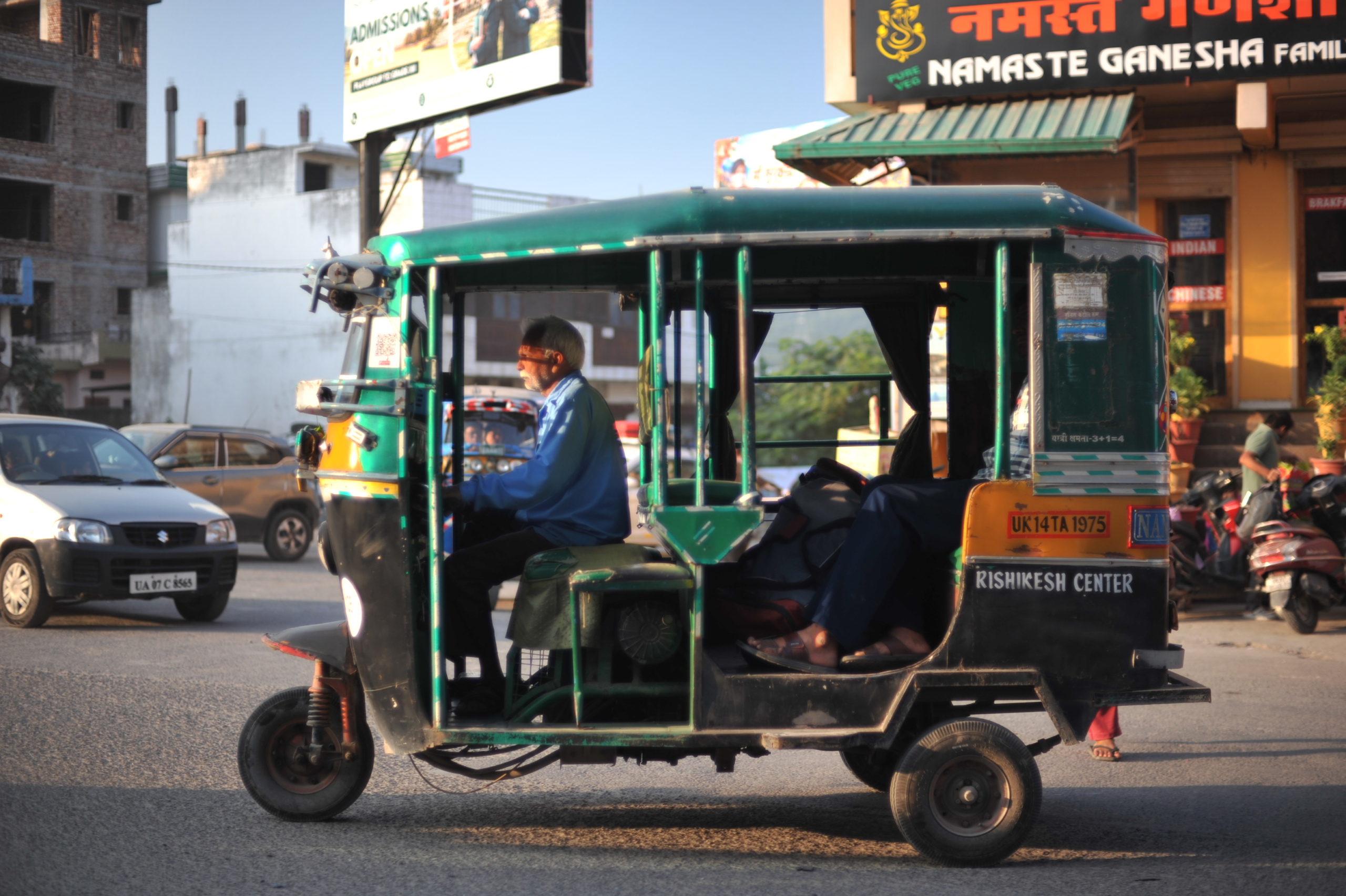
Rishikesh
Our Yatra had finally come to an end.
Each of us had set out with different expectations. Venky and Raghavendra had embarked on a sacred pilgrimage with a clear religious purpose. I, on the other hand, had begun the journey without any particular expectations beyond the desire to embrace an opportunity that had unexpectedly appeared after years of waiting. In that sense, the pilgrimage had given me exactly what I had hoped for.
If there is a wish I still carry with me, it is that this journey may prove to be a new beginning, a way of resuming a path that had been left unfinished many years ago.
That possibility, more than any specific revelation or insight, is what remains with me.
As we covered the final kilometres towards the airport, I found myself looking back towards the hills that surround the city. The mountains were no longer visible. A veil of haze hung over the landscape and the humid air softened every outline. Even so, I thought I could still see the snow among the distant ridges.
Perhaps it was only imagination. Or perhaps not.

Back home
Ganges Map

See all the photos

In Badrinath
Acknowledgments
This story would not exists without three people.
Venky, who connected all the pieces together.
Raghavendra, who gave meaning to many of them.
Raman, who carried us from one place to the other and who, somewhere along the, became a friend.
Read other Stories