
Ladakh
Travel Journal (Lucio Magi, January 2008)
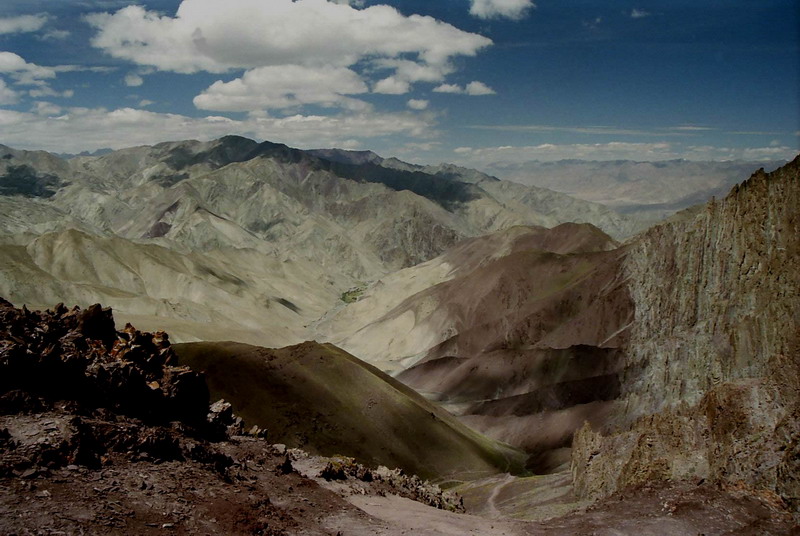
Once you reach the pass, everything looks different.
The climb has been extremely hard, but we made it. Looking down over the valley from above is an extraordinary feeling.
I believe this moment represented the true destination of our journey.
We crossed much of northern India from south to north, travelling by bus and four-wheel drive, traversing the western section of the great Himalayan chain and crossing passes above 5,000 metres.
For two weeks we followed the Indus River from east to west, tracing its course through the mountains, and eventually reached the Nubra Valley near the Karakoram, crossing the mighty Khardung La and travelling almost to the Pakistani border.
Yet the greatest emotion is here, at the summit of Stok La.
After two days of trekking that have tested our determination as much as our physical endurance, we have finally reached our true goal.
For me it has always been this way.
Every journey has its climax, its defining moment, its emotional peak.
Sometimes you know what it will be even before you leave. At other times, and these are naturally the most rewarding journeys, you discover it unexpectedly along the way.
Perhaps in this case it is the satisfaction of having reached the pass with nothing more than our own legs. Perhaps it is the grandeur of the landscape surrounding us.
The mountains seem endless.
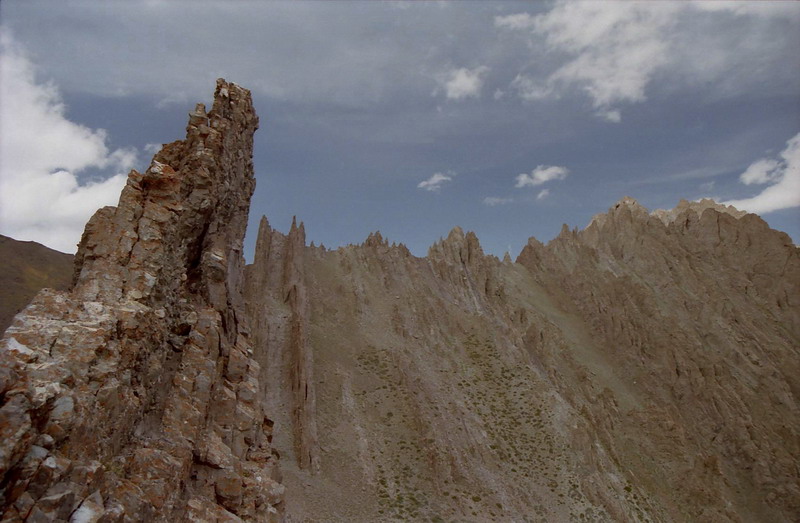
On one side they plunge steeply towards the tiny green valley of Rumbak. On the other they become sharper, crowded with ridges, pinnacles, and jagged peaks.
This small mountain pass, where the only signs of life are Tibetan prayer flags fluttering in the wind and tiny stone stupas scattered here and there, is one of those places where you feel small and important at the same time.
One of those places that are worth every step it takes to reach them.
We left very early this morning.
Yet Rumbak, the tiny village of four houses where we spent the night, had been awake long before us. The shepherds had already driven their goats towards the pastures.
The valley that cradles Rumbak feels almost miraculous.
Surrounded by barren mountains, it is a true oasis.
The morning sunlight outlines the buildings and casts long shadows across the surrounding slopes.
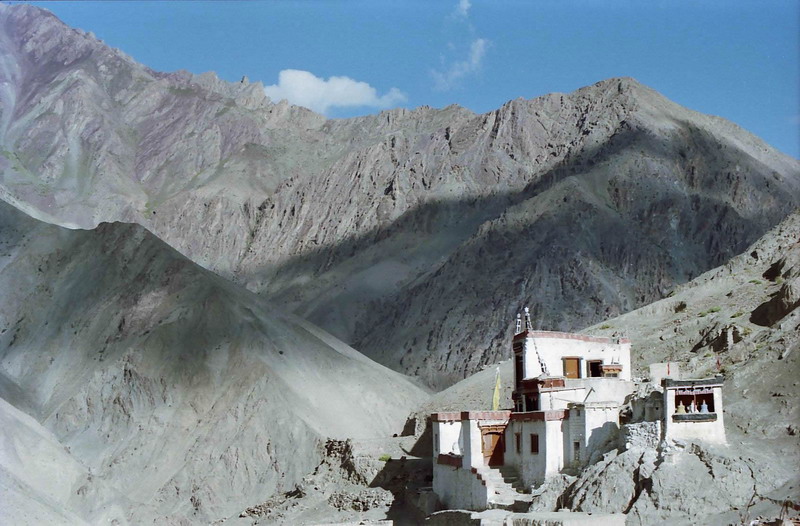
We slept here as guests of one of the families participating in the Ladakh homestay programme, opening their homes to the few travellers who pass through these mountains.
The village can only be reached in summer, either on foot or by pack animal. During winter, every family moves down to Leh, leaving it completely deserted.
Yesterday, after our first day of trekking from Zinchen, a seemingly endless and exhausting march, Rumbak appeared before us like a mirage made real.
Several difficulties and setbacks had almost convinced us to give up.
The lingering effects of dysentery, an accidental fall into an icy stream, the relentless sun, and the altitude had left us completely drained.
The prospects for today were not particularly encouraging either.
We already knew that another thousand metres of ascent stood between us and Stok La.
But a restorative night’s sleep, the generous care of our hosts, and our determination have made today a good day to continue.
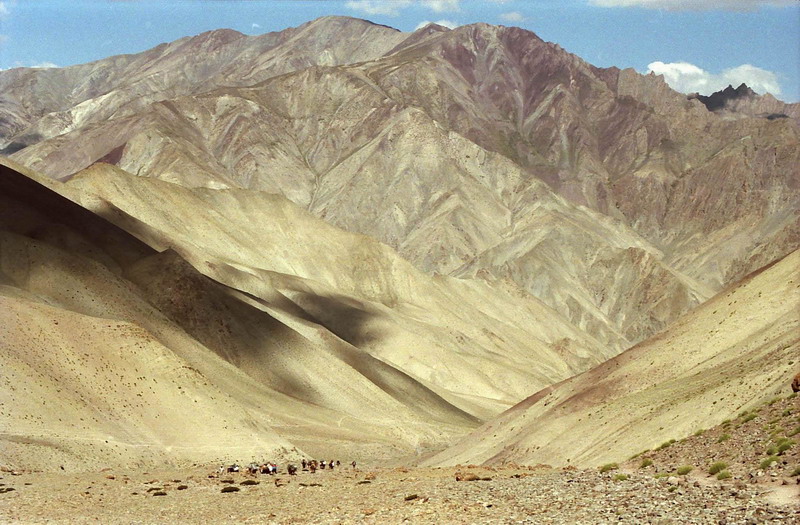
Step by step we move forward at a very slow pace.
Once again the altitude makes itself felt, and there is no possibility of rushing.
Eventually, at the end of the valley, we find ourselves facing what looks like a wall.
We begin climbing, accompanied by another small group of trekkers.
Not much farther ahead, however, two of them finally surrender after a long hesitation and decide to turn back.
We continue.
By now we move almost automatically, concentrating solely on placing one boot in front of the other.Slowly.
We stop whenever necessary and still manage to appreciate the landscape around us.
Every step comes at a cost. But every step is also richly rewarded. And it is exactly in this way, step after step, that we reach our climax.
The journey had begun in a completely different world.
Instead of the mountains and crystal-clear air of Little Tibet, our first encounter with India had been Delhi.
For anyone visiting India for the first time, I would strongly recommend reading the short section in the Lonely Planet Guide to North India that describes arriving in Delhi.
Every word of it is true. The chaos of the city, streets overflowing with life and every imaginable means of transport, and the overwhelming humidity are the first things to greet visitors and put their endurance to the test. Wandering through the alleys of Old Delhi offers a glimpse of the real India, a world that would undoubtedly deserve far more exploration.
But our goal lay elsewhere. We wanted to reach the Land of High Passes, hoping to find a corner of Tibet that remained as intact as possible. And so we moved on.
The journey from Delhi to Leh is a journey within the journey.
The eighteen-hour bus ride to Manali, along comparatively normal roads, is merely the beginning. The real adventure starts beyond.
Beyond Manali there is only one road leading to Ladakh, travelled either by regular buses or by the countless four-wheel drives that operate as shared taxis to Leh.
Just outside Manali, the ascent begins immediately towards the first of many unavoidable mountain passes: Rohtang La.
The road is little more than a muddy, landslide-prone track, battered relentlessly by the monsoon rains that spare nothing south of the Himalayas.
The brightly painted Tata trucks and overcrowded buses make it even more dangerous, and during many periods, even in summer, the road is closed to tourists altogether.
This time we are fortunate, and we are allowed to continue.
We enter the region of Lahaul and find ourselves at the very foot of the great Himalayan chain.
It is here that the truck travelling ahead of us in a narrow canyon decides, for reasons known only to its driver, to reverse without checking what might be behind. Rear-view mirrors are virtually non-existent on vehicles in this part of India.
The result is not ideal. Half of our bonnet is crushed, the starter motor damaged, and the radiator hose torn apart.
We are introduced firsthand to the rather “straightforward” local procedures for dealing with road accidents: compensation is settled immediately and directly, usually by handing over whatever cash happens to be in one’s pocket. Unfortunately, money alone does not solve our problem. We are stranded.
The vehicle refuses to move, and all we have at our disposal are a few tools and a certain amount of imagination.
Armed with a jack and two rocks, we begin reshaping the bonnet, the starter motor and the radiator as best we can.
The damaged hose is patched together with adhesive tape. Necessity is a remarkable teacher.
In circumstances like these, ingenuity sharpens quickly, and we discover mechanical talents we never suspected we possessed.
Eventually, incredibly, we are moving again. Not for long, however. A little farther on we have to stop once more because the engine is making alarming noises.
At that point the rope becomes useful. It is the only thing, apart from a few rupees, that the truck driver has left us.
We tie one end to the radiator and the other to a tree. Then, by carefully reversing, we somehow complete the repair.
Against all expectations, it works.
Apart from one further delay, while army engineers blast away an unstable section of mountainside with explosives, we eventually succeed in crossing the Himalayas via Baralacha La.
The following day provides another reminder of how distant this place is from the world of mobile phones, constant communication, and meaningless text messages.
At Tso Kar, our second driver is supposed to be waiting for us with camping equipment, food supplies, and a cook. He is not there. We can do nothing but wait.
There is no telephone signal, no internet, and no means of contacting anyone apart from the occasional traveller camping near the lake.
The jeep never arrives. In the end there is only one option left. We continue directly towards Leh.
To do so, we must cross Taglang La, one of the highest motorable passes in the world. The altitude makes its presence felt rather forcefully.
Only three days later do we finally discover what happened.
Our driver and cook had misunderstood the agreed meeting point and spent the entire time waiting for us at Tso Moriri. Eventually, after running out of food, they gave up and returned to Leh.
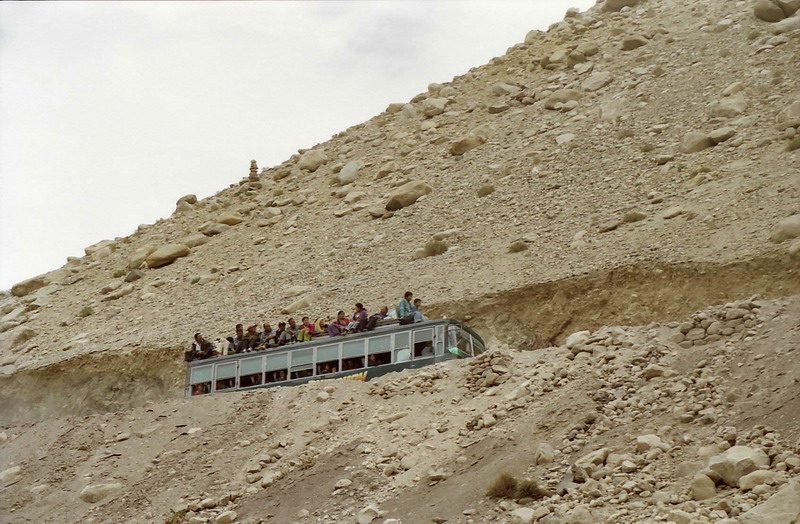
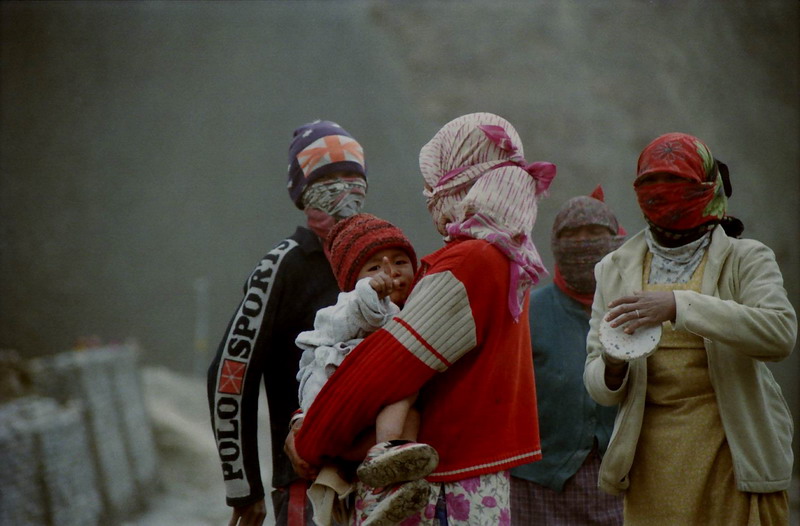
Travelling these roads, one cannot help but think about the immense effort undertaken by the famous Road Tamers of Project Himank, the organisation responsible for connecting the far north of India to the rest of the country.
They have built roads in environments that seem utterly impossible. Roads that constantly shift, collapse, and require endless maintenance.
Every summer entire families arrive from Nepal and from some of India’s poorest states, such as Bihar, to spend months digging earth, moving rocks, and breathing dust at altitudes where many visitors struggle simply to walk.
Perhaps as a way of lightening the burden of such difficult work, or perhaps to remind travellers of the dangers they face, the Border Roads Organisation decorates the roadsides with countless yellow signs carrying messages such as:
“LEFT IS RIGHT”
“LOVE YOUR NEIGHBOUR, BUT NOT WHILE DRIVING”
“IF YOU ARE MARRIED, DIVORCE SPEED”
The men of Himank continue their work tirelessly.
New roads are opened every year, and already there is talk of a future route that will link Zanskar directly to the Manali-Leh highway.
Finally, we arrive in Leh.
Instead of the remote and undiscovered corner of Tibet we had imagined, we find ourselves in a lively, cosmopolitan town that is wonderfully welcoming.
The streets of the old centre are lined with guesthouses, cafés, small restaurants and market stalls.
Yet despite its growing popularity, Leh remains an immensely pleasant place.
It is the perfect base camp from which to explore the rest of Ladakh.
Although our journey is an itinerant one, Leh becomes its true centre of gravity.
Every excursion begins here and eventually returns here.
For that reason, we have the opportunity to appreciate fully its relaxed atmosphere and extraordinary sense of calm.
Although Ladakh is not an especially large region, our limited time and the road conditions, which rarely allow average speeds greater than 30 km/h, force us to make choices.
We decide to leave the entire western part of Ladakh and Zanskar for another journey and instead concentrate on the Changthang plateau, the Nubra Valley, the Dha Valley, and, of course, Leh itself and the region’s most important Buddhist monasteries.
I honestly cannot remember a single place that disappointed me.
Yet I do not want simply to repeat here what can already be found in every guidebook or travel website about Ladakh.
There are, however, a few images that I believe deserve to be remembered.
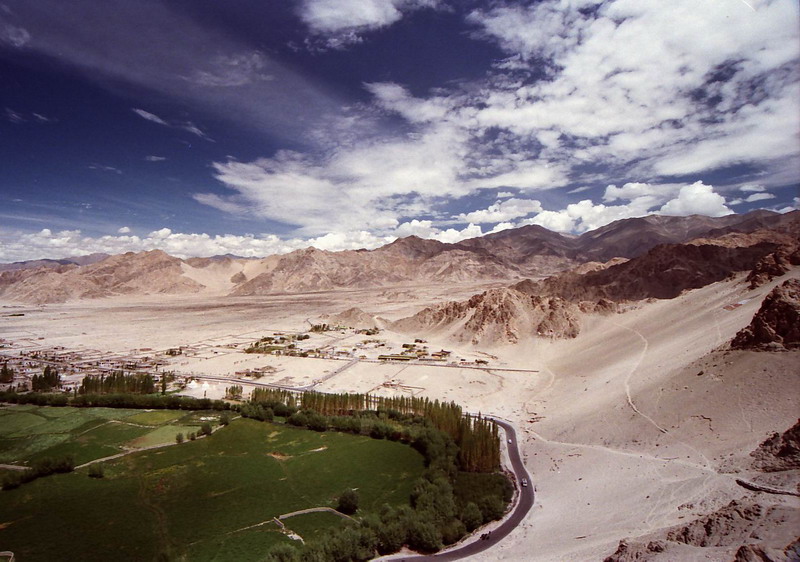
One is the view from the Shanti Stupa or from the terraces of Shey.
From these vantage points, the lush green valley of the Indus stretches below, perfectly defined against the barren mountains that surround it on all sides.
It appears almost unreal. An oasis suspended in a desert of rock.
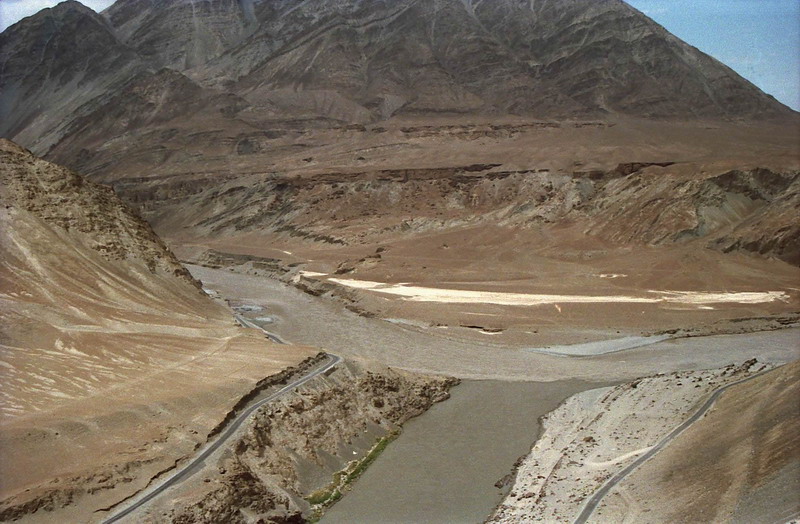
Another unforgettable place is the point where Ladakh’s two great rivers meet.
The turbulent, muddy Zanskar rushes forward impatiently to merge with the calm and crystal-clear Indus.
For a moment they struggle with one another.
One may feel slightly disappointed upon discovering that it is the Zanskar that ultimately prevails, imposing its character upon one of the world’s great rivers.
Yet the spectacle remains unique.
Every place visited, every monastery, every mountain, every village possesses its own distinctive character.
What impresses the attentive traveller most, however, is the sense of harmony and serenity that seems to envelop this enchanted land.
Everything appears suspended within a timeless dimension, a place where it becomes easier to think, to be alone with oneself, and to reflect.
Thanks to Jigmet, our wonderful guide, we were also able to experience something deeper than the landscapes alone.
He allowed us to move a little further “inside” Ladakh and closer to its people.
The tranquillity, optimism, and warmth they shared with us left a lasting impression.
The many setbacks and misadventures we encountered, both large and small, were always resolved in the best possible way thanks to their hospitality and friendship.
Because of them, we felt at home. And because of them, we were able to experience this extraordinary journey to the fullest.
I believe that every one of us received something valuable from this trip.
Some were fortunate enough to rediscover feelings they had already encountered elsewhere.
Others discovered entirely new emotions and perspectives.
Whatever each of us found along the way, I am certain that it will remain alive within us for a very long time.
Julley! Julley!