
Mongolia
Travel Journal (Lucio Magi, September 2005)
Nowhere
We’re almost there.
We found the paved road again only a little over half an hour ago, and with it the first signs of “civilization.” Road signs and billboards, written partly in English and partly in Cyrillic, tell us that we have nearly reached our destination.
The asphalt carries our four-wheel-drive van up a small hill, a ridiculous pass compared to those we have grown accustomed to over the past few weeks.
By now I expect it, we all do.
As soon as we reach the summit, it feels as though something is coming to an end. I look beyond the ridge and a lump forms in my throat. The sight of Ulaanbaatar’s smokestacks hits me like a punch to the stomach, leaving me almost breathless for a moment.
This is when you truly understand what a journey like this means.
Entering the city for the first time in weeks, we see a traffic light and are forced to stop because there are other vehicles, too many of them, all needing to use the same road.
The road.
It is the same road that faithfully accompanied us and carried us across mountains, steppes, and desert, yet here it seems to have lost its authenticity, its very essence.
A road exists to take you from one place to another, dusty and unpaved. Outside the capital, on the Mongolian plateau, it constantly divides and rejoins itself, still offering the pleasure, and sometimes the thrill, of getting lost.
Across the steppes and through the desert it forms countless tracks, wheel ruts left by four-wheel drives that at times resemble railway lines converging at a great station. We have travelled along those tracks for weeks, and their sudden disappearance feels strangely disorienting.
We arrived at the hotel exhausted and completely covered in dust, but finally aware that we had experienced something unforgettable.
In many ways, the return is the most intense moment of any journey. Without returning home, it is impossible to fully appreciate the meaning of travel. Yet this return was different. It left me with no desire to speak for several hours.
That had never happened to me before.
The journey had begun roughly three weeks earlier, in that very same place.
The moment we left the capital behind, a city larger than most but, like all Mongolian cities, too orderly, too full of straight lines, it was clear that we were entering another dimension.
At first glance the landscape seemed nothing extraordinary, at least to someone who had already visited other countries of such immense scale. A vast plain suddenly becomes hills, then mountains, before flattening out again. For days on end it feels as if you are riding a gigantic roller coaster.
You cross immense conifer forests, dried-up riverbeds, and mountain passes.
The northern lakes are another spectacle not to be missed. In Lake Khövsgöl, the water is so crystal clear that it changes colour according to its depth.
Eventually the route turns southward. After travelling across the steppe for several days, you head toward Karakorum, the ancient capital of Genghis Khan’s empire, and then farther south still, until you reach the Gobi.
Here even the few remaining points of reference disappear. The outlines of mountains fade away, and you feel strangely adrift. At times there is a sense of complete isolation; at others, it almost seems possible to glimpse the curvature of the Earth or reach out and touch the sky.
Much has already been said and written about Mongolia’s famous blue sky, its immense scale, its seemingly unreal colour, and the clouds that wander across it casting shadows in every direction.
That sky must be closer to the Earth than any other. I can find no other explanation.
At night the sensation becomes even stronger. It is almost possible to feel its weight. An infinite number of stars appear, and the Milky Way reveals itself in unmistakable clarity. It looks as though the stars could come crashing down upon you at any moment.

Nowhere
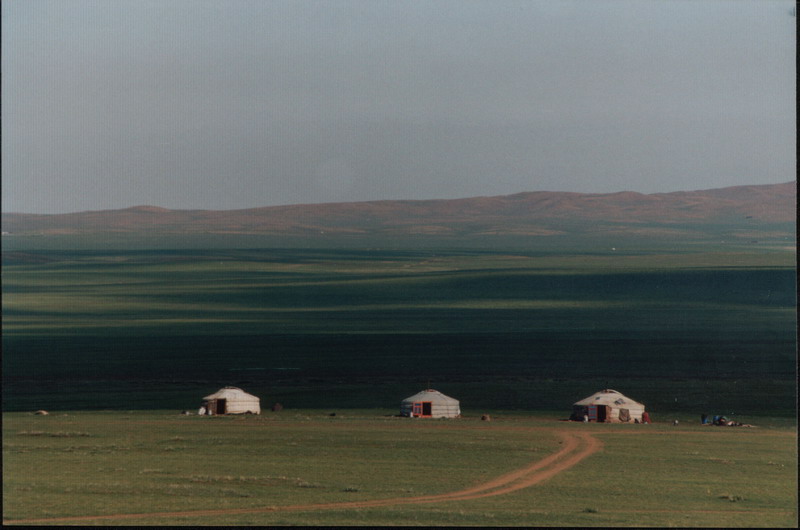
Then, as the kilometres drift by and your eyes become accustomed to focusing only on distant horizons, as you gradually adapt to this almost magical dimension, a ger or a herd of yaks suddenly emerges from the landscape like an apparition seen through half-closed eyes. The dream is interrupted, and you realise that it is all real.
Travelling across the Mongolian plateau is a little like watching a play with extraordinarily long intervals between each scene.
A few elements of the scenery change, but the stage itself remains the same for days at a time.
Upon that stage appear, one after another, solitary horsemen, herders on motorcycles gathering their livestock, Buddhist monks dressed in brilliant robes, and children running alongside dusty tracks selling airag.
The children here are not yet accustomed to tourists. They never ask for anything.
They approach timidly only when invited and accept even the smallest gift in silence, holding out both hands with their palms facing upward, as though they were receiving a priceless treasure.

Bayanzag

amarbayasgalant
That is what these people are like: simple and genuine.
But above all, they are free. They are people accustomed to respecting the land rather than possessing it.
They are people accustomed to infinity and to silence.
At Hongoriin Els, in the Gobi, while climbing the sand dunes, I experienced something entirely new, something that for the nomads must simply be part of everyday life. I had wandered alone into a hollow between the dunes, several dozen metres from the others, and I stopped.
There was not the slightest breath of wind.
For the first time in my life, I listened to silence, a silence that I imagine came very close to being absolute.
Mongolia is all of this.
It is an honest land, still largely untouched by tourism, where travelling requires patience and a willingness to adapt.
Fortunately, it is not yet a country ready to welcome busloads of visitors. Because of that, it must be experienced slowly and attentively, allowing yourself to be carried along kilometre after kilometre, savouring the emotions, images, and music it offers when you least expect it.